
How to Hire Medical Assistants Quickly
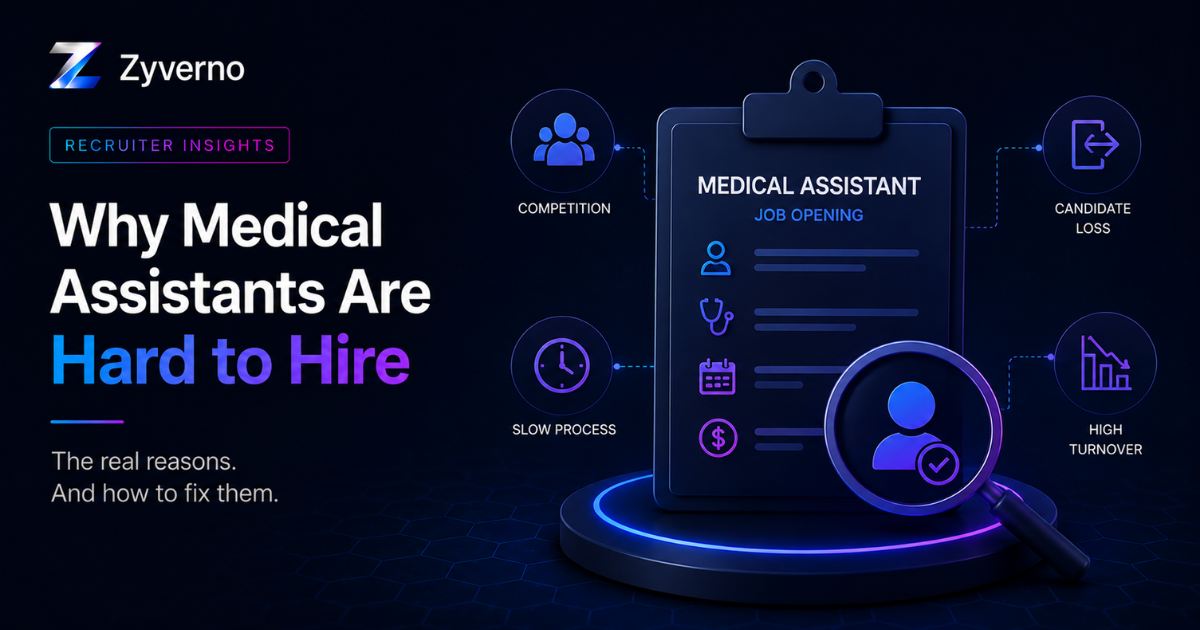
Medical assistants are the hardest staff role to recruit in medical practices today. A May 2025 poll by the Medical Group Management Association found nearly half of practice leaders named them harder to hire than nurses, billers, or coders.
The difficulty is not a market shortage. It is a pipeline problem: clinics write vague postings, screen candidates too slowly, and lose good applicants to faster-moving competitors before a first interview is scheduled.
Key Takeaways
- Nearly half of medical practice leaders name medical assistants as harder to hire than nurses, billers, or coders (Medical Group Management Association, May 2025)
- Poor collaboration among staff ranked higher than workload as a driver of medical assistant departure, with supervision quality and lack of resources being stronger predictors of turnover than workload alone (PMC study on medical assistant turnover predictors, 2024)
- 55% of former medical assistants said they would not choose the profession again, with 85% reporting higher job satisfaction after leaving; departures were rarely sudden (PMC qualitative study on medical assistant career exit, 2024)
- The Bureau of Labor Statistics median annual wage for medical assistants in the United States was $44,200 in May 2024, though this varies significantly by specialty, geography, and certification level
- Early attrition peaks between 30 and 90 days, driven most commonly by pace higher than described, supervision less available than expected, or administrative burden not mentioned during the interview
- National certification is required or strongly preferred by 99% of employers, with 38% requiring it specifically; the American Association of Medical Assistants, American Medical Technologists, and National Healthcareer Association all provide online verification tools
Why Medical Assistants Are Hard to Hire
Medical assistants sit at the intersection of clinical and administrative work. They take vitals, assist with procedures, manage patient intake, and handle documentation. The role demands both clinical competence and strong interpersonal skills. Most clinics pay at the lower end of what the job actually requires.
Competition compounds the problem. Larger hospital systems and multi-site practices can offer higher base pay, better benefits, and clearer career ladders. A small clinic competing against a regional health system is often competing on factors other than salary.
The research on why medical assistants leave is specific. A prospective cohort study published in a peer-reviewed journal found that poor collaboration among staff ranked higher than workload as a driver of departure. Poor leadership from supervisors and a lack of resources to do the job well were stronger predictors of departure than workload alone. What you offer in the job posting matters less than what you signal about the work environment and the quality of supervision.
Why medical assistants leave
Interpersonal factors rank above workload as departure drivers
Bar widths reflect relative risk ratios from a peer-reviewed cohort study on medical assistant turnover predictors (PMC, 2024). Bars are proportional, not percentage-based.
A qualitative study of former medical assistants found that 55% would not choose the profession again, with 85% reporting higher job satisfaction after leaving. Departures were rarely sudden. Former medical assistants described staying in roles for months or years after deciding to leave, held in place by loyalty to colleagues or a sense that leaving would burden the team.
Define the Role Before You Post
Most medical assistant postings fail before they are written because the clinic has not clarified internally what the role actually requires.
Medical assisting covers three distinct categories:
Clinical medical assistants focus on direct patient care: taking vital signs, preparing examination rooms, drawing blood, administering injections, and assisting with minor procedures.
Administrative medical assistants focus on scheduling, insurance verification, billing support, and patient correspondence.
Specialty medical assistants work in specific clinical disciplines such as dermatology, ophthalmology, or obstetrics.
Define the split before you post. A primary care clinic where the medical assistant rooms patients and assists with basic procedures has different requirements than a dermatology practice that needs phlebotomy certification or laser therapy experience.
Also, define the certification level you actually need. Requiring national certification when your role does not need it reduces your pool significantly. Not requiring it when the role does need it creates compliance and competency risk.
Write a Job Posting That Attracts Qualified Applicants
Four elements separate a strong medical assistant posting from a weak one.
A specific title and specialty context. "Certified Medical Assistant, Family Practice, Day Shift" outperforms "Medical Assistant, Full Time" because candidates filter by specialty and shift first.
A realistic description of the daily schedule. How many patients does the medical assistant interact with per shift? What percentage of time is clinical versus administrative? These details help candidates self-select accurately and reduce post-hire turnover from role misalignment.
A transparent pay range. Postings with salary ranges receive significantly more qualified applicants than those that withhold pay information. The Bureau of Labor Statistics median annual wage for medical assistants in the United States was $44,200 in May 2024, though this varies significantly by specialty, geography, and certification level.
Supervision and team context. Research on medical assistant turnover consistently identifies supervision quality as a primary driver of whether a medical assistant stays. "You will work directly with two family practice physicians and two registered nurses" is more informative than "team-oriented environment."
Sourcing Medical Assistant Candidates
In the United States, Indeed is the largest single source of medical assistant applicants. Health eCareers and CareerVitals are specialist platforms with higher signal-to-noise ratios for clinical candidates. In Australia, SEEK is the dominant platform. In the United Kingdom, NHS Jobs covers National Health Service-adjacent roles, and Totaljobs and Reed are the primary commercial platforms for clinic staff.
Training programme partnerships are the highest-yield sourcing channel for practices willing to invest six to twelve months ahead of a hire. Most community colleges, vocational schools, and dedicated medical assistant training programmes actively place their graduates.
A clinic that offers to serve as a clinical placement site becomes visible to graduates before they begin searching for jobs. Training programme graduates who completed a placement at your clinic have already been through a de facto job preview.
Employee referrals are another strong channel. Medical assistants refer colleagues they trust to work environments they believe are well-run. If your current staff is not referring candidates, the most useful question is why. Referral bonuses in the $500 to $1,500 range are standard, with split payment at hire and at 90 days.
Screening Medical Assistant Candidates
The first screen answers two administrative questions: does this candidate have the required certification or credential, and do they have the right to work in this jurisdiction? These questions can be answered before a recruiter or hiring manager spends time on a phone screen.
For practices hiring multiple medical assistants per year, the volume of initial screening creates a genuine bottleneck. Zyverno handles this layer via structured voice or chat conversations that confirm certification status, availability, and basic eligibility. The hiring manager's first direct contact is with a candidate already confirmed as qualified.
Medical assistant screening priority matrix
Run checks in sequence — blocking criteria first
Run Stage 3 checks in parallel with interviews, not after an offer is made. Running verification post-offer adds 5 to 10 days to a process where candidates are actively comparing timelines.
Once administrative eligibility is confirmed, the clinical screen covers specialty-specific experience, scheduling alignment, and communication style. Medical assistant positions frequently involve early starts, extended hours, or rotating weekend coverage.
Confirming availability before a first interview prevents losing a candidate within 60 days because the shift pattern was not what they expected.
Certification verification should happen early, not as a post-offer step. The American Association of Medical Assistants maintains an online verification tool for Certified Medical Assistant credentials. American Medical Technologists verifies Registered Medical Assistant credentials.
The National Healthcareer Association verifies Certified Clinical Medical Assistant credentials. Starting this check at the shortlist stage eliminates the risk of investing interview time in a candidate whose credentials do not check out.
Interview Questions That Surface Fit
"Describe the highest-volume shift you've worked. How many patients did you see, what were you responsible for, and what did you do when the schedule backed up?" This reveals experience with pace and actual clinical history.
"What does supervision look like in your current or most recent role? How often do you interact with the physician directly, and what happens when you have a question that needs an immediate answer?" Medical assistants who have worked under attentive, accessible physicians respond to this very differently from those who have been largely unsupervised.
"Have you ever been asked to do something you were not sure was within your scope of practice? What did you do?" This surfaces the candidate's understanding of scope-of-practice boundaries and their willingness to speak up.
Compensation and Benefits That Attract Candidates
Salary is the entry ticket, not the differentiator. A medical assistant reviewing two similar offers will make the final decision based on the supervision quality they sensed in the interview, the clarity of the role description, and whether the shift pattern works for their life.
Benefits that differentiate offers at similar salary levels:
- Paid continuing education and certification renewal. National certification requires recertification every 60 months, making this a direct financial benefit.
- Clinical advancement tracks, such as a lead medical assistant designation with additional responsibilities and pay.
- Schedule predictability. Medical assistants with family or care responsibilities consistently rate schedule consistency above incremental salary gains.
- Funding the Certified Medical Assistant or Certified Clinical Medical Assistant exam for uncertified candidates in exchange for a 12-month commitment. This accesses a larger, less competitive candidate pool while creating a retention incentive built around professional development.
Onboarding Medical Assistants for Retention
Early attrition follows a predictable pattern. The most common departure point is between 30 and 90 days, driven by one of three mismatches: the pace was higher than described, the supervision was less available than expected, or the administrative burden was not mentioned in the interview.
A named mentor on the clinical team who is explicitly available for questions during the first 30 days gives the new medical assistant a go-to resource before problems become frustrations.
A scheduled 30-day check-in with the office manager or supervising physician confirms the role matches what was described. Medical assistants who decide to leave rarely announce it until they have secured another position. The 30-day check-in exists to surface the conversation before that point.
An honest conversation at 60 days about where the candidate sees themselves in 12 months and whether this role supports that, prevents quiet disengagement from becoming resignation.
Process benchmarks
Four numbers that tell you if your medical assistant hiring is working
48 hrs
First contact target
From qualified application to first recruiter contact. Beyond 5 days signals a bottleneck.
75%+
Offer acceptance rate
Below this means candidates are reaching the offer stage and choosing a competitor.
<20%
90-day attrition
Above 20% indicates unresolved fit issues in screening or a failing onboarding process.
2–4 wks
Posting to accepted offer
Well-organized practices hit this. Slow processes run 6 to 8 weeks and lose candidates.
Frequently Asked Questions
What qualifications should I require when hiring a medical assistant?
The minimum for most clinical settings is completion of a programme accredited by the Commission on Accreditation of Allied Health Education Programs or the Accrediting Bureau of Health Education Schools.
National certification from the American Association of Medical Assistants, American Medical Technologists, or National Healthcareer Association is required or strongly preferred by 99% of employers, with 38% requiring national certification specifically.
For roles involving phlebotomy, intravenous insertion, or specific clinical procedures, confirm that the candidate's credentials and scope-of-practice rules cover those tasks.
What are the most common reasons medical assistants leave quickly?
Research consistently identifies four causes: a role described differently in the interview than it functions in practice, scheduling that does not match what was agreed, supervision that is unavailable or dismissive, and pay that falls below market for the level of clinical responsibility. The first two are entirely preventable with an honest posting and a candid interview process.
What should a medical assistant job posting include to attract qualified candidates?
A specific title with shift and specialty context, a realistic description of the daily patient volume and the clinical-to-administrative split, a transparent pay range, and information about supervision.
Research on medical assistant turnover consistently identifies supervision quality as a primary driver of whether a medical assistant stays. "You will work directly with two family practice physicians and two registered nurses" is more useful to a candidate than "team-oriented environment."
How do I verify a medical assistant's certification before extending an offer?
The American Association of Medical Assistants provides an online verification tool for Certified Medical Assistant credentials. American Medical Technologists verifies Registered Medical Assistant credentials.
The National Healthcareer Association verifies Certified Clinical Medical Assistant credentials. Run these checks at the shortlist stage, not post-offer. This prevents investing significant interview time in a candidate whose credentials do not check out.
What benefits differentiate a medical assistant's offer at a similar salary level?
Paid continuing education and certification renewal (national certification requires recertification every 60 months, making this a direct financial benefit), schedule predictability, a clinical advancement track such as a lead medical assistant designation, and funding the certification exam for uncertified candidates in exchange for a 12-month commitment. That last option accesses a larger and less competitive candidate pool while building a retention incentive around professional development.