
How to Screen Nursing Candidates for Credentials Before Making an Offer
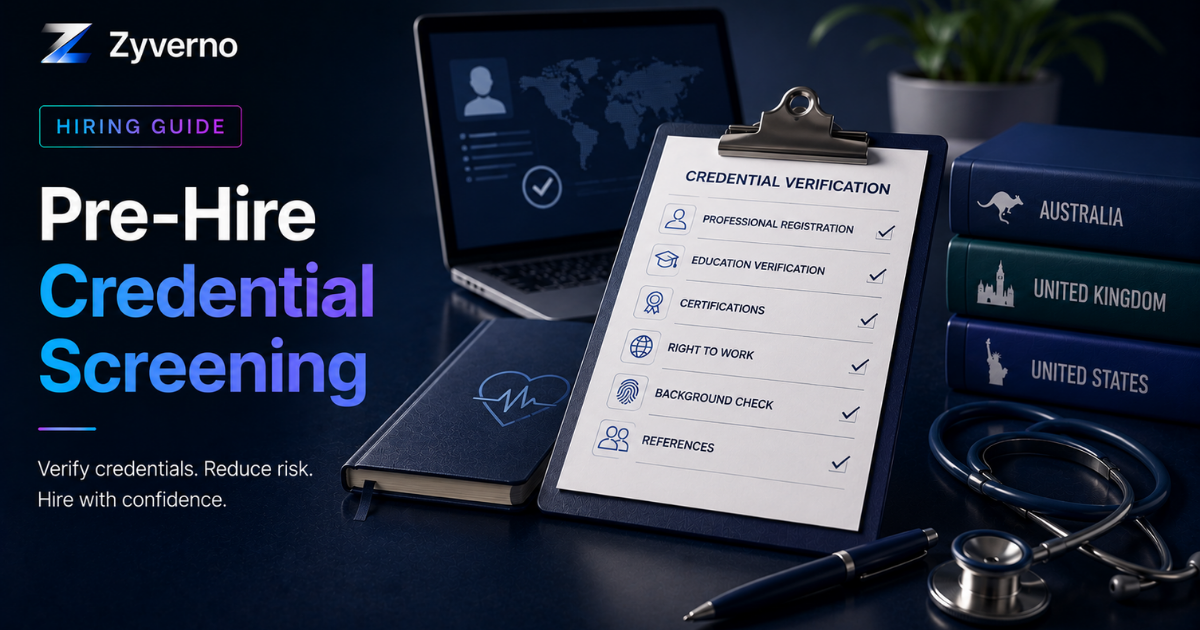
Credential verification for nursing candidates should happen before you make an offer, not after. This guide covers the pre-hire credential screening process: what to verify, how to verify it, and in what order. It covers three markets: Australia (Australian Health Practitioner Regulation Agency), the UK (Nursing and Midwifery Council), and the US (state nursing boards). Post-offer credentialing administration is a separate process and is not covered here.
The goal of pre-hire credential screening is simple: confirm that a candidate can legally and safely work in the role before you commit to them, so that the period between offer and start date is not delayed by credential failures you could have caught earlier.
Key Takeaways
- Pre-hire credential screening covers six distinct components: professional registration, education and degree verification, specialty certifications, right to work, background check, and references. Each must be tracked separately.
- Professional registration verification is available in real time for all three markets: the Australian Health Practitioner Regulation Agency public register, the Nursing and Midwifery Council public register (UK), and the Nursys database (multi-state, US)
- Starting credential verification at the shortlist stage, not after a verbal offer, recovers five to ten working days from the typical timeline.
- The average time to fill a registered nurse role in US hospitals is 83 days; delays at the credential verification stage are a primary contributor (2025 NSI National Health Care Retention Report)
- Nursing and Midwifery Council certificates of current professional status are only valid for three months from issue. Time this check carefully. (Nursing and Midwifery Council: Request a certificate of current professional status)
- Criminal background check requirements vary by setting: enhanced checks (Disclosure and Barring Service in the UK, state-level checks in Australia) are required for all roles involving vulnerable adults.
- Reference checks from clinical supervisors are required in all markets and typically take the longest: allowing five to ten working days for reference completion is realistic.
- An active exclusion on the Office of Inspector General list or the System for Award Management database is a non-negotiable disqualifier for any role at a Medicare or Medicaid-billing organisation.
- After hire, ongoing monitoring is a compliance requirement: Nursys e-Notify alerts employers to licence status changes, and monthly Office of Inspector General and System for Award Management checks are required for organisations billing Medicare or Medicaid.
Average fill time
83calendar days to fill a registered nurse role in US hospitals
NSI National Health Care Retention Report, 2025
The avoidable portion
Credential verification delays are a primary contributor. Most happen after the offer, when they could have been completed weeks earlier.
Where the 83 days go — relative time by phase
What Pre-Hire Credential Screening Covers
Pre-hire credential screening has six components. They are distinct from each other and should be tracked separately. The Joint Commission accredits most hospitals and many other healthcare settings. Its credentialing standards drive employer obligations across all three markets. Not every organisation is subject to Joint Commission accreditation. Its framework still reflects the minimum due diligence that protects patients and the organisation.
Professional registration. Confirming that the candidate holds a current, unencumbered registration with the relevant regulatory body. This is a binary check: registered or not registered. But "registered" is not sufficient on its own. You need to confirm whether the registration has any conditions or restrictions attached to it. An unconditional registration is what you are looking for.
Education and degree verification. Confirming that the candidate's nursing qualification comes from an accredited programme. In the US, nursing programmes are accredited by the Accreditation Commission for Education in Nursing or the Commission on Collegiate Nursing Education. Degrees from non-accredited programmes may not satisfy state board licensing requirements and should be treated as a red flag requiring further investigation.
In Australia and the UK, registration bodies assess educational qualifications as part of the registration process. A confirmed current registration provides implicit assurance that the education meets the required standard. For overseas-trained nurses, verify that the qualification has been formally assessed by the destination country's registration body before proceeding.
Specialty certifications. For clinical roles, verify any specialty certifications the role requires or that the candidate claims. In the US, the American Nurses Credentialing Center and the Board of Certification for Emergency Nursing are the two primary certifying bodies. Both provide free online verification of current certification status. For roles requiring basic life support or advanced cardiac life support, verify certification currency directly through the issuing provider (American Heart Association or equivalent). Certifications have fixed validity periods and expire. A wallet card is not verification. Use the issuing body's online lookup.
Right to work. Confirming the candidate has the legal right to work in the role's jurisdiction. This is a separate check from professional registration. A nurse can hold a valid registration and lack the right to work in a specific country or state. Check both.
Background check. A criminal record check appropriate to the care setting and patient population. Enhanced checks are required for roles involving direct care of vulnerable adults in all three markets, though the specific bodies and processes differ.
References. Professional references from recent clinical supervisors confirming the candidate's clinical conduct, professional behaviour, and reliability. References can confirm or contradict what a candidate stated in their application and interview.
Credential check sequence
When to Run Each Check — and Why the Order Matters
Front-loading removes the main sources of offer-to-start delay.
Before formal interview
At interview stage
Before verbal offer
With formal offer documentation
Working days lost to credential gaps between offer and start date
When to Start Each Check
This is the most actionable change most organizations can make. The standard approach of beginning all credential checks after a verbal offer adds weeks to the process unnecessarily.
The recommended sequence:
At the shortlist stage (before formal interview): Request the candidate's registration number. Ask them to confirm there are no conditions on their registration. Run a preliminary check against the public register to confirm the current status. This takes five minutes and confirms you are interviewing a registered practitioner.
If the role bills Medicare or Medicaid, run the Office of Inspector General exclusion check and the System for Award Management exclusion check at this stage. Both are free and take seconds. The Office of Inspector General's list covers federal health programme exclusions. The System for Award Management list covers federal contractor debarments. Run both together. An active exclusion on either is a non-negotiable disqualifier for any role at a Medicare or Medicaid-billing organisation.
During the interview process: Ask directly about any conditions on registration, any regulatory investigations (past or current), and any periods of non-practice. Document the answers. If anything requires follow-up, you have time to address it before the offer stage. Give candidates a complete itemized list of everything you will need from them, with deadlines. Candidates who receive a clear list complete credentialing faster than those who receive piecemeal requests over several weeks.
Nurses who have been through multiple hiring processes describe this clearly. Receiving a new document request every few days for three weeks feels disorganized. Each request requires the nurse to stop, locate the document, and send it to a different contact than the last.
The experience of an ad hoc credential process is not neutral. Nurses interpret it as a preview of how the organization runs its clinical operations. One complete list with one contact person, delivered at the start of the process, changes that perception and reduces the time from offer to start date.
After the panel interview, before making a verbal offer: Initiate the reference request. Do not wait until after the verbal offer to request references. Ask the candidate for referee details and permission to contact them now. Send reference forms immediately. References typically take five to seven working days to return. Initiating them at this stage means they are often back before the formal offer documentation needs to be sent. Note that many facilities only review completed credential files at scheduled committee meetings. Some meet every two to four weeks. Missing a committee deadline by one day means waiting for the next cycle. Know your facility's schedule and work backward from it.
At the point of conditional offer: Complete the enhanced background check. In most jurisdictions, the background check requires the candidate's explicit consent and personal details. A conditional offer is the appropriate point to request these formally.
The key shift: start the reference process and conduct a preliminary registration check before the verbal offer. Start the background check at the point of conditional offer, not after a signed contract.
A compliance lead at an NHS community trust described the benefit directly: "We moved credential checks to the shortlist stage two years ago. The time between verbal offer and start date dropped by about two weeks because we were no longer discovering problems at the last moment."
Credential Check Timeline: When Each Check Should Start
The standard approach of starting all checks after a verbal offer adds weeks unnecessarily. Parallel tracking from shortlist stage recovers 5 to 10 days from a typical offer-to-start timeline.
Recovered from the typical offer-to-start timeline
By starting registration checks at shortlist and references before the verbal offer, rather than waiting until after a signed contract
Verification by Market
Australia: Australian Health Practitioner Regulation Agency
The Australian Health Practitioner Regulation Agency maintains the national registration database for all regulated health practitioners in Australia, including registered nurses, enrolled nurses, and midwives.
How to check: The Australian Health Practitioner Regulation Agency's public register is searchable by name at the Australian Health Practitioner Regulation Agency public register. You can confirm: current registration status, registration type (registered nurse, enrolled nurse, midwife), any conditions or undertakings on the registration, and the registration renewal date.
What to look for once you are on the register: An unconditional registration with a future renewal date is the baseline. When conditions are present, the register shows them in one of two forms. Conditions imposed on a practitioner are written as directives: "the practitioner is to..." Undertakings agreed voluntarily by the practitioner are written in the first person: "I will..." Both carry the same legal weight for employers. Both require the same response: read each restriction and assess whether the role can comply with it.
What conditions actually require from employers: Conditions involving supervised practice place specific obligations on your organisation. Supervision levels range from direct to indirect level one, indirect level two, and remote. Direct means the supervisor must be consulted before every patient management decision. Indirect level one means the supervisor is physically present and available at all times. Remote means the supervisor is reachable by phone.
Only a registered practitioner with the appropriate training and experience can serve as a supervisor. The Australian Health Practitioner Regulation Agency's Supervised Practice Framework prohibits supervision in private practice settings where the nurse works as a sole practitioner. If your roster cannot support the required level of supervision, the candidate cannot be employed in that role. Identifying this at the shortlist stage avoids the cost of reversing a hire.
Health-related conditions: Details of health-related conditions are not always published on the public register. Under section 176BA of the National Law, the Australian Health Practitioner Regulation Agency can disclose the content of health conditions to an employer to help with oversight and supervision. If the register shows conditions but does not detail their nature, contact the Australian Health Practitioner Regulation Agency directly before making an offer.
For larger organisations: The Australian Health Practitioner Regulation Agency offers a Practitioner Information Exchange service for employers managing many practitioners. It provides real-time alerts when an employee's registration status changes. This is worth setting up for any organisation that regularly employs registered health practitioners.
For enrolled nurses: The same register applies. Enrolled nurses hold a separate registration category and can be verified via the same search.
Right-to-work check (Australia): Visa status and work rights must be confirmed separately. The Department of Home Affairs' VEVO system (Visa Entitlement Verification Online) allows employers to check visa conditions and work rights in real time.
Background check (Australia): A national police check is required for most aged care roles and many other clinical settings. Some states also require a Working with Vulnerable People check (or equivalent). The specific requirement depends on the state and the setting. Confirm your obligations under your state's screening framework before hiring.
United Kingdom: Nursing and Midwifery Council
The Nursing and Midwifery Council maintains the register of all nurses, midwives, and nursing associates in the UK. Registration is required to work as a registered nurse in any National Health Service or private setting.
How to check: The Nursing and Midwifery Council public register is searchable at nmc.org.uk/registration/the-register/. Search by registration number for the most accurate result, or by name if you do not have the number. The result page shows: name, registration status, registration type, geographical location, expiry date, and any recorded sanctions.
What the registration status terms mean: The register uses specific status labels. "Registered" with no additional marker is the clean result you are looking for. "Conditions of practice order" means the nurse can still work, but with restrictions.
Common conditions include mandatory supervision or required training, and they last between one and three years. "Caution order" means a fitness to practise panel found a concern but determined it did not require suspension.
Cautions last between one and five years and are visible on the register for their full duration. "Suspended" means the nurse cannot work in any nursing role during the suspension period. "Striking-off order" means removal from the register entirely.
What does not appear automatically on the public register: Warnings and undertakings issued by Nursing and Midwifery Council case examiners are not always displayed in standard search results. They may be disclosed to employers on request where there is a public interest in doing so.
If you want to confirm whether a warning or undertaking exists, contact the Nursing and Midwifery Council directly. Nurses are required to disclose any conditions on their registration to their employers, but this disclosure requirement falls on the nurse, not the register. Do not rely solely on self-disclosure.
Certificate of current professional status: For some purposes, particularly international verification or formal employer audit, a certificate of current professional status can be requested from the Nursing and Midwifery Council. Per the same Nursing and Midwifery Council guidance, these certificates are valid for three months from the date of issue. If you require a certificate, request it as close to the start date as operationally practical.
Background check (UK): An enhanced Disclosure and Barring Service check, including a check of the Adults Barred List, is required for all clinical roles involving direct care of vulnerable adults. The candidate must apply through an umbrella body or directly through the Disclosure and Barring Service. This check typically returns in one to five working days.
Right-to-work check (UK): Employers must check original right-to-work documents before the first day of work. Since 2022, this can be done via an Identity Document Validation Technology-certified provider for remote checks. The check must be completed before the candidate starts work.
United States: State Nursing Boards
Unlike the centralised systems in Australia and the UK, nursing regulation in the US is managed at the state level. Each state has its own nursing board, and a nurse must hold a licence valid in the state where they practice.
Multi-state licence (Nurse Licensure Compact): More than 40 states participate in the Nurse Licensure Compact, which allows nurses to hold one multi-state licence valid in all compact member states. Confirm whether your state is a compact member and whether the candidate holds a compact licence or a single-state licence.
How to check: The Nursys e-Notify database, maintained by the National Council of State Boards of Nursing, provides real-time license verification across compact states. For non-compact states, check the individual state nursing board's public register. Most state boards have a search tool on their website. The Nursys QuickConfirm service is free for employers and recruiters.
What Nursys shows: Nursys displays the nurse's name, jurisdiction, licence type, licence number, compact status, licence status, expiration date, and any publicly available discipline against the licence or privilege to practice. Boards of nursing in participating states report disciplinary actions to Nursys as they occur.
The most common verification gap: Checking only the current practice state and missing discipline recorded in other jurisdictions. When a nurse has held licences in multiple states, each state board can take action based on discipline imposed elsewhere. A nurse under a disciplinary order in their home state cannot practice on a compact privilege in another state without written approval from both states.
Checking Nursys rather than a single state board gives you visibility across all participating jurisdictions in a single search. Do not rely on a state board check alone for any nurse who has worked in more than one state.
Historical discipline and the National Practitioner Data Bank: All boards of nursing are required to report disciplinary actions to the National Practitioner Data Bank within 30 days. The National Practitioner Data Bank is not publicly accessible, but licensed healthcare entities can query it. If your organisation is a licensed healthcare entity, a National Practitioner Data Bank query adds a layer of verification beyond what Nursys displays.
What to look for: Current active status, no conditions or restrictions, and no disciplinary actions on record. Some state boards display historical disciplinary actions. Review these and assess whether any prior action is relevant to the role.
Background check (US): Background check requirements for nursing roles vary by state and by setting type. Hospitals and long-term care facilities regulated by the Centers for Medicare and Medicaid Services must comply with specific exclusion screening requirements, including checking the Office of Inspector General's List of Excluded Individuals and Entities. Confirm the specific requirements for your setting type and state before hire.
Registration Verification by Market: Australia, United Kingdom, and United States
Which checks are mandatory, which are recommended, and where market-specific rules change the sequence
Reference Checks for Nursing Candidates
References for nursing candidates should come from clinical supervisors, not HR departments. The person completing the reference should have direct knowledge of the candidate's clinical practice. HR departments at large healthcare organisations will typically confirm only dates of employment and job title. That is institutional policy, not a reflection on the candidate. A clinical supervisor who provides the same response is a different matter.
The reference form should ask specifically:
- The nature of the supervisory relationship and how long it lasted
- The clinical setting and patient population with which the candidate worked
- Whether the supervisor observed any concerns about clinical practice, professional conduct, or reliability
- Whether the supervisor would rehire the candidate and in what capacity
- Whether there are any conditions or investigations the supervisor is aware of
The rehire question is the most diagnostic. A supervisor who says they would not rehire is signalling a concern they may be unwilling to state explicitly. A qualified response of "yes, but only in a specific setting" tells you something about scope. A clear affirmative from a supervisor with direct clinical knowledge carries more weight than two pages of generic positive language.
When a reference is evasive or unusually brief: If a direct clinical supervisor provides only dates of employment and declines to comment on practice, ask directly: "It seems like you are only providing basic information. Is there a reason for that?"
The answer will tell you whether this is a policy constraint or a personal one. If the answer is not clear, bring the finding to the candidate. Tell them what the reference provided and ask them to respond directly. A candidate who acknowledges a prior concern and explains the context is a different risk profile from a candidate who denies or deflects.
Nurses and clinical managers note that HR department references from large health systems are almost always limited to dates of employment and job title. This is institutional policy, not a commentary on the candidate. What matters is the response from direct clinical supervisors.
When submitting reference requests, ask for the candidate's direct clinical manager or charge nurse by name. Do not ask for "two professional references." A candidate who can only supply HR contact names for all references is worth following up with.
When a reference does not respond: Allow five to seven working days before following up. Two follow-ups are standard. A supervisor who does not respond after two follow-up requests is a signal worth taking seriously. Consider it alongside everything else you know about the candidate.
Flags That Require Further Investigation
The following are not automatic disqualifiers, but each requires specific assessment before proceeding.
Conditions on registration. Conditions range from supervision requirements to restrictions on certain practice settings. Read them carefully. A condition requiring direct supervision is incompatible with a role designed for an independent practitioner.
Confirm whether your organisation can meet the supervision requirement before making an offer. An offer made without confirming this typically needs to be reversed once the full conditions are understood.
A registration that lapsed and was renewed. Ask directly when and why the registration lapsed. A short administrative lapse is common and unremarkable. A short lapse at renewal time comes up regularly in nursing communities. Nurses describe forgetting to renew by the deadline or letting registration lapse between jobs. This is not a practice concern. A lapse that coincided with a period of suspension or regulatory investigation is a different matter entirely.
A gap in clinical practice. Ask directly what the candidate was doing during any significant gap in clinical employment. A career break for family or health reasons is unremarkable. A gap that cannot be explained without a reference from the period in question warrants further inquiry.
A reference that is evasive or unusually brief. A reference that confirms employment dates and declines to comment on clinical performance is not a useful reference. If this comes from a direct clinical supervisor rather than an HR department, treat it as a signal. A short reference from a supervisor with direct knowledge of the candidate's practice warrants a follow-up conversation: first with the referee, then with the candidate.
A disclosure on the background check. Not all disclosures are disqualifying. Assess the nature, recency, and relevance of any disclosure to the specific role. Many settings have formal policies on which disclosures are disqualifying. Apply those policies consistently.
Prior discipline in another state or jurisdiction. In the US, a nurse who has held licenses in multiple states may have a disciplinary history recorded in a previous state that does not appear on the current practice state's register. Always check Nursys for any candidate who has practiced across more than one state. In Australia and the UK, the respective national registers cover all jurisdictions, but ask directly about any regulatory investigations from previous countries of practice if the candidate trained or worked internationally.
Ongoing Monitoring After Hire
Pre-hire credential screening confirms that a candidate can legally and safely start work. It does not guarantee their credentials will remain current after hire. Registrations expire. Certifications lapse. Disciplinary actions can be imposed at any point. Ongoing monitoring is the process of detecting these changes before they create a compliance exposure.
Nursys e-Notify is the free monitoring service operated by the National Council of State Boards of Nursing. Employers enrol nurses by licence number and receive email or text alerts when a registered nurse, licensed practical nurse, or licensed vocational nurse licence status changes in any participating state. This is the minimum standard for US-based organisations employing nurses across multiple states.
Office of Inspector General and System for Award Management re-screening is a requirement, not a recommendation, for organisations that bill Medicare or Medicaid. The Centers for Medicare and Medicaid Services expects monthly exclusion checks on all active employees and contractors in these settings. A single pre-hire check does not satisfy this obligation. If a nurse is excluded from federal health programmes after hire and the employer has not detected it through ongoing monitoring, the organisation is at risk of continued liability for any care billed during that period.
Registration renewal tracking applies across all three markets. In Australia, the Australian Health Practitioner Regulation Agency registration year runs from 1 November, and renewal is required annually. In the UK, Nursing and Midwifery Council registration must be renewed every three years. In the US, renewal cycles vary by state, typically between one and three years. Organisations with more than a handful of registered nurses benefit from a centralised system that tracks expiry dates and flags upcoming renewals, rather than relying on individual nurses to prompt their own renewal checks.
The distinction between pre-hire credential screening and ongoing monitoring is the dividing line between this article and post-hire credentialing administration. What is described here represents the minimum ongoing obligations that begin the day employment starts.
Frequently Asked Questions
When should credential verification begin for nursing candidates?
At the shortlist stage, before the formal interview. A preliminary check of the relevant registration body's public register takes five minutes and confirms the candidate is currently registered. Reference requests should be initiated after the interview, before the verbal offer. Starting both of these steps earlier than the post-offer stage removes the main sources of delay between offer and start date.
Can an employer verify an Australian Health Practitioner Regulation Agency registration without the candidate's consent?
Yes. The Australian Health Practitioner Regulation Agency register is publicly searchable. Any employer can verify whether a practitioner holds current registration without requesting permission from the candidate.
However, if the registration shows conditions, investigating further may require direct communication with the Australian Health Practitioner Regulation Agency, for which a professional context may be helpful.
What does it mean if a nurse's Nursing and Midwifery Council registration has a caution?
A caution on a Nursing and Midwifery Council registration means a fitness to practise panel found a concern about the nurse's practice, but determined it did not require suspension or removal from the register. The details of the caution are not publicly visible, but the existence of a caution is. Contact the Nursing and Midwifery Council directly if you need more details about the nature of a caution before making a hiring decision.
How do you verify nursing credentials for a candidate who trained overseas?
The process depends on the destination country. In Australia, overseas-trained nurses must hold Australian Health Practitioner Regulation Agency registration before working in any nursing role. The Australian Health Practitioner Regulation Agency assesses overseas qualifications as part of the registration application.
In the UK, the Nursing and Midwifery Council requires overseas-trained nurses to demonstrate that their qualifications meet UK standards. In the US, overseas-trained nurses typically need to have their credentials assessed by the Commission on Graduates of Foreign Nursing Schools or an equivalent body before applying for state board licensure.
What specialty certifications should employers verify beyond the nursing licence?
The answer depends on the role. For most clinical roles, verify current basic life support certification at a minimum. For critical care, emergency, or high-acuity settings, the role may require advanced cardiac life support, paediatric advanced life support, or trauma nursing certifications. The American Nurses Credentialing Center verifies specialty certifications such as medical-surgical nursing, oncology, and infection control.
The Board of Certification for Emergency Nursing verifies emergency nursing credentials. Both provide free online verification. Do not accept a photocopy of a wallet card as confirmation. Verify directly with the issuing body, as certification cards can be altered after issue.
Does an Office of Inspector General exclusion automatically disqualify a candidate?
Yes, for any role at an organisation that bills Medicare or Medicaid. An active exclusion on the Office of Inspector General's List of Excluded Individuals and Entities means the individual cannot be employed in any capacity (clinical or administrative) at a Medicare or Medicaid-billing organisation without putting the organisation's billing eligibility at risk.
The same applies to an active exclusion on the System for Award Management database. These are non-negotiable disqualifiers in that setting. For roles at organisations that do not bill federal health programmes, the exclusion carries less automatic legal weight, but the nature of the underlying exclusion still warrants investigation before any hiring decision is made.
What is the difference between pre-hire credential screening and post-hire credentialing administration?
Pre-hire credential screening is what this article covers: verifying that a candidate holds the necessary credentials to be offered the role and can legally work before you make the offer. Post-hire credentialing administration covers what happens after an offer is accepted: maintaining ongoing registration compliance, tracking renewal dates, managing continuing professional development records, and handling any conditions attached to the registration on an ongoing basis. These are separate processes.