
AI Screening for Driver Hiring: What Works in 2026
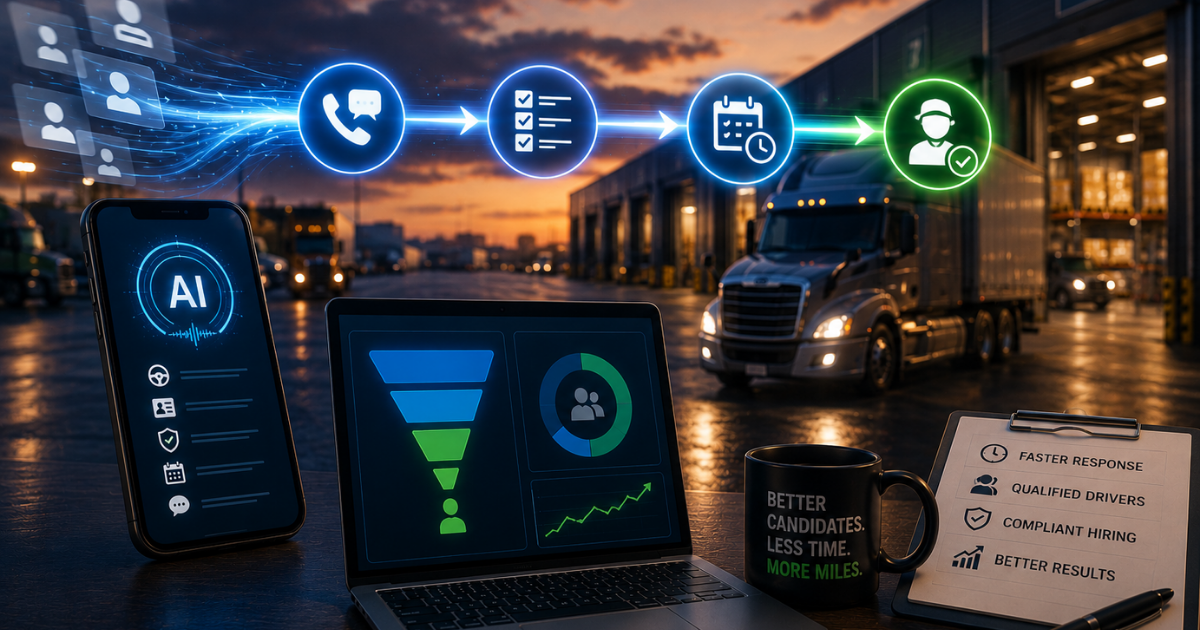
AI screening tools work for driver hiring when they handle the early-contact and qualification layer: reaching every applicant within minutes, filtering for license class and safety record basics, and delivering pre-qualified candidates to a recruiter's queue. They do not replace the compliance verification steps or the human judgment required to assess safety culture.
The fleets getting results are using AI to eliminate 70 to 90 percent of recruiter time currently spent on calls that go to voicemail or candidates who don't meet basic requirements.
Key Takeaways
- According to Transport Topics reporting on agentic AI in driver recruiting, 70% of drivers who call a carrier never reach a recruiter. AI pre-screening closes this gap by making contact automatically
- Private fleet operator Tyson Foods, which manages approximately 2,800 trucks with a six-person recruiting team, uses AI agents to pre-screen applicants around the clock and delivers three to four pre-qualified calls per recruiter each morning, per Transport Topics
- Fleets using AI-assisted recruiting report contact rates above 80% and time savings of more than ten hours per recruiter per week, per Double Nickel recruiting platform data
- AI handles pre-qualification well: license class, years of experience, home-time expectations, and equipment type. It does not handle Pre-Employment Screening Program report review, Motor Vehicle Record analysis, or safety culture assessment. Those steps require human judgment
- Drivers have mixed reactions to automated initial contact. The consistent pattern: they accept bots for convenience (24/7 availability, fast response) but leave if a human never enters the process
- The Pre-Employment Screening Program is available through the Federal Motor Carrier Safety Administration's official PSP portal at $10 per report. AI can flag when to run it; it cannot run it or interpret the results
Why Driver Hiring Has a Screening Problem
Manual Recruiter vs. AI-Assisted: Days Per Stage
Time spent at each step when screening a batch of 50 driver applications
The constraint in driver hiring is not finding applicants. It is processing them fast enough.
Experienced recruiters at mid-size fleets describe receiving 40 to 80 applications per open position during active periods. A recruiter making contact by phone hits voicemail on the majority of those calls. By the time a callback lands, the driver has often already accepted another offer or simply moved on.
The five-minute contact window matters more in driver hiring than almost any other role. A driver with a clean commercial driver's license and good safety record is, by definition, in a market with a documented shortage on the employer side. They are not waiting for you.
Fleets that reach candidates within minutes of application submission have a measurably higher chance of converting that application into a hire.
This is where AI enters. The tools available in 2026 can make contact at the moment of application, any time of day, with no recruiter on duty. For operations where applications arrive overnight, on weekends, or across time zones, the ability to respond at 11 p.m. on a Sunday changes the competitive dynamic.
Zyverno makes contact at the moment of application, any time of day, covering the commercial driver's license pre-qualification basics before a recruiter has started their morning. The voicemail cycle is behind you before your day begins.
What AI Screening Can Actually Do in Driver Hiring
The category has matured considerably since early chatbot experiments. Here is what current tools handle reliably and what they do not.
Initial Contact and Pre-Qualification
AI tools in 2026 can initiate an outbound voice or chat interaction within seconds of an application coming in. The initial conversation typically covers:
- License class confirmation (Class A or Class B commercial driver's license)
- Required endorsements if the role demands them (hazardous materials, tanker, doubles, and triples)
- Years of experience with the relevant equipment
- Home-time expectations (over-the-road, regional, or local)
- Current employment status
- Basic interest and availability
This takes four to eight minutes in a conversational format. At the end of it, the AI has either confirmed the candidate meets your stated minimums or noted the gap and flagged accordingly. The recruiter receives the summary rather than sitting through the call themselves.
Tyson Foods' implementation illustrates the practical outcome. Their six-person recruiting team now begins each day with three to four pre-qualified calls already scheduled rather than starting from a cold list of 40 to 80 applications. Recruiters describe spending more of their time in substantive conversations with candidates who have already expressed genuine intent.
Document and Credential Prompting
Some platforms can prompt candidates to upload their commercial driver's license photo, medical certificate, and employment history documents before any recruiter is involved. This does not verify the documents. It collects them. The practical effect is that when a recruiter does engage, the file is partially assembled rather than empty.
A recruiter who picks up a candidate file with a license photo already present, employment dates listed, and a medical certificate attached is in a fundamentally different position than one starting from scratch. The verification work still happens. It starts from a better position.
Scheduling and Follow-Up
AI scheduling tools can book phone screens and interviews directly into recruiter calendars, send confirmation messages, and send reminders before the scheduled time. Driver no-show rates at the phone screen stage are high.
A simple reminder text sent two hours before a scheduled call measurably reduces the no-show rate. This is low-complexity work that occupies meaningful recruiter time at scale.
What AI Cannot Do in Driver Hiring
This is where the category is frequently oversold. Understanding the limits matters as much as understanding the capabilities.
Motor Vehicle Record and Pre-Employment Screening Program review. The Pre-Employment Screening Program, accessed through the Federal Motor Carrier Safety Administration's official database, provides five years of crash history and three years of roadside inspection data for a commercial driver. A recruiter reading a Pre-Employment Screening Program report is looking for patterns: frequency of out-of-service orders, types of violations, whether anything was disclosed on the application. This is judgment work. AI tools cannot access the Federal Motor Carrier Safety Administration's database, run the query on your behalf, or interpret what the results mean in context.
Drug and Alcohol Clearinghouse queries. Federal regulations require a pre-employment query of the Federal Motor Carrier Safety Administration Drug and Alcohol Clearinghouse before hiring any commercial driver. This requires the candidate's explicit electronic consent through the Clearinghouse system. It is a manual process with regulatory standing. No AI screening tool performs or replaces this step.
Safety culture assessment. The most predictive signal in driver hiring is whether a driver treats safety as a daily operational practice rather than a compliance formality. This comes through in how they talk about pre-trip inspections, prior incidents, and load refusals. This comes out in a live conversation with a recruiter who knows what to listen for. AI can conduct a conversation. It cannot assess the depth or authenticity of the answers the way an experienced driver recruiter can.
Driver Qualification File compilation. The Driver Qualification File, as required by ecfr.gov, must be assembled and maintained by the carrier. AI tools can prompt document collection, but the compliance obligation and its verification remain with a human.
How Drivers Actually Respond to AI Screening
This is the part most AI vendor marketing underweights.
Drivers are a skeptical audience for automated outreach. The industry has a documented history of carriers over-promising on home time, pay, and equipment. Drivers who have been in the market for a few years have learned to screen recruiters as carefully as recruiters screen them. When the first contact is an automated system, the trust dynamics are different.
The pattern that emerges from driver community discussions and industry reporting: drivers accept AI for speed and availability, but expect a real person before they commit to anything meaningful. Getting a response at 10 p.m. is appreciated. Getting only bot interactions through the entire process and never reaching a human recruiter is a disqualifier for experienced drivers who have options.
A specific concern that comes up among drivers: the risk that an AI system disqualifies them incorrectly. A driver with a minor violation disclosed on their application being rejected by an automated filter before a human could evaluate the context is not a rare complaint.
Carriers that limit AI hard-disqualification to the clearest failures (no commercial driver's license, wrong class, wrong route type) and pass everything else to a recruiter for judgment report better candidate experience than those who use AI to make binary accept-or-reject decisions.
The practical rule: AI for contact and information gathering, humans for evaluation and decision.
Where AI Screening Fits in the Driver Hiring Workflow
The most effective deployment model treats AI as the first layer, not the final one.
How AI Fits into the Driver Hiring Workflow
Four stages — who handles what, and when
Application received
AI contacts the candidate within seconds via voice or chat. Confirms license class, endorsements, experience, home-time expectations, and equipment type. Flags clear mismatches. Passes qualified leads to the recruiter queue.
Artificial intelligenceRecruiter follow-up
Recruiter calls flagged candidates. Covers safety culture, work history details, and expectations alignment. This is the step that builds trust and assesses what the record cannot show.
HumanCompliance checks run in parallel
Motor Vehicle Record, Pre-Employment Screening Program, and Drug and Alcohol Clearinghouse query all begin simultaneously with the recruiter call. Waiting for one before starting another adds days candidates won't wait.
Human with workflow supportInterview and road test
Only pre-qualified, compliance-cleared candidates reach this stage. Covers safety culture assessment, expectations alignment, and practical driving evaluation.
HumanCompliance Considerations When Using AI in Driver Hiring
Carriers using AI screening tools need to understand where the regulatory obligations sit.
The Federal Motor Carrier Safety Administration does not prohibit AI-assisted screening. It does require that certain steps happen regardless of what tools are used: the Driver Qualification File must be assembled per ECFR, the Drug and Alcohol Clearinghouse pre-employment query is mandatory, employment verification for the past three years is required, and the Pre-Employment Screening Program check, while technically voluntary, is considered standard practice and creates liability if skipped.
An AI tool that prompts applicants to consent to background checks or submit documents is useful. But the carrier bears the compliance obligation. If an AI workflow inadvertently skips a step or collects consent in a format that does not satisfy regulatory requirements, the liability sits with the carrier, not the software vendor.
Equal employment opportunity considerations apply as well. Automated screening criteria need to be reviewed for disparate impact. If a screening filter disproportionately excludes candidates in a protected class, the question of whether the filter is job-related and consistent with business necessity becomes a legal question. Review your screening criteria with legal counsel before deploying automated filters that make or strongly influence hiring decisions.
Driver Qualification File violations are among the most common compliance failures in the industry. Most are documentation failures, not hiring failures. Missing Motor Vehicle Records, expired medical certificates, and incomplete prior employment verification are preventable errors. AI tools that help keep the paperwork process in order are genuinely useful here. They are a compliance support, not a substitute for it.
What Happens When AI Is Deployed Without a Human Follow-Up Layer
The failure mode is well-documented. A carrier deploys an AI screening system, sees improved application contact rates, and assumes the pipeline problem is solved. Applications get pre-screened. The AI flags qualified candidates. But the recruiter queue is still overloaded, or the response time to those flagged candidates is slow.
The 70% of drivers who never reach a recruiter is not only a pre-AI problem. It can happen after AI if the tool floods the recruiter's queue faster than the team can process it.
The bottleneck shifts. Before AI, the contact rate was the problem. After AI is deployed without team capacity adjustment, the filtered candidate list piles up, and the response time to flagged candidates increases.
Carriers that report the best results from AI screening consistently combine the AI contact layer with a disciplined recruiter follow-up process. Double Nickel's platform data shows customers reporting over 80% lead contact rates and a 20% reduction in cost per hire. The AI creates the qualified lead. A human closes it.
The tool is not the strategy. The workflow is.
Frequently Asked Questions
Does AI screening replace the Federal Motor Carrier Safety Administration compliance steps in driver hiring?
No. Federal Motor Carrier Safety Administration regulations require specific steps regardless of what tools a carrier uses. The Drug and Alcohol Clearinghouse pre-employment query, the Motor Vehicle Record check, employment verification for the past three years, and the Driver Qualification File assembly per 49 CFR § 391.51 are all mandatory. AI tools can assist with document collection and workflow prompting, but the compliance obligations remain with the carrier.
How do drivers respond to being screened by an AI first?
Drivers accept AI screening for speed and availability. Getting a response within minutes of applying, at any hour of the day, is genuinely useful in a market where drivers compare multiple offers simultaneously. What drives candidates away is a process where a human never enters.
Drivers want to speak with a recruiter before committing. AI that captures the first qualification step and delivers a pre-qualified lead to a human recruiter within the same day produces better candidate experience than processes where AI is the only contact point.
What should an AI screening conversation cover for driver candidates?
At minimum: commercial driver's license class and relevant endorsements, years of commercial driving experience, home-time expectations (over-the-road, regional, or local), equipment type preference or experience, and current employment status. This four-to-eight-minute conversation filters out clear mismatches on hard criteria before recruiter time is spent.
Everything beyond these basics requires a human: safety culture assessment, work history details, and expectations alignment.
Can AI tools access the Federal Motor Carrier Safety Administration's Pre-Employment Screening Program database?
No. The Pre-Employment Screening Program is accessed through the Federal Motor Carrier Safety Administration's official portal at psp.fmcsa.dot.gov. Carriers run the check directly, with the candidate's consent. The report costs $10 per driver and returns within 24 hours.
AI tools cannot initiate or receive this report on a carrier's behalf. What AI can do is prompt the candidate to provide consent and remind recruiters to run the check as part of the workflow.
Is AI screening for drivers legal under equal employment opportunity regulations?
Automated screening tools are subject to the same equal employment opportunity requirements as any other selection process.
If a screening filter produces disparate impact on a protected class, the business justification for that filter must be defensible. This means using only job-related criteria (license class, route-relevant experience, home-time expectations) rather than factors that could serve as proxies for protected characteristics.
Review your automated screening criteria with employment counsel before full deployment.
How does AI screening change the role of a driver recruiter?
The role shifts from making contact and collecting basic information toward higher-value work: assessing safety culture, managing expectations alignment, closing offers, and building relationships with candidates who might not be ready now but could be in 90 days.
Most recruiters currently spend the majority of their time on the contact-and-collection work. AI absorbs that layer. Recruiters at operations using AI describe the change as moving from a dialing-and-voicemail job to a real conversation job. The volume of calls drops. The quality and conversion rate of each call increase.
Related articles
Distribution Center Staffing: Hire in the Right Order
Discover why hiring sequence trumps speed in distribution center staffing. Ensure effective onboarding and lower attrition rates with strategic planning.
logisticsCost Per Hire in Logistics: Benchmarks and Where to Cut
Discover benchmarks for cost per hire in logistics. Learn how to identify hidden costs and streamline hiring processes for efficiency.
logisticsFreight Coordinator Hiring: Screen Before You Interview
Streamline your freight coordinator hiring process with effective pre-screening techniques. Improve candidate quality and reduce turnover.