
How to Hire Forklift Operators: Screening Certifications and Red Flags
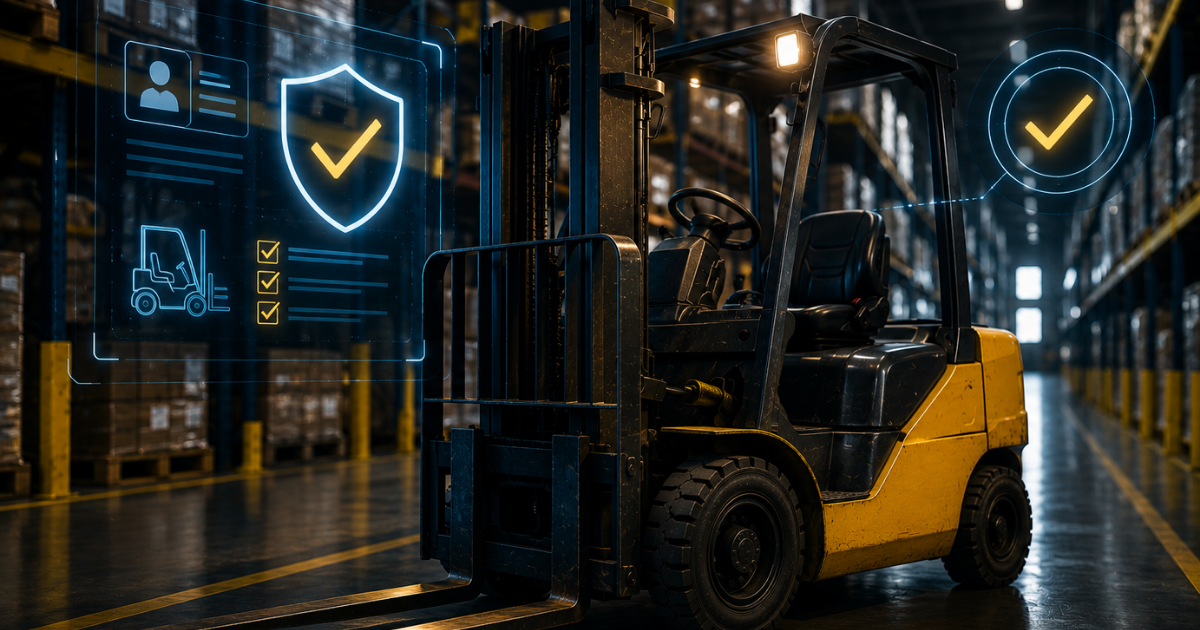
To hire a forklift operator, you need to verify their certification, confirm it covers the specific equipment in your facility, and assess whether their safety habits hold up under a practical evaluation. A paper certificate from an online-only course is not enough. This guide covers what a valid certification actually means under federal law, what questions reveal a candidate's real experience, and the red flags that predict an unsafe or unreliable hire.
Key Takeaways
- The Occupational Safety and Health Administration requires forklift operator certification under 29 CFR, which mandates formal instruction, practical training, and a workplace performance evaluation before an operator can work unsupervised.
- Certification must be equipment-type specific: an operator certified on a sit-down counterbalanced forklift is not automatically certified to operate a reach truck or order picker.
- Operators must be re-evaluated at least every three years, or sooner following an accident, near-miss, or unsafe behavior observation, per the Occupational Safety and Health Administration standard.
- According to the U.S. Bureau of Labor Statistics Occupational Outlook Handbook for Material Moving Machine Operators, this occupation employs approximately 867,700 workers nationally, with a median annual wage of $46,620 as of May 2024
- According to the National Safety Council's Injury Facts, 84 workers died in incidents involving forklifts, order pickers, or platform trucks in 2024, with tipovers accounting for 42% of fatalities.
- According to the Occupational Safety and Health Administration's Local Emphasis Program for Powered Industrial Trucks, approximately 70% of forklift accidents could be prevented through improved operator training and enforcement of safety policies
150 Applicants — Who Makes It Through
Each gate reflects a compliance or skills requirement that filters the pool
What "Forklift Certified" Actually Means
Most hiring managers know they need to ask for certification. Fewer know what a valid certification actually requires under federal law.
The Occupational Safety and Health Administration governs forklift operator training under standard 29 CFR. The standard does not issue a nationally recognized credential or license.
There is no federal forklift license. What it requires is that the employer certify each operator has completed three specific components: formal instruction (classroom or online), practical training (hands-on demonstrations and exercises), and a workplace performance evaluation on the actual equipment in the actual facility.
That third component is the one most often missing from cut-rate or purely online certifications. An operator who completed a 90-minute online course and received a printed card has only satisfied the formal instruction portion of the requirement. They are not fully certified under the Occupational Safety and Health Administration standard until an authorized evaluator has observed them operating the specific type of truck they will use, in the environment where they will use it.
When a candidate presents a certification card, the right questions to ask are: where was the practical evaluation conducted, who evaluated you, and what type of equipment was included? A candidate who cannot answer those questions specifically may have completed only the online portion.
The employer is also required to maintain written records of each operator's training. The certification document must include the operator's name, the date of the training, the date of the evaluation, and the identity of the person who conducted the training or evaluation. If a candidate's paperwork does not include all four elements, the certification is incomplete.
When multiple certified operators apply, gathering the four required documentation elements from every candidate before scheduling interviews takes days. Zyverno collects equipment type, certification category, and training record details from every applicant before a recruiter is involved, so candidates who reach the interview stage have already confirmed whether their documentation meets the requirements.
Equipment Type Is Not Transferable
One of the most common hiring mistakes in forklift operator recruitment is treating certification as a single blanket credential. It is not.
The Occupational Safety and Health Administration classifies powered industrial trucks into seven types, defined in 29 CFR. The categories that matter most for warehouse hiring are:
- Class I: Electric motor rider trucks (sit-down counterbalanced forklifts, the most common type)
- Class II: Electric motor narrow aisle trucks (reach trucks, order pickers, side-loaders)
- Class III: Electric hand trucks and pallet jacks (walkie stackers and rider pallet jacks)
An operator who has spent five years on a sit-down Class I forklift is not automatically qualified to operate a Class II reach truck. The equipment operates differently, the visibility is different, the mast behavior is different, and the movement in narrow aisles demands a separate skill set. The Occupational Safety and Health Administration is explicit on this: when an operator is assigned to a different type of truck, refresher training and re-evaluation are required before unsupervised operation.
This matters for hiring in two directions. First, if you operate reach trucks and a candidate's certification only covers sit-down equipment, you cannot deploy them in your racking aisles without additional training and evaluation.
Second, a candidate who claims to be certified on all equipment types should be able to tell you specifically what types they have been formally evaluated on, and by whom.
When reviewing a candidate's work history, ask which specific equipment they operated at each previous employer. Not just "forklift experience" but the make, model, type, and class. A candidate who can tell you they ran a Raymond 7500 reach truck in a very narrow aisle configuration for three years has given you verifiable, specific information. A candidate who says "I've driven forklifts for ten years" has told you almost nothing useful.
How to Screen Certification Claims
Screening certification is not the same as asking, "Are you certified?" It requires following up on the answer.
Forklift Operator Certification: What Valid Documentation Requires
All four elements must be present. Missing any one makes the certification incomplete under the Occupational Safety and Health Administration standard 29 CFR 1910.178(l).
Request the certification documentation before the interview. Ask candidates to provide their most recent certification card or employer-issued training record. The document should show a training or evaluation date within the last three years, an equipment type or class, and the name of the evaluator or training organization. A card without a date raises an immediate compliance concern.
Verify the evaluation component was on-site. Many online training providers offer a certificate of completion that looks identical to a full certification document. The difference is that online-only training satisfies only the formal instruction requirement. Ask candidates directly: "Where did the practical evaluation take place, and who evaluated you?" The answer should name a physical location (their employer, a training facility with equipment) and a qualified evaluator. An answer like "I took the test online and printed the card" tells you the practical component was not completed.
Ask about the pre-shift inspection routine. Under 29 CFR, operators are required to inspect their equipment at the start of every shift before placing it in service. Ask the candidate to walk you through their pre-shift inspection process without prompting. A candidate who has actually been doing this regularly can describe it in sequence: checking fluid levels, inspecting forks for cracks or bends, testing horn and lights, checking tire condition, verifying the load capacity plate is legible and attached, and testing the brakes and lift mechanism at low speed. A candidate who gives a vague answer or says "I just checked, it looks okay" has not been performing compliant inspections.
Ask what they do when a problem appears. The right answer is to tag the equipment out of service and report it. Candidates who describe continuing to operate a truck with a known issue, or waiting to see if it worsens, are telling you how they will handle your equipment.
Warehouse managers in discussions on hiring forums consistently note that this single question is the most revealing in any forklift operator interview. Operators who normalize skipping inspections or operating compromised equipment are a liability regardless of what their certification paperwork says.
Interview Questions That Reveal Real Experience
Generic interview questions produce generic answers. The questions below are designed to surface specific experience, not rehearsed responses.
"Walk me through how you handled a load that was not palletized or was irregularly shaped." Experienced operators have done this. They can describe how they adjusted forks, used strapping or wrapping, assessed the center of gravity, and moved slowly. A candidate who has only worked with standardized pallet loads will not have a specific answer.
"Tell me about a time you had to refuse to move something." This question surfaces two things: whether the candidate understands that operators have the right and responsibility to refuse unsafe lifts, and whether they have actually done it. A strong answer describes a specific situation, what the hazard was, who they reported to, and what happened next.
"What is the load capacity of the heaviest lift you regularly performed, and how did you know you were within capacity?" Every forklift has a data plate. Every experienced operator knows to read it. The answer to the second part of the question matters most. If the candidate cannot explain how they calculated or verified they were within the rated capacity, they have not been checking.
"Describe the racking or storage system you worked with most recently." This question verifies the environment they actually operated in. A candidate who claims extensive reach truck experience but cannot describe very narrow aisle racking, the wire guidance, or floor-rail systems used to navigate, and the height limitations of the equipment has likely exaggerated their experience.
"What happened the last time a piece of equipment you were operating had a problem?" The answer reveals how they handle equipment issues: did they stop immediately, did they complete the task first, did they report it at all?
Red Flags That Predict Unreliable or Unsafe Hires
Some signals in a forklift operator's application or interview consistently predict problems. These are not disqualifying on their own in every case, but they warrant follow-up.
A certification with no date or a date more than three years ago. The Occupational Safety and Health Administration requires re-evaluation at least every three years. A candidate whose last evaluation was four or five years ago and who has not had a more recent one is either working without a valid re-evaluation or their current employer is not tracking compliance. Either is a problem.
Work history with very short tenures at multiple warehousing employers. A pattern of two to four months at several facilities in a row is worth asking about directly. The most common explanation is disciplinary termination, a near-miss that triggered performance management, or the candidate leaving before being let go. Occasional short stints happen for legitimate reasons; a consistent pattern of them does not.
Vague answers to equipment-specific questions. An experienced forklift operator who has been doing this work for years will be specific about equipment. If a candidate cannot tell you the make and rough model of the equipment they used most recently, they have not been using it as regularly as they claim.
Claims of certification on equipment types that do not match their work history. An operator who claims to be certified on narrow aisle reach trucks but whose entire work history is in loading dock and shipping roles would rarely have needed reach truck certification. The mismatch is worth exploring.
Resistance to a practical evaluation before hire. Legitimate candidates with real experience expect to demonstrate their skills. Candidates who push back on a practical evaluation, claim they "don't need to prove themselves," or express reluctance to operate equipment in a controlled setting are a consistent red flag in operator discussions on hiring forums.
Any history of forklift-related injury claims. This does not automatically disqualify a candidate. Accidents happen. What matters is how the candidate describes the incident. An operator who takes accountability, describes what they changed afterward, and can articulate how they now handle similar situations is a different proposition from one who deflects, minimizes, or blames the equipment or surrounding workers.
The Practical Evaluation
A practical evaluation before hire is the most reliable way to confirm that a candidate's skills match their certification paperwork. It does not have to be elaborate. It does need to be conducted by someone qualified to evaluate the type of equipment the candidate will actually operate in your facility.
A basic evaluation should include:
- Pre-shift inspection completed without prompting
- Smooth acceleration and stopping with a loaded pallet
- Turning in a confined space without dropping the load or striking racking
- Travel at a reasonable speed with the mast tilted back and forks at the correct travel height
- Stacking to a specified rack location with accurate placement
- Setting down a load without jarring, tilting, or dragging
Timing the evaluation is less important than watching the process. An operator who speeds through the inspection, fails to tilt the mast back before travel, or drives with forks at an incorrect height has given you more information than their certification card ever could.
Document the evaluation outcome the same way you would a formal operator re-evaluation: date, evaluator's name, equipment type, and result. This serves both as a hiring record and as the foundational documentation for the new hire's operator file.
Standard Process vs. Structured Process: Days Per Stage
Where unstructured hiring loses time and qualified candidates
Frequently Asked Questions
Do I need to recertify a forklift operator who comes to us already certified?
Yes, in most cases. The Occupational Safety and Health Administration standard requires that certification be specific to the equipment and environment where the operator will work. A new hire's previous certification covers the equipment and conditions at their last employer, not yours. You are required to conduct a workplace evaluation in your facility before deploying them unsupervised. In practice, this means running them through a practical evaluation on your equipment in your operation. The formal instruction component of training can be waived if they have already completed it recently and have valid documentation.
Is a forklift license the same as a forklift certification?
No. There is no federal forklift license issued by a government agency. What exists is an employer-issued certification under the Occupational Safety and Health Administration standard. Some states have additional requirements for specific industries or public roads, but for most warehouse operations, the federal Occupational Safety and Health Administration standard governs. When someone refers to a "forklift license," they typically mean their certification card from a training program.
Can I hire a forklift operator without prior experience and train them in-house?
Yes. The Occupational Safety and Health Administration standard does not require candidates to arrive certified. It requires the employer to ensure certification is complete before unsupervised operation begins. Many operations hire candidates without prior experience and complete the formal instruction, practical training, and evaluation in-house. This approach gives the employer control over training quality and ensures the certification is specific to the actual equipment used. The tradeoff is the time investment in training.
How long does forklift certification take?
Formal instruction can be completed in a few hours to one day, depending on the curriculum and the candidate's prior knowledge. Practical training duration depends on the equipment type and the candidate's starting skill level. A competent evaluator typically needs 30 to 60 minutes to assess an operator's performance. The total time from start to a complete certification is usually one to three days for a new operator.
What documentation should I keep for each forklift operator?
Your operator file for each certified employee should include: the operator's name, the date the training was completed, the date of the performance evaluation, the identity of the person who conducted the training or evaluation, and the type of equipment the certification covers. The Occupational Safety and Health Administration does not prescribe a specific form. What matters is that all four data elements are present and that the record is accessible if your operation is inspected.
What should I do if a candidate's certification paperwork is incomplete?
You have two options. The first is to conduct your own full certification process before hiring, treating them as a new operator, and completing all three components in-house. The second is to decline the hire. What you cannot do under the Occupational Safety and Health Administration standard is deploy an operator whose certification does not meet the documentation requirements and hope for the best. Incomplete documentation is a compliance gap that becomes a liability the moment an incident occurs.
Related articles
Distribution Center Staffing: Hire in the Right Order
Discover why hiring sequence trumps speed in distribution center staffing. Ensure effective onboarding and lower attrition rates with strategic planning.
logisticsCost Per Hire in Logistics: Benchmarks and Where to Cut
Discover benchmarks for cost per hire in logistics. Learn how to identify hidden costs and streamline hiring processes for efficiency.
logisticsFreight Coordinator Hiring: Screen Before You Interview
Streamline your freight coordinator hiring process with effective pre-screening techniques. Improve candidate quality and reduce turnover.