
How to Hire Last-Mile Delivery Drivers at Scale
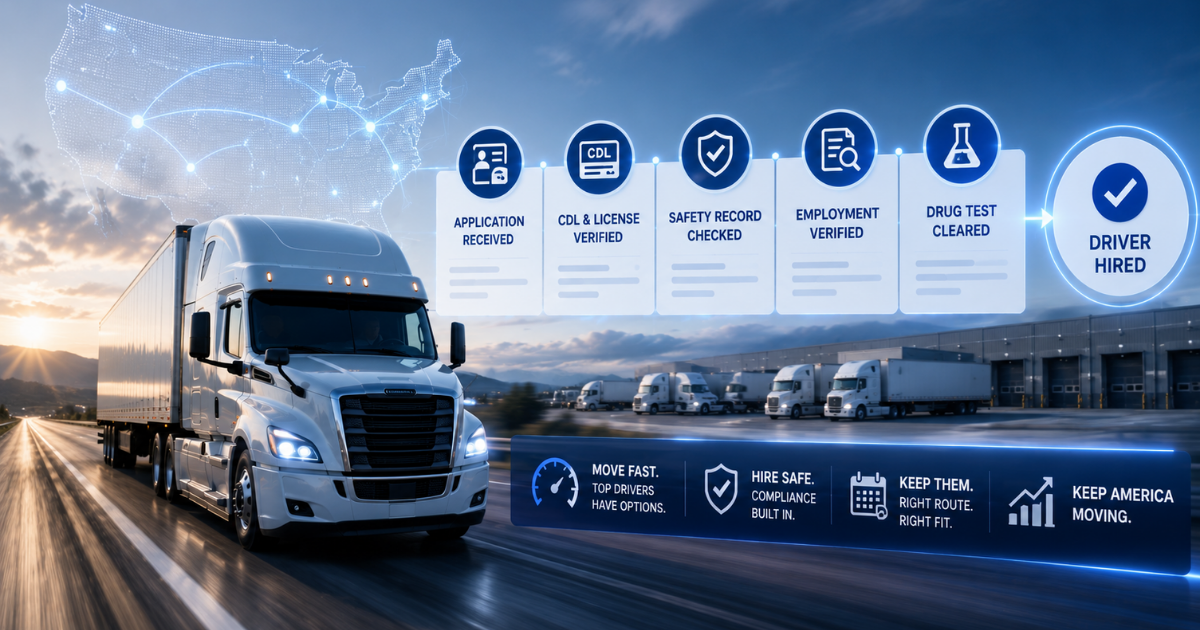
Hiring last-mile delivery drivers at scale means filling a high-volume role with fast churn, tight margins, and candidates who evaluate your posting in under thirty seconds. The process that works is: write a posting that leads with what drivers actually need to know, screen fast, and build a pipeline before the next open position creates pressure. This guide covers each step.
Key Takeaways
- Employment of delivery truck drivers and driver/sales workers is projected to grow 8 percent from 2024 to 2034, much faster than the average for all occupations, according to the U.S. Bureau of Labor Statistics Occupational Outlook Handbook
- The median annual wage for light truck drivers was $44,140 in May 2024, with the highest 10 percent earning more than $79,630 (U.S. Bureau of Labor Statistics Occupational Outlook Handbook)
- About 171,400 openings for delivery truck drivers and driver/sales workers are projected each year, on average, over the 2024-to-2034 decade (U.S. Bureau of Labor Statistics Occupational Outlook Handbook)
- Last-mile delivery drivers turn over at rates that mirror or exceed those in trucking broadly. Industry research on the gig-economy and permanent delivery driver retention points to a structural pattern: the role attracts workers for short-term income who cycle out quickly, and the carriers and delivery service partners that manage retention best treat the role as a career track rather than a job.
- Last-mile delivery drivers prioritize three things when evaluating a posting: specific pay structure, confirmed home time every night, and route predictability. Vague language on any of these drives candidates to the next listing.
- Manual screening becomes the bottleneck at more than 30 open positions per month. At that volume, autonomous screening tools let operations process every applicant consistently without adding recruiter headcount.
- Referred drivers close faster and stay longer. A structured referral program with a 90-day milestone bonus is the lowest-cost pipeline available.
Why Last-Mile Hiring Is Its Own Challenge
Last-mile delivery roles sit in a different category from long-haul trucking. Most positions do not require a commercial driver's license. That opens the applicant pool considerably, but it also means the work attracts people with shorter employment histories and less industry commitment. Turnover is the defining operational problem.
The driver shortage that affects long-haul trucking is not the same dynamic here. Last-mile operations face a high-volume hiring problem, not a credentials problem. There are applicants. The challenge is that many apply, few complete the process, and many of those who start leave within 90 days.
What creates this pattern is often the gap between what drivers expect and what the job actually is. Route density, stop count, delivery windows, parking constraints, and customer interaction levels are not always clear in job postings. Drivers who are accepted based on incomplete information leave when the reality sets in.
Fleet operators and operations managers who ask practitioners on logistics forums about last-mile turnover get consistent answers: the drivers who stay are the ones who knew what they were signing up for. The screening process that produces that outcome is one that sets accurate expectations before the offer, not after.
What Last-Mile Delivery Drivers Actually Look For
Last-mile drivers evaluate your posting differently from long-haul drivers. They are not comparing rate-per-mile structures or freight types. They are comparing three things: how much they will take home, whether they get home every night, and what the route actually looks like day to day.
Pay structure specifics
"Competitive pay" is a phrase that experienced delivery drivers read as a signal that the pay is below market. Discussions among drivers on logistics and trucking forums show this clearly: when a posting uses vague pay language, the assumption is that the actual rate would not survive comparison.
Drivers want to see the hourly rate or the daily guaranteed rate. If pay is structured as hourly, they want to know the minimum guaranteed hours per day and whether they are paid for waiting time at facilities. If pay is a flat daily rate, they want to know what happens when a route runs long.
Stop pay matters for roles with high daily stop counts. A driver completing 120 stops per day wants to know whether they are compensated on a per-stop basis on top of their base rate. Leaving this out of the posting forces the candidate to ask or assume, and many will assume the worst and move on.
Home time is non-negotiable for local routes
Last-mile delivery is local delivery. Drivers take a local route position specifically because they want home time every night. A posting that says "home daily" satisfies this. A posting that lists schedule requirements as "Monday through Friday, full-time" without specifying whether nights are involved creates uncertainty.
If your routes occasionally require early morning starts, say so. Drivers who prefer morning work will self-select in. Drivers who cannot do it will self-select out before you spend recruiter time on them.
Route clarity: stop count and territory
Operators on logistics forums note that one of the most common friction points in last-mile hiring is stop count. A driver who accepts a role expecting 60 stops per day and then receives a manifest for 130 stops feels misled, even if nothing was technically misrepresented.
Your posting should state the average daily stop count for this specific route. If routes vary by day of week or season, give a range. Experienced drivers know that peak periods exist and are not deterred by volume. What deters them is surprise.
Territory also matters. A driver with a car or apartment in the northwest part of the metro does not want to discover on day one that their route is on the opposite side of the city with no warehouse close to them. If your routes are geographically concentrated, say where.
Writing a Job Posting That Gets Applications
Most last-mile delivery job postings are written from the employer's perspective. They list what the employer needs from a driver. The postings that generate applications are written from the driver's perspective. They answer what a driver needs to know before they decide to apply.
Lead with pay, not the company
Your first line should state the pay. Not "competitive pay." Not "$18-$22 depending on experience." State the actual starting rate and what a driver can realistically earn in their first 90 days. If there is a sign-on bonus, state the amount and the conditions required to receive it.
Applicants for delivery roles are often evaluating four or five postings at the same time. If the pay is not visible in the first few lines, most will scroll to the next listing rather than read far enough to find it.
State route structure and schedule in plain terms
Include the daily route structure: territory, approximate stop count, start time, and expected end time based on current routes. If drivers return to a warehouse between runs, say so. If they keep the vehicle overnight, say so.
The schedule section should include which days of the week are required, what happens during peak periods, and whether overtime is available or expected. Drivers who want overtime want to know it is available. Drivers who cannot do it regularly need to know before accepting.
List requirements that are real, not aspirational
A common mistake in delivery driver postings is listing requirements that are not actually enforced in hiring. "Three years of driving experience" as a requirement, when the operation routinely hires drivers with one year of clean record, wastes the candidate pool. It filters out qualified people without surfacing better ones.
State what you actually require: a valid driver's license (class if applicable), a clean motor vehicle record within a specific number of years, the ability to lift a specified weight, and smartphone capability for the delivery app you use. Any requirement you list should be a real screen, not a legal formality.
Vehicle type and equipment condition
For last-mile operations that supply vehicles: state the vehicle type, average age, and whether vehicles have working climate control. A driver who learns on day one that they will be operating a 2018 cargo van with a broken heater in January will leave faster than you can train a replacement.
For operations that use delivery service partners or require drivers to use personal vehicles: be direct about this. The compensation model, mileage reimbursement rate, and insurance requirements should all appear in the posting.
The job posting is the top of the funnel. Screening is the filter.
A strong job description gets applications. The screening layer is what converts applications into qualified hires. For roles with high applicant volume, the job description gets you the pipeline, and a structured screening process gets you the shortlist. For organizations where applicant volume is the bottleneck, Zyverno screens every applicant via voice or chat, asking the same structured questions to every candidate and surfacing qualified drivers for human follow-up the same day they apply.
Last-Mile Delivery Driver Job Posting Checklist
What drivers look for before they decide to apply
Sourcing Channels for Last-Mile Delivery Drivers
Indeed and ZipRecruiter
General job boards produce the highest volume for delivery roles because this is where drivers look. Post on both simultaneously. Do not wait to evaluate one before opening another. At the volume most last-mile operations need, a single channel creates avoidable delays.
Indeed's delivery driver audience skews toward candidates actively searching, which is the right pool for roles that need to be filled within two to three weeks. ZipRecruiter's apply flow is optimized for mobile, which matters for drivers who apply on their phones between shifts.
Facebook and community groups
Delivery drivers are active on Facebook, often in local groups organized around gig work, local commerce, or community news. Targeted paid posts in these groups reach drivers who are passively open to a switch but not actively searching job boards. The targeting parameters that work best: people within a specified distance of your warehouse or depot, who have expressed interest in driving, delivery, or logistics.
Facebook job postings also surface in Marketplace, which is a segment of the delivery-driver candidate pool that checks regularly.
Driver referral programs
Your current drivers know other drivers. They also know whether your operation is one they would recommend. If your referral rate is low, that tells you something before any external sourcing strategy will.
A referral bonus structured around the 90-day retention mark works better than one paid at hire. It aligns the referring driver's incentive with retention, not just application submission. A $300 to $500 bonus paid at 90 days is enough to motivate referrals without creating a backdoor for rushed endorsements.
Delivery service partner networks and gig platforms
For operations using delivery service partner models, Amazon Flex and similar networks maintain their own driver pools. Posting on these platforms reaches people who are already comfortable with delivery work and have been through at least a basic verification process.
The trade-off is that gig drivers often maintain multiple platform relationships and have lower loyalty to any single operator. If your operation relies heavily on this pool, expect higher baseline churn and build your pipeline accordingly.
Screening at Volume: What to Verify and What to Skip
What actually matters for a last-mile driver screen
Last-mile delivery driver screening is not the same as commercial driver's license screening. The compliance layer is lighter. Most positions require a valid driver's license, not a commercial license. The pre-employment checks that matter are:
Motor vehicle record. Run this before a recruiter spends any time on the candidate. A motor vehicle record check for a delivery driver should look at the past three to five years. Disqualifying factors for most operations: driving under the influence conviction within the past five years, license suspension within the past two years, or more than two at-fault accidents in the past three years. Adjust based on your insurance carrier's actual requirements.
Employment history. Verify at least the past two years of work. Look at gaps and the circumstances of departures. A driver who has left five jobs in two years warrants a conversation about why, not automatic disqualification. The reasons matter more than the count.
Smartphone capability and app familiarity. Most last-mile operations run on delivery management apps. If your operation uses a specific platform, ask whether the candidate has used it or a similar tool. The learning curve is short, but candidates who resist app-based workflows create dispatch friction from day one.
What to skip
Physical fitness tests that are not operationally relevant. A delivery driver lifting packages of 50 pounds can be assessed in a brief practical walk-through, not a formal fitness evaluation. Lengthy written applications with redundant fields. Personality assessments for a delivery driver role. These do not predict retention or performance in this role, and they extend your time to hire without filtering for anything real.
Phone screen goals: set expectations before the offer
The purpose of the phone screen for a delivery driver is not to assess driving skills. It is to confirm that the candidate understands what the job actually involves and still wants it.
Ask about their prior experience with delivery or driving routes. Ask what they found difficult about prior delivery roles and how they handled it. Ask what they need from a schedule to make the job work with their life. These questions surface mismatches early, which is where you want to surface them.
A driver who cannot work the start time your routes require, or who has a strong preference against the route density your operation runs, is better off learning that before accepting the offer.
Phone screens for last-mile roles should run 10 to 15 minutes. If they run significantly longer, the process is doing something other than screening.
For operations processing more than 30 to 40 applicants per open position, running phone screens manually produces a multi-day backlog. By the time a recruiter reaches candidates who applied on Monday, those candidates may have accepted offers elsewhere. Autonomous screening tools run the initial conversation with every applicant on the day they apply, asking the same structured questions and flagging candidates who meet your criteria.
The On-Boarding Decision: What Predicts Who Stays
Research consistently shows that delivery driver retention is driven more by expectation alignment than by pay level. Drivers who leave in the first 60 days do so primarily because the job was different from what they were told.
The factors that predict 90-day retention for last-mile drivers are:
Accurate route time estimates. If your average route takes six hours but your posting or onboarding language suggests four to five, the mismatch shows up in week one. Drivers who feel misled about the time commitment leave.
Equipment reliability. A vehicle that breaks down during a route, a delivery app that crashes regularly, or a scanner that does not read package barcodes creates driver frustration that compounds quickly. New hires do not have the organizational goodwill that long-tenure drivers use to absorb these frustrations.
Dispatcher relationship quality. The first person a driver calls when something goes wrong on a route is the dispatcher. Drivers who report to a dispatcher who is unresponsive or dismissive cite this as a primary reason for leaving. This is not a hiring problem. But it is a retention problem that hiring cannot fix if it is not surfaced during onboarding.
Stop count accuracy. If a driver was told their routes average 80 stops and the actual manifest runs 110 regularly, the trust deficit is immediate. Over-promising on stop count is one of the most common causes of early turnover in last-mile operations, according to practitioners managing these fleets.
The practical implication: the offer conversation should include a frank discussion of what a typical week actually looks like, with real numbers from recent dispatch history, not the theoretical average.
Building a Pipeline Before You Need It
Most last-mile operations hire reactively. A driver quits. A position opens. The recruiting process starts from zero. The operations that manage turnover best do not hire this way.
A standing pipeline of pre-screened candidates who have completed the motor vehicle record check and a brief screening conversation reduces time to fill from two to three weeks to two to three days. The mechanics of building this are straightforward: run your job posting continuously, not just when there is an open position. Every applicant who completes the screen goes into a database with their availability and current status.
When a position opens, the first call goes to pipeline candidates, not to a fresh posting. This model requires a small amount of ongoing recruiter time but eliminates the cost and stress of emergency hiring.
A structured referral program runs in parallel. Your current drivers are your best sourcing channel because they know other drivers and they self-select by recommending candidates who they believe will fit. A referral that converts and stays 90 days creates a genuine driver advocate for your operation within the broader driver community.
Frequently Asked Questions
What is the difference between last-mile delivery driver hiring and long-haul truck driver hiring?
Last-mile delivery roles typically do not require a commercial driver's license, which means the applicant pool is larger, but the compliance screening layer is lighter.
Long-haul truck driver hiring involves Federal Motor Carrier Safety Administration checks, commercial driver's license verification, Drug and Alcohol Clearinghouse queries, and Driver Qualification File compliance. Last-mile hiring focuses on motor vehicle record checks, employment verification, and schedule fit.
The screening timelines are also different: last-mile hiring can move from application to offer in two to three days for a prepared operation, while commercial driver's license hiring typically takes five to ten business days.
How many stops per day are typical for a last-mile delivery route?
Stop counts vary significantly by route type, delivery density, and parcel size. Urban residential routes for package delivery can run 100 to 150 stops per day. Smaller parcel count routes for large-item delivery may run 15 to 30 stops. Business-to-business delivery routes often fall somewhere between these. The key is stating the actual range in your posting rather than an average that may not reflect peak-period reality.
Should I post specific pay rates or a range in my job posting?
Post a specific rate or a narrow range tied to a clear variable (such as experience or route). A wide range like "$16 to $28 per hour" signals that the employer does not know what they are paying or that most people end up at the lower end. Drivers on logistics forums consistently identify vague or wide pay ranges as a reason to skip a listing. A specific number or a range of $3 to $4 per hour communicates that you know what the job pays.
How do I reduce first-90-day turnover in last-mile delivery?
The three most reliable levers are: accurate stop count and route time expectations set before the offer, reliable vehicle and equipment from day one, and a dispatcher relationship where the driver feels supported rather than ignored. Pay adjustments help at the margin but rarely solve early turnover if those three factors are absent. The drivers who stay through 90 days are primarily those who found the job matched what they were told.
What motor vehicle record disqualifiers should I use for last-mile delivery drivers?
Common thresholds for last-mile delivery roles, which are largely set by insurance carriers rather than federal regulation: no driving under the influence in the past five years, no license suspension in the past two years, no more than two at-fault accidents in the past three years, no reckless driving conviction in the past three years. Your insurance carrier may have stricter or different requirements. Confirm with your insurer before setting your screening criteria, since hiring a driver who does not meet insurer thresholds may affect your coverage.
How fast should I respond to a delivery driver application?
Within the same day, ideally within hours. Delivery driver candidates in active job searches are often applying to multiple positions simultaneously. A same-day contact rate is the baseline for competitive operations. Operations that respond to applications the next business day frequently reach candidates who have already accepted other offers or are no longer available.
What is a delivery service partner, and how does it change driver hiring?
A delivery service partner is a small business that contracts with a carrier (most commonly Amazon) to handle the last leg of the delivery process. The delivery service partner employs the drivers, manages the vehicles, and executes the routes. If your operation is structured as a delivery service partner, your drivers are your employees, not contractors. Hiring practices apply in full, and retention is your business problem, not the carrier's. Delivery service partner turnover averages are typically higher than industry norms because the model attracts people seeking short-term income rather than career positions.
Related articles
Distribution Center Staffing: Hire in the Right Order
Discover why hiring sequence trumps speed in distribution center staffing. Ensure effective onboarding and lower attrition rates with strategic planning.
logisticsCost Per Hire in Logistics: Benchmarks and Where to Cut
Discover benchmarks for cost per hire in logistics. Learn how to identify hidden costs and streamline hiring processes for efficiency.
logisticsFreight Coordinator Hiring: Screen Before You Interview
Streamline your freight coordinator hiring process with effective pre-screening techniques. Improve candidate quality and reduce turnover.