
How to Hire Logistics Dispatchers Without Spending Weeks on Interviews
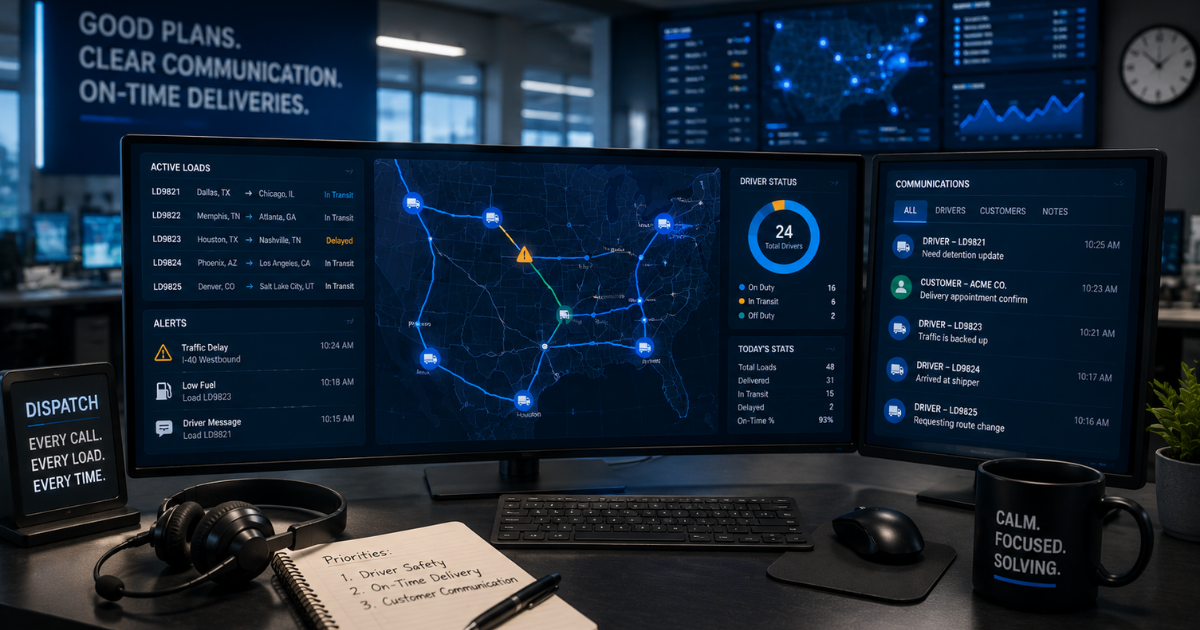
Hiring a logistics dispatcher takes too long because most operations screen for the wrong things. The role looks like a coordination job on paper. In practice, it is a stress management job conducted entirely over the phone and radio, often simultaneously.
When the job posting, the screening questions, and the interview are all built around logistics knowledge rather than stress tolerance and communication under pressure, qualified candidates slip through, and weak ones advance.
This guide covers how to write a posting that attracts the right applicants, what to screen for before any interview, which questions actually separate strong candidates from confident-sounding ones, and how to compress the entire process without cutting corners.
Key Takeaways
- According to O*NET's 2024 occupational data for dispatchers, the median wage for dispatchers (excluding police, fire, and ambulance) is $23.50 per hour, with approximately 218,700 workers in the occupation and around 18,500 job openings projected annually
- According to Randstad's Workmonitor research on logistics talent, 3 in 4 logistics organizations report acute talent shortages extending beyond the holiday season. Every open dispatcher seat becomes more expensive to fill the longer it stays vacant.
- The dispatcher role sits at the intersection of operations, customer service, and crisis management. Job postings that describe it purely as an administrative role attract candidates who are not prepared for its actual demands.
- Former drivers and owner-operators are frequently cited as an overlooked hiring pool for dispatcher roles. They understand the road constraints dispatchers need to account for.
- Screening for stress tolerance before any interview saves weeks of processing. Candidates who cannot describe a structured coping approach rarely last past the first real pressure situation.
- The first 90 days of a dispatcher hire fail most often because candidates underestimate the emotional weight of the role, not because they lack logistical knowledge
- Scenario-based interview questions outperform generic experience questions at predicting dispatcher performance. The way a candidate describes prioritizing a three-crisis overlap reveals more than five years of resume history.
Why Dispatcher Hiring Takes So Long
Most operations approach dispatcher hiring the same way they approach hiring for any administrative role: post the job, screen resumes for relevant experience, interview the top few, and pick the most credible. The process takes three to six weeks. The hire often leaves within six months.
The delay is not a volume problem. Dispatcher roles rarely attract 200 applications. The delay comes from two predictable points.
First, the job posting attracts a mixed pool. Some candidates genuinely understand what the job demands. Many see a desk job in logistics.
Second, the interview is structured around logistics knowledge rather than the behavioral signals that predict whether someone can handle the role's actual weight.
The result is a long process that still ends in a poor hire. Fixing both problems shortens the timeline and improves the outcome.
Write a Posting That Attracts the Right Candidates
The standard dispatcher job posting describes a coordination role. It lists responsibilities like "schedule drivers," "communicate with customers," and "track shipments." All of this is accurate. None of it prepares the candidate for the reality of the job.
A logistics dispatcher's day involves managing multiple overlapping crises under time pressure, communicating clearly with frustrated drivers and demanding customers, making fast decisions without full information, and staying regulated when everything is going wrong at once. A candidate who does not know this before they apply is likely to be surprised by it within the first month.
Your posting should name this directly. Use language that reflects the real experience: "You will be managing 15 to 30 active loads at once, fielding calls from drivers in difficult situations, and making decisions quickly that affect delivery timelines. This role demands calm under pressure, not just organizational skill."
This approach does two things. It discourages candidates who want a low-stress administrative role. It attracts candidates who actively want a fast-paced, problem-solving environment. Both outcomes benefit your process.
Include shift information explicitly. Dispatcher roles often involve early starts, late finishes, or weekend coverage. Candidates who discover this in the interview, rather than the posting, frequently withdraw or become no-shows. State the exact shift window: "You will work Monday through Friday, 5 AM to 2 PM" or "This role covers a rotating schedule including one Saturday per month." Candidates who accept this information in the posting stay through the offer.
State software familiarity as a preference, not a requirement. Most transportation management systems take two to four weeks to learn. A candidate with strong problem-solving instincts and route awareness will pick up your software. A candidate who knows your specific platform but cannot handle pressure will not. List your system. Mark it as preferred. Do not make it a filter.
What to Screen Before Any Interview
Screening dispatcher candidates before a formal interview saves more time than any other change in the process. Most operations send resumes directly to an interview.
The first interview then becomes a discovery session where the interviewer realizes the candidate has not worked in a live dispatch environment, cannot describe how they handle multiple simultaneous demands, or treats the role as a step into logistics management rather than a front-line operations job.
Dispatcher Pre-Screen: 3 Questions to Ask Before Any Interview
15 minutes. Eliminates half your interview load.
Confirm role understanding
"Describe what you think a typical day in this dispatcher role looks like." Listen for driver breakdowns, customer escalations, rerouting decisions. Not just scheduling.
Confirm shift availability
State the exact shift window and ask directly. Do not save this for the formal interview. Candidates who withdraw for schedule reasons save everyone's time.
One behavioral question on stress
"Tell me about a time when you had several things going wrong at once. Describe specifically what you did to manage it." Look for a specific process, not a general statement about staying calm.
If the candidate cannot describe a specific mechanism for managing simultaneous pressure, do not advance to the formal interview.
The pre-screen should do three things:
First, confirm the candidate understands what the role actually involves. A single open question: "Describe what you think a typical day in this dispatcher role looks like." This separates candidates who have done their research from those who are applying broadly.
A candidate who describes scheduled shipments and phone calls has a surface understanding. A candidate who mentions driver breakdowns, customer escalations, rerouting decisions, and end-of-day reconciliation has a working picture of the role. Neither answer is perfect, but the gap between them is significant.
Second, confirm availability and shift commitment. This is the most common reason candidates exit after the first contact. Ask it directly in the first conversation rather than saving it for the formal interview stage.
Third, ask one behavioral question about stress. Not "How do you handle stress?" Every candidate answers that positively. Ask instead: "Tell me about a time when you had several things going wrong at once and describe specifically what you did to manage it."
A candidate who can give a specific example with a clear process is demonstrating the pattern you are looking for. A candidate who describes the situation without describing the mechanism for managing it has a gap that is hard to train.
For operations receiving a high volume of dispatcher applications, this pre-screening layer is where the most time is recovered. Instead of interviewing seven candidates across three weeks, a structured pre-screen reduces that to two or three candidates who have already demonstrated the right profile.
Frontline hiring tools like Zyverno can run this layer via voice or chat, applying the same structured questions to every candidate before a recruiter gets involved. The interview queue then contains only candidates who have already confirmed fit.
The Interview Questions That Actually Predict Performance
Most dispatcher interviews ask about experience. "Have you worked in a dispatch environment before?" "What software have you used?" These questions confirm history. They do not confirm capability under the conditions that determine whether a dispatcher will last.
The questions that separate strong candidates from confident-sounding ones are all scenario-based. They describe a real situation and ask what the candidate would do. The answer reveals whether they have an instinctive process or whether they are guessing.
Use these questions in this order:
1. "You have three drivers calling at the same time. One has a breakdown on the highway, one is reporting a customer refusing delivery, and one needs directions because the GPS route is blocked. Walk me through exactly what you do first."
Strong candidates prioritize by urgency and consequence. The breakdown is a safety and recovery issue. The customer's refusal is a relationship and documentation issue. The directions request is immediate but addressable quickly.
A candidate who goes to the directions request first because it is faster has not thought through the consequences. A candidate who immediately sequences these by impact, communicating hold times to drivers two and three while addressing driver one, demonstrates triage thinking. This matters more than any resume line.
2. "A driver calls you upset and raises their voice. You have a customer on hold and three loads to enter before the end of the shift. How do you handle that conversation?"
This tests emotional regulation under simultaneous pressure. The question has no single correct answer. What you are looking for is evidence that the candidate has a way of stabilizing difficult conversations without either escalating or caving.
Candidates who describe specific techniques (naming the driver's concern, setting a clear next step, returning to the backlog with a structured sequence) demonstrate a pattern. Candidates who say "I would stay calm" without describing how are telling you they have not had to do this in a real environment.
3. "Tell me about a time when you made a decision quickly, and it turned out to be wrong. What happened and what did you do?"
Dispatchers make dozens of fast decisions per day. Some of them will be wrong. The question is not whether a dispatcher makes mistakes. It is whether they can own them, correct them, and keep moving.
Candidates who cannot give a specific example are either overstating their experience or have not operated in a high-decision environment. Candidates who describe a mistake but cannot articulate what they did to correct it have a pattern of avoidance that will create problems in the role.
4. "What is your approach to staying organized when several things are happening at once?"
This is the system question. Dispatchers who rely on memory alone hit a ceiling. Strong candidates describe a specific tool or habit: a visual whiteboard, a priority queue in the system, a check-in cadence with drivers, or an end-of-hour reset. The specificity of the answer indicates whether the candidate has actually developed a system or is describing one in the moment. Follow up with: "How has that system changed based on experience?"
Red Flags to Catch Before the Offer
Some patterns in dispatcher candidates are not obvious until the pressure starts. A structured interview surfaces them earlier.
Candidates who describe managing stress through "just staying calm." This is not a method. It is a description of an outcome. Strong candidates describe what they actually do: breathing technique, sequencing decisions, communicating estimated wait times to put callers on hold, and building buffer into the schedule. When pressed for the mechanism and the candidate cannot name one, that gap will show up in the role.
Candidates who have never worked in a high-contact, high-volume phone environment. Dispatcher work is almost entirely phone and radio. Candidates whose entire work history is in roles with minimal real-time phone communication often underestimate the energy cost of being in constant voice contact. This is not disqualifying, but it requires direct conversation about what to expect.
Candidates who describe dispatch as a stepping stone. The dispatcher role requires full investment. Candidates who frame it as a path into logistics management or operations planning are often physically present but mentally checking out within ninety days. This is not a negative career ambition, but the mismatch between their goal and the role's demands produces poor retention.
Candidates who speak poorly about former drivers or customers. Dispatcher work involves daily contact with people who are under pressure. A candidate who describes drivers as difficult or customers as unreasonable without any acknowledgment of the operational context those people are operating in will struggle with the relationship maintenance the role requires.
The 90-Day Retention Problem (and How to Avoid It)
A recurring pattern in trucking and logistics hiring communities: dispatcher hires look strong in the interview and leave in the first three months. The role description they imagined and the role they encountered were different enough that the adjustment became a reason to look elsewhere.
The gap is rarely in logistics knowledge. It is an emotional load.
Dispatchers are the contact point for everyone when something is wrong. Drivers call when there is a breakdown, a route problem, a schedule conflict, or a conflict with a customer. Customers call when a delivery is late or damaged.
Operations management calls when loads are behind. All of these calls arrive under pressure, and the dispatcher is expected to resolve, document, and move on to the next call without carrying the stress of the last one into it.
Candidates who have been hired into customer service roles or sales coordination understand this pattern. Candidates who have worked primarily in back-office or inventory roles do not. Former drivers often make strong dispatchers precisely because they understand the road from the inside. They know what a breakdown actually feels like, what rerouting decisions cost a driver, and how to communicate with someone who is frustrated without adding to that frustration.
Three practices reduce the 90-day exit rate for dispatcher hires:
Set expectations in the offer conversation, not the onboarding. Describe the emotional volume of the role before the candidate signs. Ask them directly: "There will be days when you are managing five simultaneous problems and none of them have a clean solution. How does that sit with you?" Their answer tells you something, and it also prepares them for reality in a way that no onboarding document can.
Assign a specific mentor for the first 30 days. The learning curve in dispatch is not the software. It is the judgment: knowing when to escalate, when to solve it yourself, when to push back on a driver's request, and when to absorb a customer complaint without involving operations. That judgment transfers person-to-person more effectively than through any documentation. A senior dispatcher who debriefs the new hire at the end of each week for the first month reduces the error rate and the exit rate.
Build in early wins. New dispatchers who manage their first week of smooth load coverage without a significant error are more likely to stay. The first two weeks of the role should have a lighter load than normal. Not so light that the hire is not learning, but light enough that they are not overwhelmed before they have any reference points.
How to Shorten the Full Hiring Timeline
The average dispatcher search takes three to six weeks. Most of that time is spent in three places: waiting for applications to accumulate before screening, scheduling and conducting preliminary interviews, and chasing candidates for availability windows.
Each of these can be compressed without reducing quality.
Batch screening by day, not by application. Set a fixed screening time twice per week rather than reviewing each application as it arrives. This prevents the stop-start cycle that stretches what should be a two-week process into four weeks.
Use a structured phone screen before any in-person time. A 15-minute structured call with the three questions above (understanding of the role, availability confirmation, and one behavioral question) eliminates half the interview load. Candidates who do not pass the phone screen never enter the in-person pipeline. Candidates who do enter have already confirmed basic fit.
Move fast between stages. Dispatcher candidates are typically employed or actively interviewing at multiple places. A candidate who completes your phone screen on a Wednesday and does not hear back until the following Tuesday has often accepted another offer by then. Same-day or next-day follow-up between stages is the single most important timeline compressor available.
Make the offer within 24 hours of the final interview. If the final interview went well, the delay between the interview and the offer is when you lose candidates you wanted. Strong dispatchers know their value. A fast offer signals that you know it too.
Frequently Asked Questions
How long does it typically take to hire a logistics dispatcher?
Most logistics operations take three to six weeks to fill a dispatcher role. The timeline can be compressed to ten to fourteen days with a structured pre-screen before any interviews, same-day follow-up between stages, and a same-day or next-day offer process after the final interview.
The compressible parts are all administrative. The quality-determining parts are the behavioral questions and the scenario assessment. These do not take more time. They just need to happen earlier in the process.
What experience should I require for a dispatcher candidate?
Prior dispatch or coordination experience is valuable but not required if the candidate demonstrates stress tolerance, organizational method, and communication capability under pressure. Former truck drivers are frequently strong dispatcher candidates. They understand what a driver actually needs in a crisis and communicate accordingly.
Candidates with customer service or emergency coordination backgrounds also transfer well. Requiring specific transportation management system experience limits your pool more than it improves quality. Most systems take two to four weeks to learn.
What is the right pay range for a logistics dispatcher?
According to O*NET's 2024 occupational data for dispatchers, the median wage for dispatchers (excluding police, fire, and ambulance) is $23.50 per hour, or approximately $48,880 annually. The actual range in your market will depend on shift coverage requirements, load volume, and whether the role covers emergency-level freight. Night or weekend shifts typically carry a premium of $2 to $4 per hour above standard market rates. Posting without a salary range reduces application volume. Candidates who screen themselves out for pay reasons save both sides time.
What is the most common reason dispatcher hires fail in the first 90 days?
The gap between the role the candidate imagined and the role they experienced. Dispatcher work involves sustained emotional load: being the contact point for every problem in the operation, often without clean solutions.
Candidates from low-contact backgrounds who have not been explicitly prepared for this pattern leave when the reality hits. Setting expectations during the offer conversation rather than onboarding, assigning a first-month mentor, and building a lighter first two weeks all reduce the 90-day exit rate.
Should I hire a dispatcher with no logistics background?
Yes, in some cases. The skills that determine dispatcher success: stress regulation, communication under pressure, organizational method, and rapid decision-making. These are transferable from other industries. Emergency services coordination, high-volume customer service, and restaurant or event management experience all develop the pattern-recognition and emotional regulation that dispatch requires. Logistics knowledge is easier to train than temperament.
What interview format works best for dispatcher candidates?
A two-stage process works well. The first stage is a structured 15-minute phone screen covering role understanding, availability, and one behavioral question. The second stage is a 45-minute interview focused entirely on scenario-based questions that describe real dispatch situations and ask the candidate to walk through their response.
Avoid spending the formal interview on resume review. That is pre-screen work. Use the in-person time for the scenarios that reveal judgment, not the resume questions that reveal history.
Related articles
Distribution Center Staffing: Hire in the Right Order
Discover why hiring sequence trumps speed in distribution center staffing. Ensure effective onboarding and lower attrition rates with strategic planning.
logisticsCost Per Hire in Logistics: Benchmarks and Where to Cut
Discover benchmarks for cost per hire in logistics. Learn how to identify hidden costs and streamline hiring processes for efficiency.
logisticsFreight Coordinator Hiring: Screen Before You Interview
Streamline your freight coordinator hiring process with effective pre-screening techniques. Improve candidate quality and reduce turnover.