
How to Hire Truck Drivers: A Recruiter's Playbook
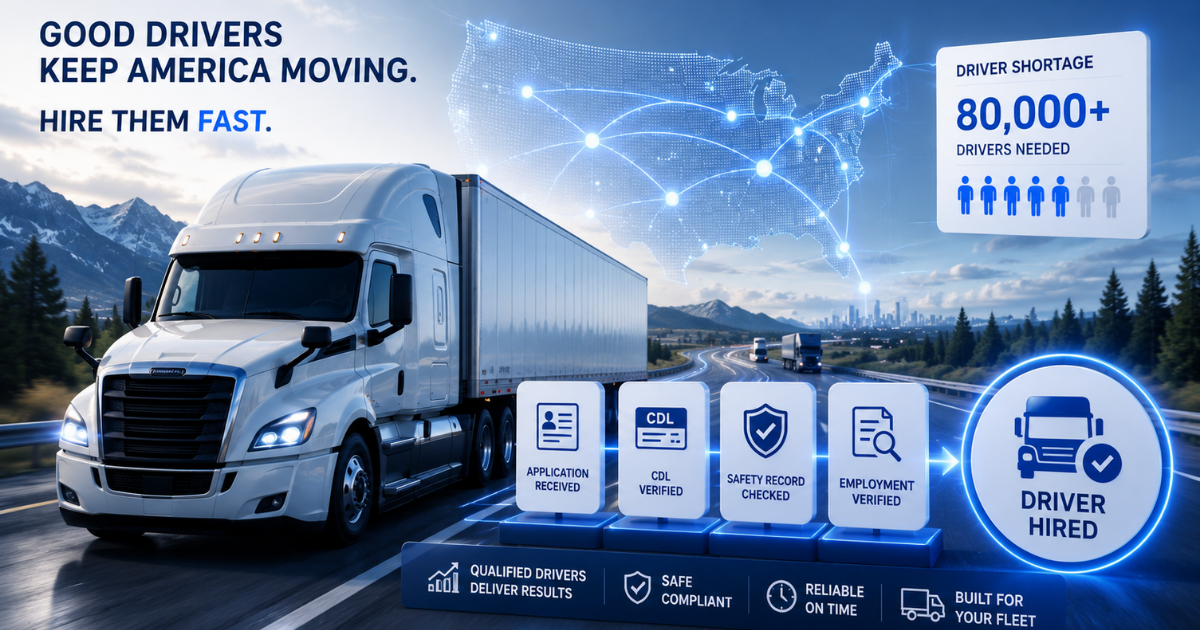
Hiring truck drivers is harder than most logistics roles because it combines tight compliance requirements, a national shortage, and one of the highest annual turnover rates of any occupation. The fundamentals are: verify credentials early, screen for safety record before anything else, and move fast because qualified drivers receive multiple offers simultaneously. This playbook covers each stage of the process.
Key Takeaways
- The U.S. trucking industry was short approximately 80,000 drivers as of late 2024, and projections from the American Trucking Associations suggest the shortage could exceed 160,000 by 2030
- The median annual wage for heavy and tractor-trailer truck drivers was $57,440 in May 2024, according to the U.S. Bureau of Labor Statistics Occupational Outlook Handbook
- Large truckload carriers report annual driver turnover rates above 90%, according to the American Trucking Associations on trucking turnover. This means most carriers are replacing the majority of their driver fleet every year.
- Heavy and tractor-trailer truck drivers held approximately 2.2 million jobs in 2024, with roughly 231,100 openings projected annually through 2034 (U.S. Bureau of Labor Statistics)
- Retention starts at the hiring stage: drivers who were accurately assessed for route type, home-time expectations, and equipment fit before accepting an offer stay significantly longer than those who accepted without that clarity
What Makes Driver Hiring Different from Other Logistics Roles
Hiring a warehouse associate and hiring a truck driver are fundamentally different processes. The compliance layer alone sets driver hiring apart from almost any other hourly role.
Every commercial driver candidate must hold a valid commercial driver's license for the vehicle class they will operate. Class A covers tractor-trailers and most heavy combination vehicles. Class B covers straight trucks, large buses, and some specialized vehicles. Class C covers vehicles not covered by A or B but requiring endorsements for passengers or hazardous materials. Verifying license class, endorsements, and expiration date is a non-negotiable step that happens before any other evaluation.
Federal Motor Carrier Safety Administration regulations require carriers to check the driver's safety record before hire. This includes reviewing a three-year driving history, running a Pre-Employment Screening Program check through the Federal Motor Carrier Safety Administration, and verifying employment history for the past three years. Skipping these steps is not just a quality risk. It is a regulatory violation and a liability.
Beyond compliance, the dynamics of this candidate market are unlike almost any other role you hire for. Driver turnover remains structurally high, and recruiters on trucking forums consistently report that most active drivers are passively or actively open to new opportunities, particularly when carriers compete on home time and pay predictability.
Qualified drivers with clean records receive multiple contacts from recruiters weekly. They compare offers on four things specifically: pay structure, home time, equipment quality, and freight type. If your process takes two weeks while a competitor hires in three days, you lose candidates to the faster offer.
Speed and compliance are both requirements. The challenge is running thorough verification without creating a slow process. Building your verification steps into a parallel workflow is the practical solution. Run the background check and driving record check simultaneously with the phone screen rather than sequentially.
When application volume is high, the bottleneck is the recruiter's availability. Zyverno handles the initial phone screen automatically, asking every applicant the same structured questions 24 hours a day and flagging qualified candidates for human follow-up. Drivers who apply at 9 p.m. get a response that night instead of waiting until a recruiter is free.
What to Look for in a Driver Candidate
What to Screen For Before Interviewing a Driver
Four criteria that separate qualified candidates from those who cannot legally operate your equipment
License Class and Endorsements
Verify the license class matches the vehicle type before any recruiter time is spent. Wrong class or missing endorsements means the candidate cannot legally operate your equipment.
- Class A: tractor-trailers and heavy combination vehicles
- Class B: straight trucks, large buses, select delivery vehicles
- Endorsements: H (hazardous materials), N (tanker), T (doubles/triples)
- Confirm license expiration date
Safety Record
The single most predictive factor for driver quality and carrier liability. Run a Pre-Employment Screening Program check through the Federal Motor Carrier Safety Administration database.
- Moving violations in the past three years
- Preventable accidents on record
- Out-of-service orders (prior regulatory violations)
- Drug and Alcohol Clearinghouse query (federal requirement)
Work History and Route Fit
Prior tenure signals reliability, but the reasons behind job transitions matter more than frequency. Route experience must match the demands of your specific operation.
- Three-year employment verification (federal requirement)
- Route type match: long-haul vs. regional vs. local delivery
- Ask reasons for each carrier transition
- Confirm home-time expectations match your route structure
Safety Culture Attitude
Beyond the paper record, assess whether the candidate takes safety seriously as a daily practice. This surfaces in the interview, not the background check.
- How they describe prior incidents (ownership vs. blame)
- Pre-trip inspection habits: specific and systematic, not vague
- Whether they ask about your safety protocols unprompted
- History of refusing an unsafe load or dispatch (a positive signal)
Run checks in parallel, not sequentially. License verification, driving record check, and phone screen should happen simultaneously the day an application arrives. Waiting to complete one before starting the next can add five or more days to your process. Qualified drivers accept other offers in that window.
Compliance requirements: Federal Motor Carrier Safety Administration regulations. Turnover data: American Trucking Associations.
License and Endorsements
Verify the license class matches the equipment they will operate. Check endorsements if the role involves hauling hazardous materials (H endorsement), operating tanker vehicles (N endorsement), or driving double or triple trailers (T endorsement). A candidate with the wrong class or missing endorsements cannot legally operate your equipment and will need to take additional licensing steps before starting.
Safety Record
The safety record is the single most predictive factor for driver quality and risk. Run both a Motor Vehicle Record check and a Pre-Employment Screening Program report through the Federal Motor Carrier Safety Administration's database.
The Motor Vehicle Record shows violations at the state level. The Pre-Employment Screening Program shows five years of crash history and three years of roadside inspection data across every carrier the driver has worked for.
Both reports matter because they reveal different things. A recruiter at a regional carrier noted that the Pre-Employment Screening Program "tells me how well they're doing their pre-trip inspections before they hit the road." Frequent out-of-service orders during roadside inspections, even without accidents, signal a driver who does not maintain compliance as a daily habit.
Look at specifics, not just totals:
- Moving violations in the past three years, particularly speeding more than 15 miles per hour over the limit (which insurance companies treat equivalently to reckless driving) and mobile phone use while driving (which some carriers treat as equivalent to a driving under the influence conviction)
- Preventable accidents on record, and whether any were concealed on the application
- Out-of-service orders, which indicate prior regulatory violations
- Prior drug or alcohol violations through the Federal Motor Carrier Safety Administration Drug and Alcohol Clearinghouse
A single minor violation is not automatically disqualifying. A pattern of violations over three years is. Dishonesty on the application about any of the above is an automatic disqualifier, regardless of the underlying violation.
Work History
A driver's work history tells you about reliability, career trajectory, and route experience. Look at tenure at prior carriers. A driver who has held five jobs in three years is not necessarily a poor performer. The industry's high turnover means frequent moves are common. But the reasons matter. Ask about each transition.
One signal experienced fleet operators watch for: a driver who shows up to the interview while still on the clock at another carrier, telling you they can start right away. Drivers in trucking community forums have noted this pattern from the other side. It usually means the driver will leave just as abruptly.
Route experience is also relevant. A driver with ten years of long-haul experience may not adapt well to a high-frequency local delivery route. Match the candidate's history to the demands of your routes. If your routes are regional or local, probe whether the candidate has genuine interest in that structure or is settling for it temporarily.
Attitude Toward Safety Culture
Beyond the paper record, you are assessing whether the candidate takes safety seriously as a daily practice. This comes through in how they talk about prior incidents, how they describe pre-trip inspection habits, and whether they ask questions about your company's safety protocols during the interview.
A driver who gives a vague answer about pre-trip inspections ("I check the truck") is telling you something different from a driver who describes a systematic walk-around covering tires, coupling, lights, fluids, and emergency kit. The depth of the answer reflects the depth of the habit.
A driver who dismisses a prior accident as someone else's fault and shows no curiosity about your safety policies is a risk regardless of their clean record.
Where to Find Driver Candidates
Job Boards with Driver-Specific Reach
General job boards like Indeed and ZipRecruiter reach high volumes of driver candidates because drivers actively search for roles on these platforms. Trucking-specific boards such as CDLjobs.com and TruckingTruth extend into audiences that are less active on general platforms.
Post on multiple platforms simultaneously for driver roles. Waiting to see results from one before opening another extends your time to fill significantly, and the driver shortage means you cannot afford extended vacancies.
Referrals from Your Current Drivers
Referred candidates close faster and stay longer in most hiring contexts, and driver hiring is no exception. Your current drivers know other drivers. They also know whether your company is one they would recommend to someone they trust. Your referral rate is a rough proxy for how your current team feels about working there.
A structured referral program with a clear cash bonus, paid after the referred driver completes 90 days, is worth setting up before you need to fill multiple positions. Informal referrals happen anyway. Formalizing it increases volume.
Commercial Driving Schools
Driving schools maintain relationships with employers and often have placement programs for graduates. New commercial driver's license holders are not experienced drivers, but they bring current training and no bad habits to unlearn.
If you can provide a structured orientation program that gets new graduates productive on your routes, recruiting from schools gives you a pipeline that bypasses the shortage in the experienced market.
Veterans are disproportionately represented in commercial driving schools and veteran transition programs. The Federal Motor Carrier Safety Administration maintains a list of military driver qualification programs that allow service members with equivalent training to skip certain licensing requirements. Military drivers often have clean records, experience with large vehicles, and strong discipline around safety protocols.
Social Media and Video Sourcing
Many commercial driver license holders are not actively checking job boards between jobs. They are active on Facebook and TikTok. Targeted paid posts on Facebook, particularly in groups organized around specific route regions or freight types, reach drivers who are passively open to a move but not actively searching.
Short-form video content showing realistic cab conditions, route types, and honest home-time schedules performs well with younger drivers evaluating trucking as a career. Carriers that show what the job actually looks like on social media consistently report better candidate quality from that channel than from vague listings on general job boards.
Women represent less than 6% of commercial drivers, but the share is growing. Organizations like the Women in Trucking Association (WIT) connect carriers with female candidates actively entering the field. Carriers that can point to current female drivers in their fleet, and describe specific policies around safety and scheduling that address concerns unique to solo long-haul driving, have an advantage in recruiting from this expanding pool.
Owner-Operator Networks and Lease Agreements
For carriers that use owner-operator arrangements, the sourcing model is different. Owner-operators are small business owners, and the decision involves rate per mile, lane preferences, equipment compatibility, and fuel surcharge structures. Recruiting for these positions requires a different conversation: less about your company and more about the economics of the arrangement.
Your Job Posting and How Drivers Read It
Experienced drivers scan job postings in under thirty seconds. They look for four things: pay structure, home time, equipment type and age, and freight type. If any of those are missing or vague, most close the tab.
Drivers on the TruckersReport forum describe this directly. One posted: "I don't care about amenities. I care about miles, freight, and equipment." Recruiters who lead with amenities and perks rather than operational details read as companies hiding something.
The pay structure for drivers is more complex than an hourly rate. Candidates want to know the rate per mile for loaded and empty miles if they differ, whether there are detention pay provisions, how layovers are compensated, and what realistic annual earnings look like. A posting that lists only "competitive pay" will underperform against one that states "$0.62 per mile loaded, $0.55 per mile empty, $18 per hour detention after two hours."
Home time is a make-or-break dimension. Drivers across the TruckersReport website and similar forums consistently rank predictable home time above marginal pay increases when evaluating new opportunities.
The pattern has held since the early 2020s: what changed is that it is now more openly stated. Be specific: weekly home, every other weekend, regional home daily. Vague language like "home time flexibility" reads as a red flag to experienced drivers, not a benefit. Forum discussions show that drivers have learned "flexible home time" often means the company will try to accommodate requests, but makes no guarantees.
Equipment age and type matter to drivers who understand the safety and comfort implications of the cab they will spend 60 to 70 hours per week in. If your fleet is current, say so. Late-model trucks with functioning auxiliary power units are a selling point. If your fleet is older, saying nothing will not prevent candidates from finding out.
Common Mistakes in Driver Hiring
Driver hiring fails in predictable ways. Understanding what goes wrong helps you build a process that avoids the most costly errors.
Moving too slowly. Research from Tenstreet, a driver recruiting platform, found that the chance of hiring a driver increases by roughly 40% when the carrier makes contact within five minutes of an application being submitted. Drivers in the market are entertaining multiple offers simultaneously. Leaving an application unreviewed for three days means losing that candidate.
Screening for experience rather than record. A driver with twenty years of experience and three preventable accidents in the past two years is a higher risk than a driver with four years of experience and a clean record. Prioritizing tenure over the safety and employment record produces hires that generate insurance claims. Carriers bear the liability.
Over-promising on home time. Home time is the most common source of early driver turnover. Operations that promise weekly home time during recruiting and then run drivers regionally for three weeks in a row lose drivers to competitors who set accurate expectations. The short-term benefit of making the role sound more attractive is offset by the cost of replacing the driver in 90 days. Drivers on forums describe dispatchers who use language like "we'll try to get you home" as a tell. The word "try" signals a non-binding promise.
Skipping employment verification. Federal regulations require employment history verification for the past three years. A driver who was terminated from a prior carrier for safety violations or who left under circumstances that make them ineligible for rehire presents risks that surface only when the check is done thoroughly. Carriers also have access to the Drive-A-Check report (sometimes called the DAC report), maintained by HireRight, which captures what prior employers reported about a driver's tenure, reason for leaving, and whether they would be eligible for rehire.
Not building the Driver Qualification File correctly. Federal Motor Carrier Safety Administration regulations require carriers to maintain a Driver Qualification File for every driver they hire. The file must contain the employment application, the Motor Vehicle Record for the past three years, the results of the Pre-Employment Screening Program inquiry, the annual review of the driving record, a certificate of driver's road test (or equivalent), and documentation confirming the medical examiner's certificate is current. Carriers that start the file late or leave items out are in violation regardless of whether the driver performed well. Building the file in parallel with the hiring process, not after the offer, is the correct sequence.
Hiring to fill seats rather than to fill roles. Under pressure to staff routes, some carriers accept candidates who do not meet their stated safety standards or who are a poor fit for their route structure. The resulting turnover compounds the pressure rather than relieving it. A short-term vacancy is less costly than a preventable accident or a driver who leaves in 60 days.
Neglecting the candidate experience. Drivers talk to each other. Word of mouth about which carriers treat applicants professionally and which do not spreads within the driver community. Forum discussions regularly feature threads naming carriers where recruiter treatment was dismissive or evasive. One thread in the same forum described a recruiter who "laughed and told me that since I am new, I don't really have a right to get picky." That kind of interaction becomes public reputation.
How to Screen Drivers Before the Interview
The pre-interview stage for driver candidates has two goals: verify that the candidate meets your minimum compliance requirements, and assess fit before investing time in a live interview. For most trucking operations, this means running three parallel checks as soon as an application comes in.
Check 1: License verification. Confirm the license class, endorsements, and expiration. In the US, you can verify a commercial driver's license status through most state Department of Motor Vehicles systems. Do not wait until the job offer stage for this step. It should happen before any recruiter time is spent on the candidate.
Check 2: Motor Vehicle Record and Pre-Employment Screening Program. Run both simultaneously. The Motor Vehicle Record shows state-level violations. The Pre-Employment Screening Program shows inspection history, crash data, and out-of-service orders across the driver's full carrier history. The Pre-Employment Screening Program check costs a few dollars and returns within 24 hours. Run it before you run the more expensive full background check.
Gaps in the address history of more than a month warrant investigation. Inspection violations that appear on the Pre-Employment Screening Program but are absent from the driver's application are a signal that the candidate is not being fully transparent. Per practitioners, dishonesty about driving history is a harder disqualifier than the underlying violation itself.
Check 3: Phone screen. The phone screen covers work history, route experience, home-time expectations, and equipment familiarity. It takes 10 to 15 minutes. The purpose is to filter for obvious mismatches before investing in a full interview.
Listen to how the driver describes why they left prior carriers. A pattern of grievances aimed entirely at external factors, with no self-reflection, is worth noting. It does not automatically disqualify, but it warrants follow-up. Also, listen to what questions they ask you.
A driver who asks nothing about your safety program, equipment age, or route structure during the phone screen may not be evaluating you carefully, which is a different kind of risk.
For operations where driver candidate volume is high (fifty or more applicants per open position), running phone screens manually becomes a bottleneck. Autonomous screening tools can handle the initial conversation at scale, asking the same structured questions to every applicant and flagging candidates who meet your criteria for a human follow-up. Our screen AI Agent, Lina, runs this layer via voice or chat, 24/7, so qualified candidates are identified the same day they apply rather than waiting for a recruiter's availability.
Check 4: Employment verification. Federal regulations require you to verify employment for the past three years. Contact prior carriers to confirm dates, position, and whether the driver is eligible for rehire. Some carriers are slow to respond. Build this into your timeline rather than letting it block the offer.
The Drug and Alcohol Clearinghouse query is mandatory before extending an offer. A violation record in the Clearinghouse does not automatically disqualify a candidate. The relevant question is whether they have completed the required return-to-duty process.
The Driver Interview
The driver interview is a structured conversation, not a general chat. You have already verified credentials and screened for basic fit. The interview's purpose is to assess safety culture, communication style, and the specifics of how this driver works.
Questions to cover:
- Walk me through your pre-trip inspection process. A driver with genuine habits gives you a systematic answer covering specific checkpoints: tires, coupling, lights, fluid levels, emergency kit, wipers, and gauges. A driver who says, "I walk around and check things" has not answered the question. The specificity of the answer tells you whether pre-trip inspection is a real practice or just something they know they are supposed to do.
- Tell me about the most difficult driving situation you have encountered and how you handled it. Assess ownership, judgment, and calm under pressure. A driver who describes a situation where everything was someone else's fault and who made no adjustments is different from one who describes what they did and what they would do differently.
- What does your home-time expectation look like? Confirm alignment with your route structure. Do not accept a vague answer. Push for a specific number of nights out per week and how flexible that is. Mismatches here are the most common source of early turnover.
- What questions do you have about our safety program? A driver who asks nothing about safety is telling you something. Experienced drivers on forums describe asking about safety culture as a way to evaluate whether a company is worth working for. A driver who asks good questions here is demonstrating that they are evaluating you carefully.
- Have you ever refused a load or a dispatch? Why? You want drivers who understand their right to refuse an unsafe situation and who exercise it appropriately. A driver who has never refused anything in years of driving may be telling you they will run unsafely rather than push back.
Transparency as a closing step. Before extending an offer, walk the candidate through the actual details of the job: realistic weekly miles based on your current lanes, specific home-time frequency from the past 90 days (not the theoretical best case), equipment age, and how detention and layover pay work in practice. This is not a sales pitch. It is the information the driver needs to make an accurate decision. Drivers who accept based on accurate information stay longer than those who accept based on optimistic projections.
Road test considerations. For most carrier operations, a practical road test is standard before extending an offer. At minimum, this involves backing into a dock space, a highway run, and city driving. Practitioners note that nerves are expected and should not automatically count against a candidate. Evaluators watch for mirror discipline, following distance, smooth shifting, and whether the driver reads road signs and speed advisories. Behavioral factors matter: a driver who claims manual transmission experience they do not have will show it within the first few minutes. Honesty about current skill level is more useful than an inflated self-assessment.
Retention Starts at Hiring
The trucking industry's turnover problem is well-documented. Annual turnover at large truckload carriers has exceeded 90% for multiple consecutive years, according to the American Trucking Associations. That rate reflects drivers moving between carriers rather than leaving the industry entirely. But for any individual carrier, the cost of constant replacement is real.
Retention data from carriers and driver community discussions points to the same pattern: a large share of first-year departures happen in the first quarter, with many carriers describing a second wave at the six-month mark.
The primary cause is not pay. The primary cause is that the job was meaningfully different from what the driver was told during recruiting.
Set accurate expectations during the hiring process on four dimensions: route structure (regional, long-haul, local), realistic home-time frequency based on actual recent dispatch history, equipment age and condition, and pay structure, including how detention time and layovers are handled.
One carrier launched a program guaranteeing drivers regular, predictable home time. Their turnover dropped by 15% in participating divisions. The mechanism was not a new policy. It was that the policy now matched what recruits were told.
Retention-oriented hiring also means screening for fit between the driver's priorities and your operation's actual structure. If your routes are unpredictable and the driver's top priority is consistency, that is a mismatch that hiring cannot fix. It will resolve itself through turnover.
Beyond expectations, pay attention to how candidates describe their motivation for the job. Practitioners who have tracked early turnover note that drivers who describe trucking as a fallback or last resort leave at higher rates than those who have a genuine professional identity in the work. This is not a knock on people who came to trucking through necessity. It is a signal to probe for: what do they want the job to look like in two years? Drivers who have thought about that question and have a real answer tend to stay.
Frequently Asked Questions
How long does it typically take to hire a truck driver?
For experienced drivers with clean records, a well-run process takes five to ten business days from application to offer. That timeline covers license verification, driving record check, employment verification, phone screen, and interview. The verification steps are the constraint. Running them in parallel with the screening stages, rather than sequentially, reduces the total time significantly.
What is the difference between a Class A and a Class B commercial driver's license?
A Class A commercial driver's license authorizes the holder to operate combination vehicles with a gross combined weight rating of 26,001 pounds or more, including tractor-trailers. A Class B commercial driver's license authorizes single vehicles of 26,001 pounds or more that are not pulling a trailer over 10,000 pounds. This covers straight trucks, large passenger buses, and some delivery vehicles. Most long-haul over-the-road positions require a Class A license.
Should you hire a recent commercial driving school graduate or an experienced driver?
Both have merit. Experienced drivers with clean records are in short supply and command premium pay. Recent graduates are more available but require orientation investment and carry higher early-turnover risk while they adjust to your operation. The practical answer depends on your onboarding capacity: if you can invest two to three weeks in structured orientation, a well-selected graduate can become a strong long-term driver. If you need someone operating independently from week one, experienced candidates are the better fit.
What is the Federal Motor Carrier Safety Administration Drug and Alcohol Clearinghouse?
The Drug and Alcohol Clearinghouse is a federal database maintained by the Federal Motor Carrier Safety Administration that records drug and alcohol violations by commercial drivers. Employers are required to query the Clearinghouse before hiring a commercial driver and conduct annual queries for current drivers. A violation record in the Clearinghouse does not automatically disqualify a candidate. The relevant question is whether they have completed the required return-to-duty process.
What is the Pre-Employment Screening Program, and how is it different from a Motor Vehicle Record check?
The Pre-Employment Screening Program is a Federal Motor Carrier Safety Administration database that contains five years of crash history and three years of roadside inspection data for commercial drivers, drawn from reports submitted by law enforcement and other carriers. A Motor Vehicle Record check pulls state-level driving history, including violations, license status, and suspensions. Running both gives a complete picture. The Motor Vehicle Record shows what happened at the state level. The Pre-Employment Screening Program shows what happened when the driver was operating commercially, including inspections that found violations even when no citation was issued.
What is a Driver Qualification File, and what does it need to contain?
A Driver Qualification File is the set of documents that federal regulations require carriers to compile and maintain for every commercial driver they hire. At a minimum, it must contain the driver's signed employment application, Motor Vehicle Record for the past three years, Pre-Employment Screening Program inquiry results, a certificate of the driver's road test or equivalent, proof that the medical examiner's certificate is current, and documentation of annual driving record reviews. The file must be kept for the duration of the driver's employment plus three years after they leave. Starting the file at the offer stage rather than after the driver begins work is the most common compliance gap. The practical approach is to begin assembling it the moment a candidate enters the screening process.
Related articles
Distribution Center Staffing: Hire in the Right Order
Discover why hiring sequence trumps speed in distribution center staffing. Ensure effective onboarding and lower attrition rates with strategic planning.
logisticsCost Per Hire in Logistics: Benchmarks and Where to Cut
Discover benchmarks for cost per hire in logistics. Learn how to identify hidden costs and streamline hiring processes for efficiency.
logisticsFreight Coordinator Hiring: Screen Before You Interview
Streamline your freight coordinator hiring process with effective pre-screening techniques. Improve candidate quality and reduce turnover.