
How to Reduce Time-to-Hire in Logistics
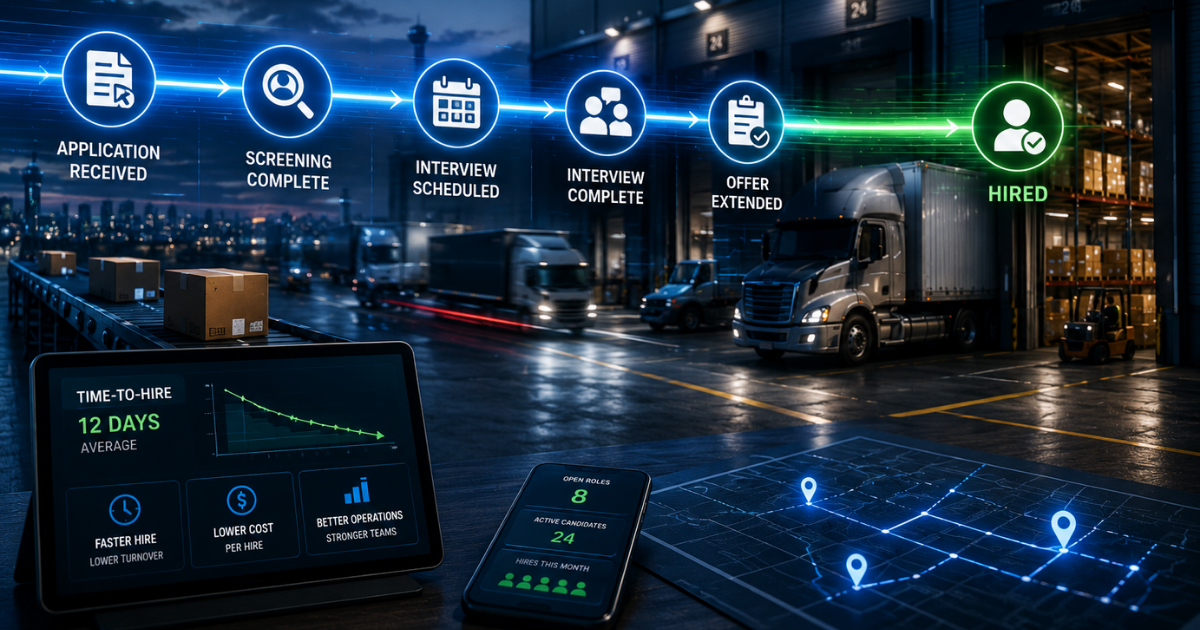
To reduce time-to-hire in logistics, compress the three stages that consume the most calendar days: application review, screening, and interview scheduling. Each stage has a predictable amount of dead time built into it, and each can be shortened without sacrificing candidate quality.
This guide walks through how each stage works, where the delay comes from, and what actually changes the number.
Key Takeaways
- Logistics and transportation roles have an average time to fill of approximately 25 days, according to the Society for Human Resource Management (SHRM) 2025 Recruiting Benchmarking Report, but high-churn warehouse and driver roles often cycle through the full process repeatedly within the same quarter
- CareerPlug's 2025 Recruiting Metrics Report found that scheduling friction alone accounts for 20% of total candidate drop-off across industries, making it the single most avoidable source of delay and loss in the hiring funnel
- The same report shows the average applicant-to-hire ratio across all industries is 180 applicants per hire, with only 3% of applicants making it to the interview stage, meaning most recruiter time is spent on candidates who will not be hired
- CareerPlug's 2025 data shows that 37% of entry-level and hourly workers cited being hired quickly as the most important factor in their job search, more than compensation or benefits
- Appcast's recruitment data analysis found that applications taking more than 15 minutes to complete experience a 365% degradation in completion rates compared to those completed in five minutes or less
- Screening is typically the longest stage in logistics hiring. Eliminating phone-tag in the screening step produces the largest time reduction of any single change most operations can make
- Same-day response to applications is the operational threshold that separates high-conversion logistics recruiters from everyone else
Why Time-to-Hire Matters More in Logistics Than in Most Industries
Time-to-hire is a problem in most industries. In logistics, it is an operations problem, not just a recruiting one.
An unfilled warehouse associate position redistributes work to existing staff who are already at capacity. An unfilled driver seat is a direct revenue loss per shift. An unfilled dispatcher role creates coordination failures that ripple into shipment delays. These are not hypothetical.
Logistics managers who describe the cost of open positions consistently talk about overtime bills, missed shipments, and penalty clauses, not just the abstract cost of a vacant seat.
The second factor that makes time-to-hire critical in logistics is candidate behavior. Warehouse workers and drivers are not passive. They apply to multiple employers simultaneously and accept the first offer that moves at a reasonable pace. CareerPlug's 2025 Recruiting Metrics Report found that 37% of hourly workers named speed of hire as the most important factor in their job search. A candidate who could have been your next hire is gone by the time a slow process reaches them.
The third factor is churn. High-turnover roles mean the hiring cycle runs continuously. A logistics operation with 20% annual warehouse turnover does not hire once and hold. It hires constantly. Any inefficiency in the process is not a one-time cost. It is a recurring cost, paid on every hire, every cycle.
Reducing time-to-hire in logistics is not about moving faster for its own sake. It is about the operational and financial cost of every day that a role stays open and every qualified candidate who exits the funnel while waiting.
Step 1: Diagnose Where Your Time Is Going
Before changing anything, identify where time is actually being consumed in your current process. Most logistics operations that try to "speed up hiring" change the wrong thing. They post jobs faster but still have a five-day application review backlog. Or they reduce the number of interview stages but still lose candidates during a four-day scheduling wait.
Measure the time between each stage:
- Application submitted to the first recruiter contact
- First contact to screening completed
- Screening completed, interview scheduled
- Interview completed to offer extended
- Offer extended to the first day of work
According to the Employ 2026 Hiring Benchmarks Report, the average time from application to initial screening interview across industries is 7.2 days. In high-churn logistics roles, where candidates accept competing offers within 24 to 48 hours, 7.2 days is not a benchmark to aspire to. It is the ceiling to break through.
In most logistics operations, the longest gaps are between application and first contact, and between screening and interview scheduling. If your data shows a different pattern, the fixes will be different. Do not assume. Measure.
Recruiters in logistics HR communities describe this diagnostic step as the one most operations skip. They implement scheduling automation but the bottleneck is still the three-day gap before applications are first reviewed. Fixing the wrong stage does not compress time-to-hire. It just shifts where the candidates are lost.
If you do not currently have stage-by-stage time data, start tracking it manually for the next four weeks before implementing any changes. Four weeks of data from your actual process will tell you more than any benchmark.
Step 2: Compress the Application Stage
A long or friction-heavy application is where a significant share of logistics candidates exit before the process ever starts. Appcast's recruitment data analysis found that applications taking more than 15 minutes experience a 365% degradation in completion rates. For warehouse and driver roles encountered on mobile devices, the tolerance for friction is even lower.
The goal at this stage is to collect enough information to route the candidate into screening. Nothing more.
What to collect at the application:
- Name and contact information
- Key credential or license class (commercial driver license type for driver roles, relevant certification for specialized warehouse roles)
- Shift availability
- Location or commute capacity
What to remove from the application:
- Full employment history going back more than three years
- References at the initial stage
- Essay or free-text responses beyond a single availability field
- Account creation requirements
- Document uploads (resume, certifications) before the candidate has expressed a clear interest
The screening stage is where you collect the detailed qualification information. The application stage is only for creating a candidate record and triggering the screening flow.
Operations managers who have compressed their applications from 20-plus-minute forms to five-minute mobile-first submissions consistently describe the same outcome: completion rates increase, and the candidates who complete the shorter form are not lower quality. The long form was selected for patience, not for job readiness.
Logistics hiring funnel
180 Applications. 1 Hire.
Each stage shows where candidates exit before reaching the next step.
Step 3: Eliminate the Dead Time Between Application and Screening
The gap between application submission and first recruiter contact is the highest-impact variable in logistics time-to-hire. It is also the easiest to eliminate in its current form.
Most logistics operations handle this step manually: a recruiter opens an inbox, reviews applications, identifies the promising ones, and calls them. In a high-volume environment, this process takes days. Applications submitted on Friday are not reviewed until Monday. Applications submitted at 10 PM are not reviewed until the following morning. Candidates who applied at peak interest have accepted other offers by then.
The fix is to trigger a structured response at the moment of application, without recruiter involvement.
This does not mean a generic "we received your application" email. That delays the process instead of compressing it. A structured response means the candidate immediately enters a screening flow: a set of role-specific questions delivered via text, chat, or voice that gathers the qualification information the recruiter needs to decide whether to advance the candidate.
When this flow runs automatically, the recruiter's inbox shifts from "unreviewed applications" to "candidates who have already answered the screening questions." The review time drops from days to minutes. The recruiter is evaluating pre-screened candidates rather than triaging raw applications.
For organizations where screening volume is the constraint, this is where autonomous tools provide the most direct return. Zyverno screens candidates via voice or chat immediately after they apply, 24/7, so the recruiter's queue contains only qualified candidates when the workday begins, rather than a pile of unreviewed applications from the night before.
Recruiters who have made this shift describe a change in how their mornings work. Instead of starting the day by sorting through applications, they start by calling a list of people who have already confirmed they meet the basic requirements. The conversations are shorter and more productive because the qualification work is already done.
Step 4: Replace Phone Screening With Async or Automated Screening
Phone screening is the most time-consuming and the most fragile step in logistics hiring. A recruiter calls a candidate. The candidate does not answer. The recruiter leaves a voicemail.
The candidate calls back and reaches the recruiter's voicemail. This cycle continues for one to three days before either a conversation happens or the candidate moves on.
For warehouse and driver candidates, the phone-tag problem is structural. Drivers are on the road during business hours. Night-shift warehouse workers are asleep. Candidates who apply at 8 PM are not reachable at 10 AM the next day. The mutual availability window is narrow and often requires multiple attempts to find.
Every day spent on phone tag is a day the candidate is still in the market. And logistics candidates in an active job search are applying continuously, not waiting for your call.
The alternative is screening that does not require simultaneous availability. This takes two forms in practice.
Text or chat screening. The candidate receives a structured set of questions they can answer at any time from their phone. They respond when it is convenient for them, which is typically faster than a scheduled phone call. The recruiter reviews completed responses in batches rather than chasing individual callbacks.
Voice screening via an automated system. The candidate calls a number or initiates a voice conversation at any hour and completes the structured screening interview. The recruiter receives a completed screening record rather than a callback queue.
Recruiters who have moved away from scheduled phone screens to asynchronous screening consistently describe the same pattern: more candidates complete the screening step, they complete it faster, and the recruiter spends less time on the phone with candidates who would have been disqualified anyway.
The shift also changes which candidates make it through. Phone screens done under time pressure, when a recruiter has 30 applications to get through by the end of the day, are inconsistent. Async screening applies the same questions to every candidate. The criteria are consistent because the process is consistent.
Step 5: Automate Interview Scheduling
After screening, the next delay point is getting the interview on the calendar. This step consumes calendar days in most logistics operations because it requires back-and-forth between the recruiter, the candidate, and the hiring manager.
The recruiter checks the hiring manager's availability. Call the candidate. The candidate is not available on the proposed days. The recruiter goes back to the hiring manager. A new set of slots is proposed. This cycle takes two to four days on average and happens after the candidate has already passed screening and expressed clear interest.
For logistics candidates, two to four days is a long time to be in the market without a firm interview date. Operations managers on logistics HR forums describe losing candidates at this stage as particularly frustrating because these are people who made it through the application, passed screening, and want to interview. Losing them to scheduling lag feels different from losing someone who ghosted after applying.
The practical fix is calendar-link scheduling. Qualified candidates who complete screening receive a link that shows available interview slots in real time and lets them book directly. No back-and-forth. No waiting for the recruiter to check availability. The interview is scheduled in the same session as the screening completion.
Recruiters who implement this describe it as the change with the most visible immediate impact. Scheduling confirmation happened over several days before. Now it happens within the hour. The time-to-interview metric drops sharply, and it stays down because the change is structural rather than behavioral.
Step 6: Reduce Interview Stages for Hourly Roles
A common source of extended time-to-hire in logistics is an interview process designed for professional roles applied to hourly positions. Two-stage interviews for a warehouse associate. Panel interviews for a driver. A second conversation with the operations manager before an offer is made.
For warehouse associate and driver roles, these additional stages add days to the process without proportionally improving the quality of the hire. The information gathered in a second interview rarely changes the hiring decision for a role with clearly defined requirements and a structured screening process.
Operations that have reduced their hourly interview process to a single structured conversation, with a conditional offer extended at the end of that conversation for qualified candidates, consistently describe shorter time-to-hire without an increase in early attrition.
The counterintuitive finding: the candidates who complete two and three interview stages for a warehouse role are not necessarily better fits than those hired through a single-stage process with strong screening. The screening step is doing the qualification work.
The interview is confirming behavioral signals and setting expectations. One structured conversation accomplishes both.
For supervisor and coordinator roles, a two-stage process is reasonable. For warehouse associate, driver, and picker roles, it typically is not. Calibrate the interview process to the complexity of the role, not to a default process borrowed from professional hiring.
Step 7: Extend Offers on the Same Day as the Interview
One of the most straightforward changes that compresses time-to-hire is making the conditional offer decision at the end of the interview, or within the same business day, rather than several days later.
The delay between interview and offer in logistics hiring is almost always caused by an approval process that requires the hiring manager to confer with someone else before extending an offer. This is appropriate for executive and professional roles. For warehouse associate and driver roles, it adds two to four days and creates another window for the candidate to accept a competing offer.
Operations that have moved decision authority for hourly roles to the hiring manager or operations manager directly, with clearly defined hiring criteria, consistently describe shorter time-to-hire and higher offer acceptance rates. The candidate does not have time to receive and accept another offer between the interview and the offer call.
Pre-approved salary bands and standardized offer language remove the administrative obstacle that makes same-day offers difficult. When the hiring manager knows the approved pay range, the shift schedule, and the start date before the interview begins, a conditional verbal offer can be extended at the end of the conversation.
Step 8: Measure the Right Metrics
Logistics operations that reduce time-to-hire without measuring it typically see the number drift back up within a few months. The process changes are behavioral as much as structural, and behaviors revert without feedback.
The metrics worth tracking for logistics hiring:
Time from application to first contact. This is the most actionable metric in the funnel. It is entirely within the recruiter's control and directly predicts downstream conversion.
Time from first contact to screening completion. Measures how much of the phone-tag problem has been eliminated. Should drop significantly after async screening is implemented.
Time from screening completion to interview booked. Measures the scheduling friction. Should be close to zero after calendar-link scheduling is in place.
Time from interview to offer. Measures whether the approval process is adding unnecessary delay.
Offer acceptance rate. A leading indicator of whether candidates are still in the market and interested when the offer arrives. A declining acceptance rate on an otherwise unchanged process usually means a competitor has gotten faster.
30-day and 90-day retention rate. Time-to-hire pressure sometimes leads operations to advance candidates who should have been screened out. If your time-to-hire drops but 30-day retention also drops, the screening criteria may have been loosened too much.
Tracking these six metrics gives a clear picture of where time is being consumed and whether changes are working. Without this data, process improvements are guesses.
Stage-by-stage breakdown
Where Calendar Days Go — and Where to Cut Them
Average days at each hiring stage: standard logistics process vs. optimised.
Application to first contact
Screening (first contact to completion)
Interview scheduling
Interview to offer extended
eliminated
Frequently Asked Questions
What is a good time-to-hire benchmark for logistics and warehouse roles?
According to SHRM's 2025 Recruiting Benchmarking Report, logistics and transportation roles average approximately 25 days to fill. For high-volume hourly roles such as warehouse associates and delivery drivers, many operations aim to compress this to 7 to 14 days from application to start date. The most competitive operations in high-churn markets run an application-to-offer process in three to five days for entry-level warehouse roles by eliminating phone-tag in screening and using calendar-link scheduling.
What stage takes the longest in logistics hiring?
For most logistics operations, screening is the longest stage, primarily because it depends on mutual phone availability between the recruiter and the candidate. Warehouse workers and drivers are often unavailable during standard business hours, and the resulting phone-tag cycle can consume three to five days for a step that, handled asynchronously, could be completed in hours. Eliminating the phone-tag problem in screening is the single highest-leverage change most logistics operations can make to reduce time-to-hire.
Does reducing time-to-hire hurt the quality of hires?
Not if the screening criteria stay consistent. The quality risk in fast hiring comes from skipping or weakening the screening step, not from compressing the calendar time between stages. An operation that maintains structured screening criteria while eliminating the dead time between stages yields faster hires of equivalent quality. The common mistake is treating speed and quality as opposites. They are only opposites when speed is achieved by removing evaluation steps rather than by removing administrative delays.
How can a small logistics company with one recruiter reduce time-to-hire?
Single-recruiter operations gain the most from automation because their constraint is recruiter bandwidth, not process design. The highest-impact changes for a one-person recruiting function are: an application that generates an automated screening response immediately (removing the manual review step from the critical path), async or AI-led screening that generates a completed candidate record without phone calls, and calendar-link scheduling that removes the back-and-forth from interview booking. These three changes allow one recruiter to handle a volume of candidates that would otherwise require a team.
How does time-to-hire affect warehouse worker turnover?
Fast time-to-hire is associated with lower early turnover in hourly roles for one specific reason: candidates hired through a slow process often started the role while waiting for a better offer to materialize. They joined without fully committing. Candidates hired through a fast, clear, well-communicated process tend to have sharper expectations about what the role involves and a cleaner decision to join. The relationship is not guaranteed, but operations that have compressed time-to-hire without weakening screening typically describe stable or improved 90-day retention rates.
What is the fastest a logistics company can realistically hire a warehouse worker?
Operations that have optimized all stages describe a three-to-five-day process: same-day automated screening triggered by application submission, async screening completed within 24 hours by the candidate, calendar-link interview booked within the same session, and a same-day conditional verbal offer at the end of a single structured interview. This timeline is achievable for warehouse associate and entry-level driver roles where the requirements are specific, the screening criteria are well-defined, and decision authority sits with the hiring manager.
Related articles
Distribution Center Staffing: Hire in the Right Order
Discover why hiring sequence trumps speed in distribution center staffing. Ensure effective onboarding and lower attrition rates with strategic planning.
logisticsCost Per Hire in Logistics: Benchmarks and Where to Cut
Discover benchmarks for cost per hire in logistics. Learn how to identify hidden costs and streamline hiring processes for efficiency.
logisticsFreight Coordinator Hiring: Screen Before You Interview
Streamline your freight coordinator hiring process with effective pre-screening techniques. Improve candidate quality and reduce turnover.