
Warehouse Job Descriptions: What Gets Applicants to Apply
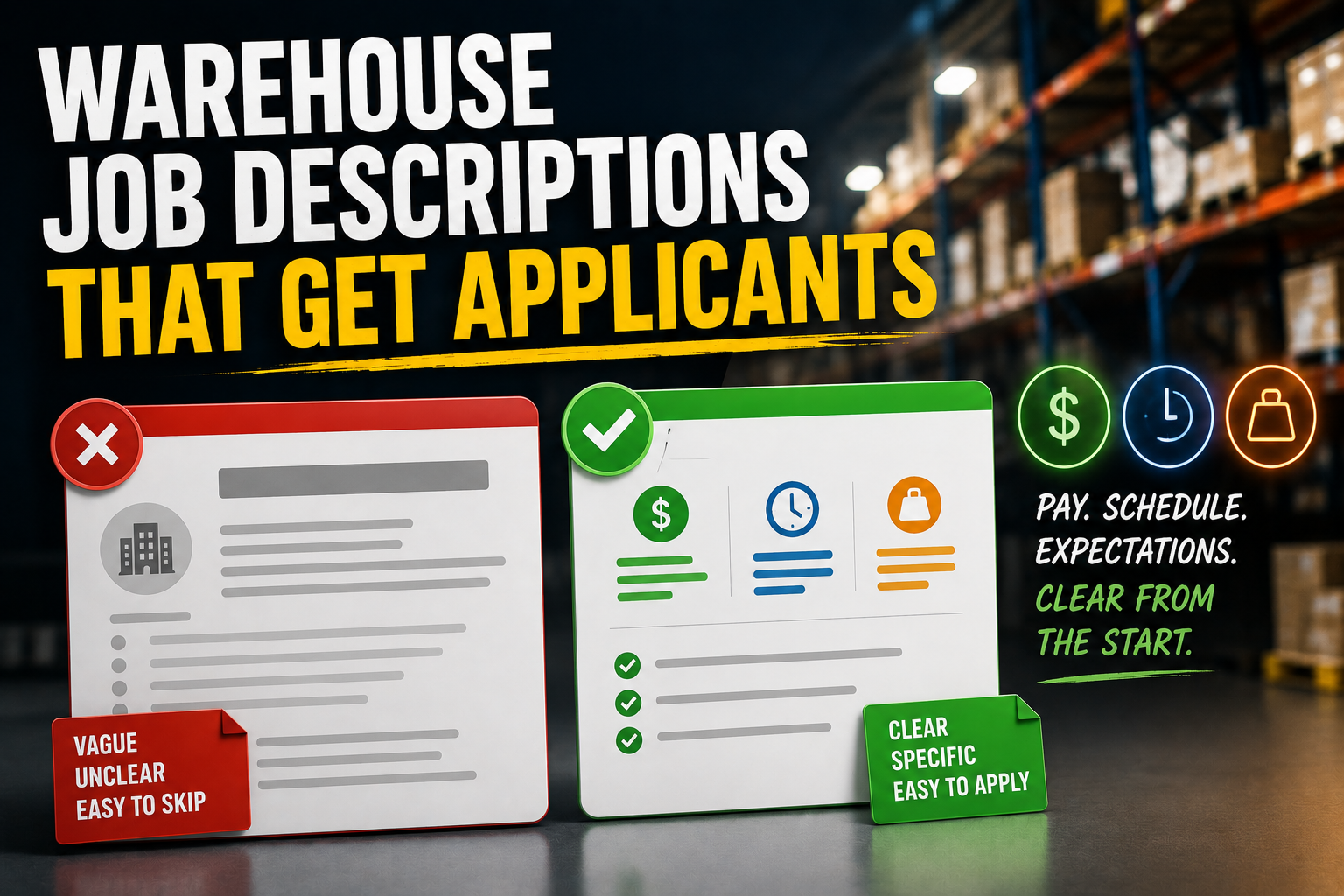
Most warehouse job postings are written to protect the employer, not to sell the job. Candidates open the listing, scan the first three lines, and close it if they cannot find pay, shift hours, or physical expectations. The fix is structural: lead with what candidates need to know, not what the legal team insisted you include.
Key Takeaways
- Candidates decide within the first three lines whether a posting is worth reading. Pay range, shift, and physical demands need to be visible immediately.
- Vague requirements like "must be able to lift heavy objects" and "experience preferred" discourage qualified applicants without filtering out bad ones.
- A specific job title outperforms a generic one. "Warehouse Picker Packer, Day Shift" gets more clicks than "Warehouse Associate."
- The requirements section should list only what is genuinely required. Every unnecessary requirement reduces applications.
- A clear timeline for the hiring process reduces no-shows at the interview stage.
Why Most Warehouse Job Postings Get Ignored
What candidates actually see
Warehouse job description: what loses applicants vs what wins them
What most postings look like
What a strong posting looks like
Most postings open with a paragraph about the company. That paragraph is the last thing a warehouse candidate wants to read when they are deciding whether to spend time applying.
Warehouse roles attract candidates who are evaluating multiple jobs at once. The questions they need answered are immediate: How much does it pay? What are the hours? Is the work physical? If those answers are buried in paragraph four, the candidate is already on the next listing.
Requirements Inflation
The second problem is requirements inflation. Legal teams and managers add requirements over time until the list reads like a warning, not an invitation. Qualified candidates who can do the job read that list and question whether they will survive it.
The First Three Lines Determine Everything
A candidate scanning on a phone screen sees roughly 150 characters before they hit a "read more" prompt. If those 150 characters contain a company mission statement, the posting has already lost them.
The first line should be a clear, direct statement of what the job pays and when the shift runs.
What Candidates Check First
What drives candidates to apply
Job description elements ranked by response lift
Bar widths reflect relative impact on application volume based on warehouse and logistics posting patterns. Proportional representation only.
Research into job posting performance across warehouse and logistics roles consistently shows three factors that determine whether a candidate clicks "apply."
Pay Range
Pay range is the single most important factor in warehouse posting performance. Listings without a pay range receive significantly fewer applications because warehouse candidates are often choosing between multiple active listings. A posting without pay forces them to invest time in an application without knowing the outcome.
Listing a range is more effective than a flat rate. A range of signals room to negotiate based on experience, which attracts candidates with more skills. "Starting at $18/hour" tells a candidate with five years of forklift experience that their background will not be rewarded.
Shift Hours
Shift information matters as much as pay for warehouse candidates. Many are managing childcare, second jobs, or transport limitations. A candidate who cannot work nights will not apply to a posting that does not specify shift timing. They also will not show up if they assumed days and discover at the interview that the role is nights.
Be specific. "Day shift, Monday to Friday, 6:00 AM to 2:30 PM" removes ambiguity and pre-qualifies candidates for schedule fit. For warehouse staffing challenges involving high no-show rates, vague shift language is often the cause.
Physical Demands
Physical demands listed vaguely read as a warning. Physical demands listed specifically read as a job description. "Must be able to lift 50 pounds occasionally and stand for up to 8 hours per shift," tells a candidate exactly what the job involves.
Honest, specific physical demand language improves application quality. Candidates who cannot meet those demands self-select out. Candidates who can meet them apply with confidence.
How to Write the Requirements Section Without Repelling Candidates
The requirements section is where most warehouse postings lose candidates who would be good at the job.
The Must-Have Trap
Every requirement you add reduces applications. That is not a reason to remove legitimate requirements. It is a reason to audit the list and remove requirements that are not actually required.
A common example: "forklift certification required" when the role is picking and packing, not operating a forklift. The certification appeared because someone copied requirements from a previous posting. That one line filtered out every qualified candidate who happened not to have forklift training.
Go through each requirement and ask: would we reject a candidate who does not have this? If the answer is no, remove it. If the answer is "we would train them," rewrite it as "forklift experience is an advantage, training provided."
Experience Levels
"Experience required" is not a requirement. It tells candidates nothing about the level or area. "Minimum 6 months of warehouse picking experience" is a requirement.
For roles that genuinely need no prior experience, say so explicitly. "No experience required. Full training provided on day one." That line will increase applications from candidates who would otherwise assume the posting is not for them.
Job Title Optimization for Warehouse Roles
The right order matters
5-part structure for a warehouse job posting that converts
Job title + pay range + shift hours
The four questions candidates ask first: what is the job, what does it pay, what are the hours, and where is it. Answer all four before any other information. This is what determines whether the candidate keeps reading.
What the role does in plain language
Two to four sentences describing a typical shift. Write for a candidate who has never worked in a warehouse before. Avoid internal terminology. "You will pick orders, pack them for dispatch, and load vehicles" is better than "performs fulfilment operations across pick, pack, and despatch functions."
Physical demands (specific, not vague)
State the maximum lifting weight, duration of standing, temperature, and any repetitive motion. Candidates who can handle those conditions apply with confidence. Those who cannot will self-screen out before the first interview. Vague language ("physically demanding") creates no filter and generates no trust.
Requirements (5 items or fewer)
Every item on this list that a qualified candidate could lack is a barrier to an application. Audit the list: if you would hire someone without a requirement, remove it or move it to an "advantages" line. Keep this section short and specific. "Minimum 6 months warehouse picking experience" beats "warehouse experience required."
How to apply + what happens next
Give a specific response timeline and describe what the interview involves. "We contact every applicant within 2 business days. Interviews are 20 minutes, in person at the warehouse." Candidates who know what to expect are significantly more likely to show up. Candidates who do not know are significantly more likely to accept another offer while waiting.
The job title is the first thing a candidate reads in search results and the primary factor in whether they click through.
Generic titles like "Warehouse Associate" or "Warehouse Operative" describe a category, not a job. A candidate searching for a picking role in a food distribution center will skip "Warehouse Associate" to find a listing that matches their search.
Effective warehouse job titles follow a simple pattern: role function plus shift or location. "Picker Packer, Day Shift" is better than "Warehouse Associate." "Forklift Operator, Night Shift, Cold Storage" is better than "Warehouse Operative." The specificity attracts candidates who are a fit and reduces the time spent screening those who are not.
Avoid internal terminology. If your company calls the role a "Material Handler Level 2," that is not the title to use on job boards. Use the terms candidates actually search for, then clarify the internal classification in the body of the posting.
For guidance on how to hire warehouse workers fast, a well-optimized title is one of the fastest ways to increase application volume without changing anything else.
A Structure That Works
A warehouse job description that generates applications and reduces no-shows follows a consistent structure. The order mirrors the sequence in which candidates evaluate a job.
Part One: Title, Pay, and Shift
The top of the posting should contain the job title, pay range, shift hours, and location. These four pieces of information answer the candidate's first four questions. Put them above the fold, before any description of the company or the role.
Part Two: What the Role Does
Write two to four sentences describing the core tasks in plain language. A short paragraph that tells a candidate what a typical shift looks like. "You will pick orders from our warehouse floor, pack them for dispatch, and load them onto delivery vehicles. Most shifts run without supervision once training is complete."
Part Three: Physical Demands
List the physical demands specifically and honestly. Include lifting weight, duration of standing, temperature of the environment, and any repetitive motion. Candidates who can meet those demands will apply with accurate expectations.
Part Four: Requirements
List only the requirements that are genuinely required. Keep the list to five items or fewer. If the list runs longer, audit it. Every item a good candidate could lack is a barrier to an application.
Part Five: How to Apply and What Happens Next
Close with a clear instruction for how to apply and a specific timeline. "Apply below. We contact every applicant within 2 business days. Interviews take place in person at our warehouse, and most take 20 minutes." That timeline sets expectations and reduces no-shows because candidates know what they are committing to.
For operations running multiple open roles at once, Zyverno's AI screening handles candidate contact and qualification automatically, which keeps the pipeline moving without adding manual workload.
FAQ
What should a warehouse job description include?
At minimum: pay range, shift hours, job location, physical demands, a short description of daily tasks, the requirements list (must-haves only), and instructions for how to apply with a response timeline.
Why is my warehouse job posting not getting applications?
The most common causes are a missing pay range, vague shift information, an inflated requirements list, and a generic job title. Check whether the first three lines of your posting contain the pay range and shift hours. If they do not, rewrite the opening.
Should I include benefits in a warehouse job description?
Yes, but after pay and shift information. Benefits like paid time off, health cover, and overtime rates matter to candidates. List them in a short section after the requirements. Do not lead with benefits when pay and shift are missing.