
Best Sales Interview Questions to Separate Top Performers from Talkers
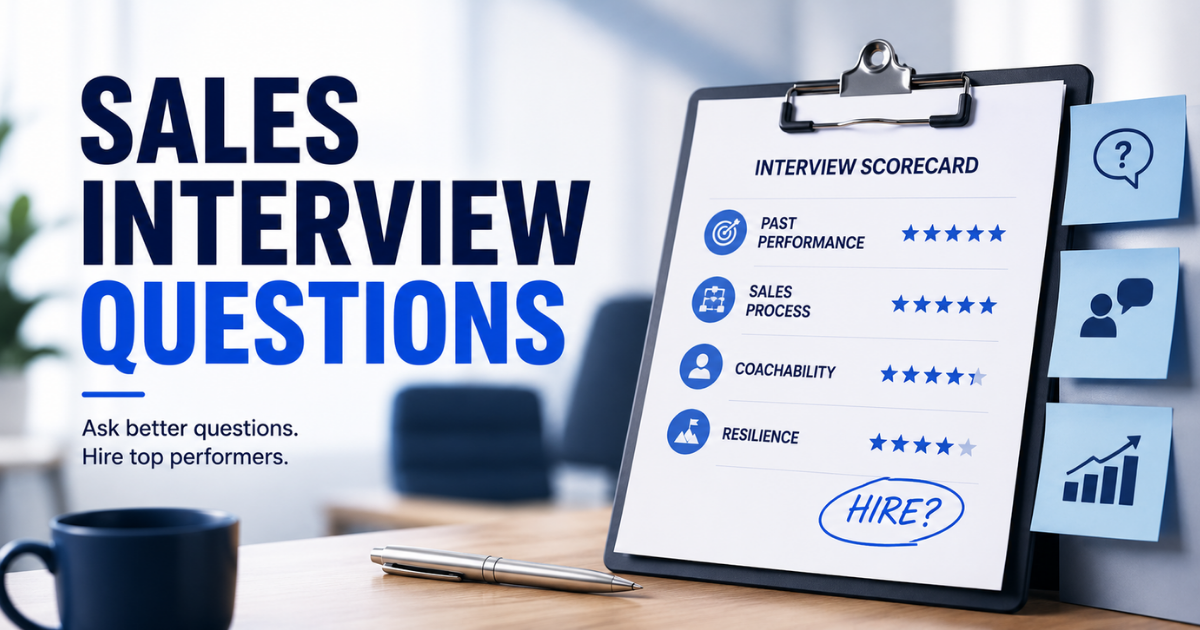
The questions that separate real producers from professional interviewees are behavioral and specific: not "tell me about yourself," but "walk me through the last deal you lost and what you'd do differently." Structured interviews outperform unstructured conversations by roughly 34% in predictive validity (Schmidt & Hunter, 1998). Every question in this article maps to a competency you can score.
Key Takeaways
- Structured interviews are 34% more predictive of job performance than unstructured conversations
- Top performers know their numbers cold, ask for specifics, not stories
- A failed sales hire costs up to 70% of their annual quota (SHRM)
- Work samples (mock pitches, role plays) predict 29% of future job performance
- Only 28% of sales reps hit their annual quota (Salesforce State of Sales 2025), and hiring precision matters more than hiring speed
Why Most Sales Interview Questions Don't Work
Unstructured interviews are essentially a 45-minute first impression. The candidate who's best at telling stories wins, not the candidate who's best at selling.
The fix is two things: structured questions (same questions, same order, scored on a rubric) and competency mapping (every question tied to a skill the role actually requires).
Before writing your list of questions, define the three to four competencies that actually predict success in your specific role. For most SMB sales roles, these are:
- Past performance: can they prove they've hit quota?
- Sales process: Do they have a repeatable system?
- Coachability: will they improve, or resist feedback?
- Resilience: how do they handle rejection and losing deals?
Everything below is organized by competency.
Question Map by Competency
Use the same questions in the same order for every candidate — score on a shared rubric before discussing as a group
Past Performance
Did they actually drive results?
- Walk me through your quota and attainment for the past three years
- Where did you rank among your peers in your last role?
- Tell me about your biggest deal — size, cycle, what you personally did
Sales Process
Do they have a repeatable system?
- How do you decide which accounts to prioritize at the start of a quarter?
- Describe a deal you lost. What happened and what would you do differently?
- What does your prospecting process look like on a typical Tuesday?
Coachability
Will they improve or resist feedback?
- Tell me about a time your manager gave you critical feedback. What changed?
- What are you actively working to improve about your selling right now?
Resilience
How do they handle rejection and loss?
- What's the longest you've gone without a closed deal, and how did you handle it?
- Tell me about a time you lost a deal you thought was won. What happened next?
Questions That Surface Past Performance
These questions expose whether a candidate actually drove results or just worked somewhere that had good results. The difference matters.
"Walk me through your quota for the past three years and your attainment against it."
This is non-negotiable as a first question. Anyone who's been hitting quota knows their number. Anyone who struggles to recall it probably wasn't.
Listen for:
- Specific percentages ("I was at 112% in 2024, 97% in 2023")
- Context that explains dips ("We lost our top account in Q2; I was still 94%")
- Ownership language vs. blame language
Red flag: Vague answers like "I was doing well" or "the territory was tough."
"Where did you rank among your peers in your last role?"
According to SHRM, high-performing salespeople typically track their competitive standing. They know if they're first, fifth, or at the bottom. This question also cross-validates their quota claim.
If someone says they were "always top 10%" but the comp plan never paid out accelerators, the story doesn't hold.
"Tell me about your biggest deal. What was the size, the cycle length, and what did you personally do to close it?"
This separates candidates who closed deals from those who were part of a team that closed deals. You're looking for specific actions, specific stakeholders, and specific objections handled.
Generic: "We worked together as a team and eventually got the contract signed." Real: "I identified the economic buyer on LinkedIn two weeks in, got a direct meeting, and rebuilt the business case to focus on their compliance risk rather than cost savings."
Questions That Reveal Sales Process
Top performers have a system. They can tell you how they prospect, how they qualify, how they advance deals, and when they walk away.
"How do you decide which accounts to prioritize at the start of a quarter?"
This tests whether they manage time strategically or react to whatever lands in their inbox. Good answers reference criteria: deal size, likelihood to close, strategic value, or stage in the cycle.
Weak answers: "I try to work on everything" or "My manager assigns them."
"Describe a deal you lost. What happened, and what would you do differently?"
Two things come out of this. First, do they lose deals? Everyone does; if they say they've never lost one, they're lying or they've never been in a competitive situation. Second, do they analyze losses or rationalize them?
A coachable rep says, "I qualified too late and brought in our VP after the competitor had already locked up the economic buyer. I'd have mapped the org chart in week one now."
A bad hire says: "The prospect just didn't understand the value."
"What does your prospecting process look like on a typical Tuesday?"
Most candidates have no answer because they've never had a systematic approach to prospecting. The ones who do will describe specific blocks, specific channels (cold email cadence, LinkedIn outreach, referral asks), and specific metrics they track (how many touches, response rates, pipeline generated per week).
Questions That Measure Coachability
Sales teams that grow require reps who improve. This is the most underrated competency in sales hiring.
"Tell me about a time your manager gave you critical feedback. How did you respond, and what changed?"
Coachable reps remember specific feedback instances and can describe concrete changes they made. Defensive reps either can't recall feedback (they didn't take it seriously) or frame the manager as wrong.
Score on: specificity of feedback described, willingness to own the gap, measurable change that resulted.
"What are you actively working to improve about your selling right now?"
This is a self-awareness probe. Excellent answer: something specific, with a plan. Red flag: "I'm always learning" with nothing concrete. Double red flag: "I don't think I have major gaps right now."
High performers are 3.2x more likely to participate in a sales community outside their company compared to underperformers (Salesforce State of Sales 2025). They're investing in their own growth.
Questions That Test Resilience
Sales roles at SMBs carry high rejection rates. You need people who process "no" productively.
"What's the longest you've gone without a closed deal, and how did you handle that stretch?"
Everyone hits a cold streak. The resilient rep describes what they did to diagnose the problem and break out of it. The fragile rep either hasn't had a cold streak (inexperience) or became visibly demoralised, describing it.
"Tell me about a time you lost a deal you thought was won. What happened next?"
Listen for emotion regulation. The rep who lost a deal should feel something; a completely flat response is also a red flag, but they should move to action quickly. Wallowing, blaming the buyer, or blaming internal teams are warning signs.
The Role-Play Question (Non-Negotiable)
No question-only interview is complete for sales. You must see them sell. A work sample test, like a mock pitch or cold call scenario, predicts 29% of future job performance, more than most interview questions alone.
The simplest format: Give them a one-page overview of your product and five minutes to prepare. Then have them open a cold call to you as the buyer. You're not assessing polish, you're assessing whether they listen, ask questions before pitching, and handle the first objection without folding.
How to Score Answers Consistently
The questions above are only as useful as your scoring system. Without a rubric, every interviewer scores differently based on gut feel, which defeats the purpose of structured interviewing.
Interview Scoring Rubric
Score every candidate on the same 4-point scale per competency — prevents gut-feel decisions from overriding structured evaluation
1
No evidence
Candidate could not demonstrate this competency in any meaningful way
Example: "I was doing well, around quota" — no specifics
2
Some evidence, vague
Evidence exists but is inconsistent or lacks specifics under follow-up
Example: knows attainment % but can't describe the deals behind it
3
Clear evidence
Specific examples with context; holds up under two or more follow-up probes
Example: quota, attainment, peer rank, and the accounts that drove it
4
Strong evidence
Examples with context, measurable outcomes, and insight about why it worked
Example: rebuilt business case mid-deal, explains the stakeholder logic
Map every question to one of these four competencies
Past performance
Has this person proven they can hit quota?
Sales process
Do they have a repeatable, describable system?
Coachability
Will they improve, or resist feedback?
Resilience
How do they handle rejection and losing deals?
Questions to Avoid
"Where do you see yourself in five years?" Doesn't predict sales performance. Predicts how well they've memorized interview coaching.
"Why do you want to work in sales?" You'll get the same three answers from every candidate.
"What's your greatest weakness?" If you ask the standard phrasing, you'll get the standard rehearsed answer. Ask about specific feedback from a manager instead, same information, harder to fake.
"Tell me about a time you worked in a team." Sales is ultimately an individual sport. You need to know what they personally did, not how their team performed.
Frequently Asked Questions
How many interview questions should you ask a sales candidate?
For a 45-minute interview, 6–8 substantive questions are enough. More than that, and you're either rushing through answers or asking surface-level questions. Depth over breadth, one great follow-up on a behavioral question surfaces more than three shallow ones.
Should you ask every sales candidate the same questions?
Yes. This is the core principle of structured interviewing. When every candidate answers the same questions in the same order, you can compare them using a consistent rubric rather than impressions. It also reduces legal exposure around claims of inconsistent treatment.
What's the best first question for a sales interview?
Start with quota and attainment. It immediately establishes whether you're dealing with someone who thinks in numbers or someone who works in generalities, and it sets the tone for a performance-focused conversation.
How do you evaluate answers when a candidate is new to sales?
If you're hiring for an entry-level role (SDR, BDR), substitute quota attainment questions with: competitive examples from school, sports, or other jobs; prospecting and outreach exercises; and evidence of grit and resilience under rejection. The competency framework still applies; you're just sourcing evidence from different contexts.
What to Do After the Interview
Document scores immediately, memory decays fast, and recency bias distorts recall. Use a shared scoring sheet so every interviewer submits scores independently before discussing the candidate as a group.
Then compare notes. Where there's strong disagreement between interviewers, go back to the transcript or notes, and don't let the loudest voice in the room win.
For teams receiving more applications than a recruiter can realistically phone-screen, the bottleneck is the qualification layer before these questions ever get asked. Zyverno handles that layer, so the structured interview process described above begins with candidates who have already met the basic criteria.
Related articles
The Holiday Hiring Horror Story
Discover how Zyverno can streamline your holiday hiring process, ensuring you don't lose top candidates during peak times.
salesAI recruitment is only for tech roles?
Discover how AI recruitment helps streamline hiring for all roles, not just tech. Improve efficiency and decision-making with Zyverno.
salesWhere candidate experience starts
Improve your candidate experience from the job ad to interview. Discover tips to streamline hiring and engage applicants effectively.