
How to Assess Sales Skills in an Interview Without Getting Fooled
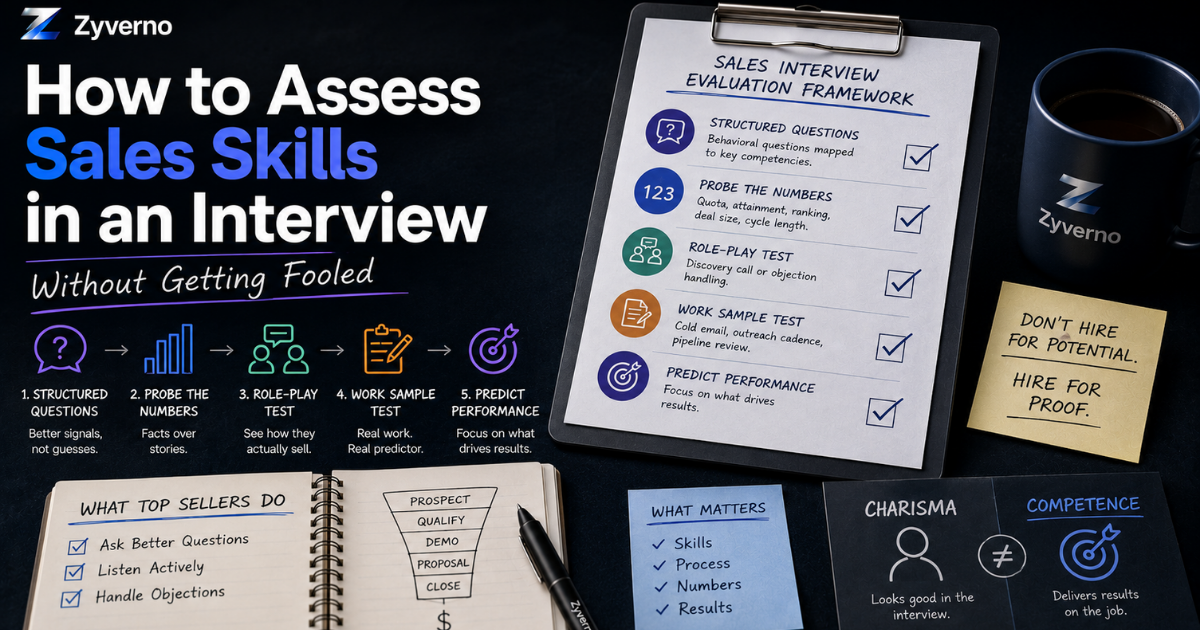
Sales candidates are better at being interviewed than most hiring managers are at interviewing them. The skills that close deals also close offers. To assess actual sales capability, run a process that combines structured behavioral questions, a role-play, and work history that requires numbers and process, not just narrative. Here's how to build it.
Key Takeaways
- 69% of sales reps missed quota in 2025; the hiring filter is broken at most companies
- Personality tests predict sales performance at r ≈ 0.07–0.10, which is statistically trivial
- Work samples (mock calls, written prospecting) are the best single predictor of future job performance (Harvard Business Review)
- Cognitive ability and process mastery are stronger predictors than personality or charm
- A mis-hire at the sales rep level costs approximately 30% of their annual salary (U.S. Department of Labor)
Why Sales Interviews Fail to Predict Performance
The core problem: interviews measure social performance, not sales performance. Salespeople are specifically trained to be persuasive, confident, and likable. Those traits help in the interview but don't predict whether someone will prospect consistently, handle a tough discovery call, or close a deal six months in.
Three interview failure modes:
1. The halo effect: a candidate is well-dressed, makes good eye contact, and tells a compelling story. You score them high across all dimensions, even though none of those signals predict quota attainment.
2. Confirmation bias. You form an impression in the first few minutes and spend the rest of the interview looking for evidence that confirms it. Research on structured vs. unstructured interviews shows that this is the default in unstructured conversations.
3. Confusing charisma with competency: high-energy, assertive candidates feel like salespeople. But energy and assertion are not the same as systematic prospecting, consultative questioning, or disciplined pipeline management.
Step 1: Define the Competencies You're Actually Testing
Before you run a single interview, define three to five competencies the role truly requires. Focus on specific, observable behaviors, not vague personality traits.
For most small and medium-sized business sales roles, you're typically assessing:
- Pipeline generation: builds consistent outbound; knows their prospecting metrics
- Discovery: asks before pitching; diagnoses problems before prescribing solutions
- Quota management: tracks attainment precisely; adjusts approach mid-quarter
- Coachability: can describe specific feedback received and changes made
- Resilience: processes rejection without derailing; analyzes losses
Step 2: Use a Structured Question Set for Each Competency
Every candidate gets the same questions in the same order. Interviewers score answers against a consistent rubric before debriefing together.
This isn't about being robotic; it's about ensuring you're comparing apples to apples. When Interviewer A asks open-ended questions, and Interviewer B digs into process detail, they end up evaluating different things.
Scoring rubric (per competency):
- 1: No evidence
- 2: Vague evidence; mostly general statements
- 3: Clear evidence with a specific example
- 4: Specific example + context + measurable outcome
Step 3: Probe the Numbers Relentlessly
This is the fastest way to separate real performance from storytelling.
Top performers know their numbers. They can tell you:
- Their quota for the last 2–3 years
- Their attainment percentage per year
- Where they ranked among peers
- Their average deal size and cycle length
- How many pipeline stage conversions did they need to hit their number
Anyone who struggles to recall these details probably wasn't driving the results. Strong salespeople track performance the same way athletes track stats. Obsessively.
Probing sequence for a past performance claim:
- "What was your quota that year?"
- "What was your attainment?"
- "Where did you rank among your peers?"
- "What accounts or deals made up the bulk of that attainment?"
- "What did you specifically do to close those deals? Not the team. You."
Each follow-up narrows the claim. Vague answers at step 3 or 4 are a signal to discount the original claim.
Step 4: Run a Work Sample Test
Work samples are the best single predictor of future job performance according to meta-analytic research, and they're underused in sales hiring.
A work sample for sales doesn't have to be elaborate. Options by role:
For sales development representatives and business development representatives:
- Write a cold email to a fictional prospect (product brief provided)
- Build a 5-step outreach cadence with rationale
- Handle a cold call objection out loud
For account executives:
- Run a 15-minute discovery call with the interviewer playing a prospect
- Prepare and deliver a five-minute pitch on your current product
- Review a fictional deal in the pipeline and explain your next move
For sales managers:
- Review a rep's pipeline and identify where they're getting stuck
- Role-play a coaching conversation about a missed deal
You're not looking for polish. You're looking for:
- Do they ask questions before pitching?
- Do they listen and adjust, or run a script?
- How do they handle an objection or an unexpected response?
- Do they take ownership or externalize problems?
Step 5: Skip the Personality Test (or Use It Correctly)
Personality tests are widely used in sales hiring and are widely misunderstood.
The data is clear: personality traits like extraversion, dominance, and "drive" predict sales performance at r ≈ 0.07–0.10, which is trivially low. Broad personality has almost no relationship with who hits quota. Meta-analyses across 100+ studies confirm this (Sales Collective).
This doesn't mean all assessments are worthless. What actually predicts performance:
- Cognitive ability tests: consistently outperform personality tests for complex roles; predict learning speed, adaptability, and problem-solving
- Achievement orientation measures: narrower than broad personality; 84% of top performers score high here (Salesforce State of Sales)
- Role-specific skills tests: written prospecting, objection handling, pipeline analysis
The right use of assessments: as one data point among several, not as a filter. Never make a hire or no-hire decision on assessment scores alone.
Step 6: Validate Your Process Over Time
Your interview process is only as good as its outcomes. Track this data for every hire:
- Interview score at hire
- Quota attainment at 6 months
- Quota attainment at 12 months
- Ramp time to first deal
After 20–30 hires, run a correlation between interview scores and 12-month attainment. Any accuracy above 60% is meaningful and improves with scale. If you're below 50%, your scoring rubric or question set needs revision.
This feedback loop is the difference between a hiring process that improves and one that repeats the same mistakes.
What Doesn't Work
Gut feel: Research consistently shows that early impressions dominate unstructured interviews, forming long before interviewers have enough information to evaluate whether someone can consistently prospect, run discovery, and close.
Long interview loops: Research from Google's People Analytics team found that after four interviews, additional rounds change the hiring decision less than 1% of the time. Beyond four, you're spending time, not gaining information.
Asking about strengths and weaknesses: Rehearsed answers. You'll hear "I work too hard" or "I care too much" from candidates who've done their interview prep. Ask about specific manager feedback instead.
Prioritizing culture fit over competency: Culture fit is often a proxy for familiarity, which introduces bias. Hire for competency first, then evaluate for additive culture contribution (not similarity to your current team).
Frequently Asked Questions
What's the most common mistake when assessing sales candidates?
Confusing a good interview with sales ability. The interview process rewards persuasion and rapport, which are sales skills, but not the most important ones. Process discipline, pipeline management, and resilience are harder to fake and better predictors of sustained performance.
Should you use a skills assessment test before the first interview?
Yes, for high-volume roles (sales development representative, business development representative, inside sales). A written outreach sample or short objection-handling exercise before the first live interview eliminates candidates who can't execute the core job task and reduces the cost of your first round.
How do you assess sales skills in someone new to sales?
Look for transfer competencies: competitive achievement in other areas, systematic approach to a difficult task, ability to handle rejection. Ask about cold outreach exercises, how they've persuaded someone resistant to their idea, or how they've tracked their own performance in a previous job or sport.
Is role-play required for every sales interview?
For any quota-carrying role: yes. The behavioral interview alone isn't sufficient. You need to see how they sell in a low-stakes environment. A 10-minute mock call is not a high bar; if a candidate can't run a basic discovery conversation, they won't be able to do it with a real prospect.
Related articles
The Holiday Hiring Horror Story
Discover how Zyverno can streamline your holiday hiring process, ensuring you don't lose top candidates during peak times.
salesAI recruitment is only for tech roles?
Discover how AI recruitment helps streamline hiring for all roles, not just tech. Improve efficiency and decision-making with Zyverno.
salesWhere candidate experience starts
Improve your candidate experience from the job ad to interview. Discover tips to streamline hiring and engage applicants effectively.