
How to Build a Sales Team from Scratch: Roles, Sequence, and Timing
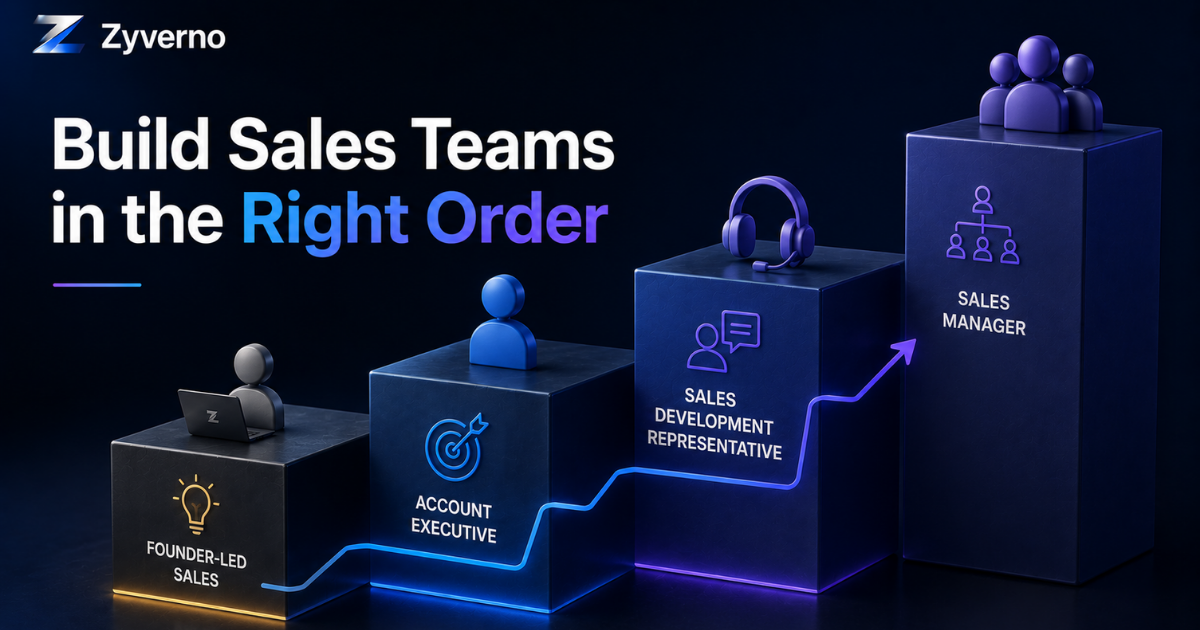
Build a sales team in the right sequence (account executive before sales development representative, manager after 5–7 reps, not before), and each hire multiplies the one before it. Add headcount to a process that isn't working yet, and you get a bigger version of the same problem. This guide covers the sequencing logic for each phase and what needs to be in place before each step makes sense.
Key Takeaways
- Sequence before headcount: The order of hires matters more than the speed of hiring: account executive before sales development representative, manager after 5–7 reps, not before
- Founder-led sales is not optional: Before building a team, the founder must prove the motion works; this is the prerequisite, not the first step.
- The sales development representative is not the first hire: A sales development representative without an account executive to hand off to creates a pipeline with no one to close it.
- Manager timing is a common error: Hiring a manager before you have 5+ productive reps means you're managing a manager instead of scaling a process.
- Infrastructure before headcount: A customer relationship management system, onboarding documentation, and a clear ideal customer profile definition should precede every new hire; reps fail without these.
- Quality over velocity: Each wrong hire costs 6–12 months of ramp time and $100,000–$200,000 in total cost; pace hiring to maintain quality
Phase 0: Founder-Led Sales
Before any sales hire, the founder needs to prove the sales motion themselves.
This means closing deals, not facilitated by investor introductions or warm referrals, but through repeatable discovery, demonstration, and closing conversations with customers who match the ideal customer profile.
The output of Phase 0 is not a revenue number. It's knowledge:
- What the ideal customer profile actually looks like (not the hypothesis, the reality)
- What objections come up, and which framings resolve them
- What the average cycle length is and what causes it to extend
- What a qualified vs. unqualified opportunity looks like in practice
- Which channels produce a qualified pipeline
Without this, you can't onboard a rep, can't coach them when they struggle, and can't distinguish between "rep isn't working" and "motion isn't working." The first sales hire inherits whatever knowledge the founder has built. If that knowledge base is thin, the hire is set up to fail.
The minimum bar for Phase 0 completion: 10–20 closed deals, a documentable sales process, and a clear answer to "why do customers buy?"
Phase 1: The First Account Executive
The first sales hire is an account executive, someone who can run the full sales cycle from qualified lead to close.
Not a sales development representative. A sales development representative generates a pipeline. An account executive closes it. At the early stage, pipeline generation is still primarily the founder's job or driven by inbound and content channels. Adding a sales development representative before an account executive means you're generating more qualified leads with no one to close them.
What this person needs to be able to do
- Take a qualified opportunity through discovery, demo, objection handling, and close without you in the room.
- Operate without brand recognition, full feature parity, or a mature product story.
- Build their own qualification criteria from the rough ideal customer profile you hand them.
- Develop their own objection responses by listening to customer language, not relying on a deck
When to make this hire
- You are closing deals consistently, but physically can't handle every qualified conversation.
- You have a documented (even rough) sales process that can be handed over
- You have 2–3 customer case studies that can be used as social proof
- Your close rate on qualified conversations is above 20%
What needs to be in place before they start
- A customer relationship management system configured for your deal stages
- Written onboarding documentation: ideal customer profile, objections and responses, deal stages, customer stories
- A defined quota with a clear ramp period (Q1 at 50% quota, Q2 at 75%, full quota in Q3 is a common structure)
The single biggest cause of first account executive failure is launching them without this infrastructure. They spend the first 60 days building it themselves rather than selling.
Phase 2: The Second Account Executive
Add the second account executive when the first is consistently at or above quota for two consecutive quarters, not before.
Adding a second rep to solve the first rep's underperformance is a common mistake. If Rep 1 is struggling, the most likely cause is a process problem or a fit problem. Adding Rep 2 to the same process produces the same result and doubles your cost.
When the first rep is genuinely at capacity, and you have more qualified demand than they can handle, add a second. By this point, you also have proof: the motion works, the onboarding works, and the quota is calibrated. Rep 2 ramps significantly faster than Rep 1 did because there's a real playbook to inherit.
Territory and coverage decisions
For two account executives, you need to decide on a territory structure:
- Named accounts: Each rep owns a defined account list
- Geographic split: Each rep owns a defined region
- Segment split: One rep owns small and medium-sized businesses, one owns mid-market
- Pure round-robin: Leads assigned by availability, no territory ownership
Named account or segment-based structures produce cleaner accountability than round-robin at this scale. Whatever structure you choose, make it explicit before the second rep starts. Territory ambiguity causes friction between reps and the manager, and time is spent arbitrating.
Phase 3: Adding Sales Development Representatives
Sales development representatives make sense when:
- You have at least 2 account executives who are at quota capacity from inbound or founder-sourced pipeline
- You've identified a specific outbound motion that generates qualified opportunities, not just a hypothesis that cold outreach should work.
- You can provide the sales development representative with a clear ideal customer profile, a qualified list, and a cadence that has some proof of concept.
The sales development representative to account executive ratio at this stage is typically 1:2, one sales development representative supporting two account executives. As the team grows, the ratio varies by product and deal complexity: simpler, transactional products can run 1:1; complex enterprise deals often run 1:3 or 1:4.
What sales development representatives are not
Sales development representatives are not a cheaper version of an account executive, and they are not a solution to an account executive pipeline problem. If your account executives don't have enough qualified pipeline, the answer might be sales development representatives, or it might be that the market isn't there, the ideal customer profile is wrong, or the product hasn't found a fit. Adding sales development representatives to an unclear motion burns headcount.
Phase 4: The First Sales Manager
The first sales manager hire is one of the most common sequencing mistakes in sales team building. Companies hire a manager too early, when they have 2–3 reps and a process that's still being invented.
The right timing: 5–7 productive reps is the threshold. Below that, the manager's time is spent on tasks the founder can still handle, and you've added a management layer without the team density to justify it.
What triggers the hire: You personally can no longer provide quality coaching to each rep. That means weekly one-to-one meetings are getting missed, pipeline reviews are superficial, and you're not catching skill gaps early enough to fix them.
At 5–7 reps, you need someone whose entire job is developing those reps, not someone who also carries their own quota and coaches on the side.
The player-coach trap
The instinct at 3–4 reps is to give one of them a "team lead" title and a small management stipend while keeping their quota. This occasionally works, but more often produces two problems: an individual contributor who's distracted from their number, and reps who aren't getting real management.
If you go this route, cap the player-coach's quota at 50% of a normal account executive's target and be explicit that the role transitions to full-time management at 5+ reports.
Phase 5: Scaling Beyond the First Team
Once you have a functioning pod (5–7 reps plus a manager), the scaling question becomes: do you add to this pod or build a second one?
Add to the current pod when: the manager has capacity, the process is working, and the new reps will be working the same segment and territory.
Build a second pod when: you're expanding into a new segment or geography that requires a different motion, or the current pod is at 8+ reps and would exceed a healthy management span.
Each new pod needs the same infrastructure as the first one had: documented process, customer relationship management system configuration, a clear ideal customer profile, and onboarding documentation. Don't assume the second pod can inherit from the first without translation.
Frequently Asked Questions
How many reps before you need a Vice President of Sales?
A Vice President of Sales is typically justified at 8–15 reps when you also need someone who can recruit, build a process, and interface with the executive team on the go-to-market strategy. Before that point, a sales manager with strong execution skills is usually the right investment. The Vice President title is often hired too early at the expense of front-line management quality.
Should you hire two reps at the same time for redundancy?
Only if you can onboard both properly. Hiring two reps simultaneously when you haven't fully developed the onboarding process guarantees both will underperform. Hire sequentially when onboarding is still being built; hire in pairs once the playbook is proven and your management capacity can handle it.
What does a healthy team look like at 12 months?
At 12 months from your first account executive hire, that rep is at full quota, you have at least one other account executive ramping, and you have a documented playbook that a new hire can actually follow. If you're still at one rep and the playbook is still in your head, the first year was building, not scaling.
How do you know if underperformance is a rep problem or a process problem?
If one rep is underperforming, it's likely a rep problem. If two or more reps are underperforming on the same metrics in the same way, it's almost always a process or ideal customer profile problem. The diagnosis is whether the pattern is individual or systemic.
Related articles
The CV Graveyard
Stop starting from zero. Use Zyverno to match past applicants to new roles based on skills and experience. Reengage your existing talent pool effectively today.
salesThe Holiday Hiring Horror Story
Discover how Zyverno can streamline your holiday hiring process, ensuring you don't lose top candidates during peak times.
salesAI recruitment is only for tech roles?
Discover how AI recruitment helps streamline hiring for all roles, not just tech. Improve efficiency and decision-making with Zyverno.