
How to Hire a Sales Manager: The Traits That Predict Team Performance
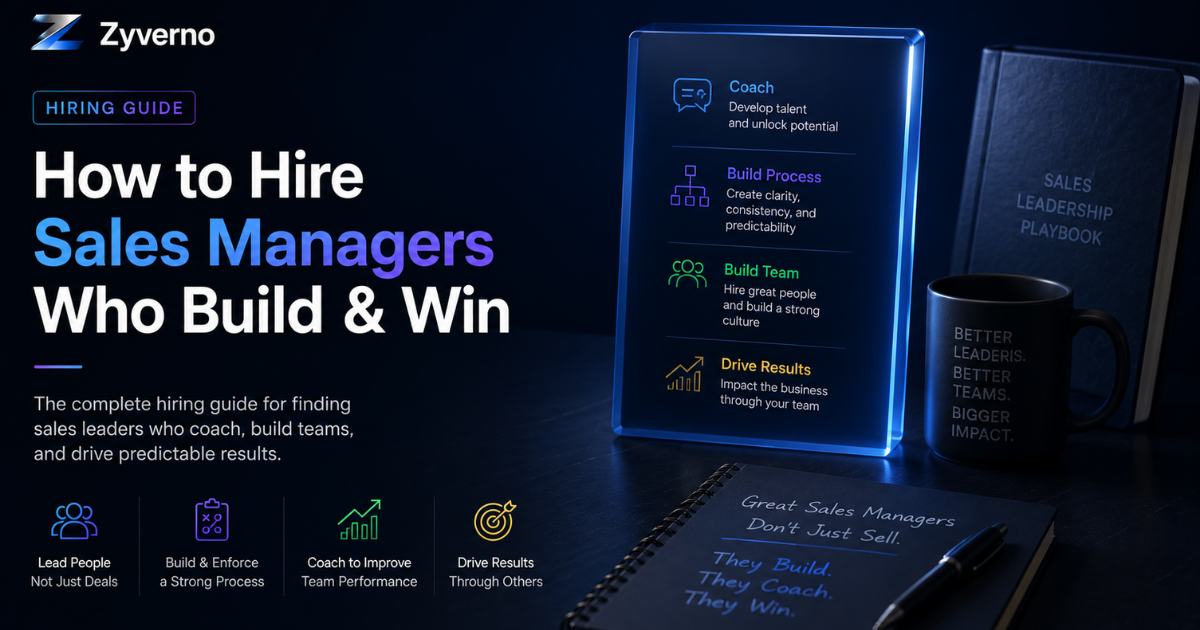
Sales management is a distinct job from selling. The traits that make a rep effective are often irrelevant or counterproductive in a role that requires coaching others, running processes, and finding satisfaction in someone else's results. This guide covers the traits that actually predict team performance and how to evaluate for them before making the hire.
Key Takeaways
- Top performer ≠ management potential: Research consistently shows individual sales performance is weakly correlated with management effectiveness; the predictive traits are different
- Coaching is the job: Sales managers who hold structured, consistent 1:1s see 19% lower voluntary turnover on their teams, and it's the highest-leverage activity in the role.
- Promote-from-within has a real cost: Promoting a rep to manager removes your quota coverage without a guarantee of management output; the break-even period is typically 12–18 months.
- The player-coach trap: Giving a manager a quota alongside management responsibilities guarantees they underperform at both; pick one or structure the split very deliberately
- Assess process before personality: The best predictor of management effectiveness is whether the candidate can describe, build, and enforce a repeatable sales process, not whether they're charismatic.
The Fundamental Mistake: Promoting the Best Rep
Fewer than 30% of top individual contributors become effective managers (Harvard Business Review, 2012). The number hasn't changed materially in the decade since, because the root cause is structural, not circumstantial.
Here's why it happens. A top-performing rep has visible, measurable output. When a management role opens, they're the obvious candidate. Leadership knows their name, trusts their judgment, and has proof of their results. The promotion feels low-risk.
But the skills being rewarded are wrong for the new role:
- A great rep is self-motivated; a manager needs to motivate others
- A great rep is independently productive; a manager needs to multiply others' productivity
- A great rep competes with their peers; a manager needs to build their peers up
- A great rep closes their own deals; a manager coaches someone else through theirs
The rep who finds it hardest to resist jumping on a call and taking over is often the highest performer. That behavior ends careers in management.
What Sales Management Actually Requires
The job breaks into three primary functions:
1. Coaching and development
This is where variance in team performance comes from. A manager who runs structured weekly 1:1s focused on deals, calls, and skill gaps (not just pipeline updates) produces significantly better team retention and performance than a manager who treats 1:1s as check-in conversations.
Teams with managers maintaining 85%+ weekly 1:1 completion see 19% lower voluntary turnover and measurably better quota attainment across the team. The mechanism: reps who feel coached stay, develop faster, and hit quota at higher rates.
The candidate who will deliver on this can describe specific moments where they coached a rep through a problem, not deals they closed themselves.
2. Process discipline
Top-performing sales teams don't win because their reps are more talented. They win because deals move through a consistent, well-defined process that catches problems early.
A sales manager's job is to build and enforce that process: qualification criteria, stage-exit requirements, forecast discipline, and activity metrics. The manager who lets reps define their own process produces unpredictable outcomes and can't diagnose why performance varies.
3. Recruiting and team building
Sales managers own the quality of the team they build over time. They should be actively involved in hiring: reviewing pipelines, conducting interviews, and raising the bar on who gets in. A manager who treats recruiting as someone else's job will inherit headcount they didn't choose and can't be accountable for.
When to Hire from Within vs. Outside
Neither is universally correct. The decision depends on what you have and what you need.
Promote from within when:
- You have a rep with demonstrated coaching instincts; they already informally mentor peers, they give feedback on calls voluntarily, they think about the process, not just their own results
- Your team is established, and continuity matters more than new methodology
- The rep being considered has explicitly expressed interest in management and has been developing toward it
Hire externally when:
- You need to install a new process or methodology that the team hasn't used
- No current rep has clear management potential or interest
- The team needs a culture reset, and internal promotions would be politically complicated
- You're scaling quickly and need someone who has managed teams before
The risk of external hiring: the new manager doesn't know the product, the customers, or the reps. They need 90–120 days before they're fully effective. Budget for that ramp.
How to Assess Management Potential in an Interview
The interview for a sales manager should look different from an interview for an AE. The questions need to surface coaching ability, process thinking, and team orientation, not closing instincts.
Coaching ability questions
"Walk me through a time you helped a struggling rep turn around their performance. What specifically did you do?"
Listen for: concrete actions (listened to calls, identified the specific skill gap, ran targeted practice sessions), a timeline, and a result. Vague answers ("I really invested in them, coached them up, they started doing better") don't tell you what the manager actually did.
"Tell me about a rep you've managed who you ultimately concluded wasn't going to make it. How did you handle it?"
Effective managers can describe both investing in the rep and making the call when it wasn't working. Managers who have never had to manage someone out either haven't managed long or have avoided the hardest part of the job.
Process questions
"Describe the sales process your team runs. How did it get built, and what do you enforce consistently?"
A strong answer describes specific stages, exit criteria, and what happens when reps skip steps. A weak answer describes what the company's CRM is configured to track, without evidence that the manager drove that structure.
"How do you distinguish between a pipeline problem and a rep skill problem when you're reviewing the team's forecast?"
This separates managers who manage from reports from managers who understand the underlying causes of performance variance.
Team-building questions
"What's your current team's biggest skill gap, and what are you doing about it?"
A sales manager who can't articulate the specific development areas of each rep on their team isn't spending enough time on individual development.
The Player-Coach Problem
Many early-stage companies hire a "player-coach," a manager who also carries a personal quota. This structure rarely works as designed.
The problem is time allocation. A manager with five reports and a personal quota faces a constant conflict: their number incentivizes them to prioritize their own deals, while their team's numbers require them to prioritize coaching and pipeline review. In practice, the team loses.
If you need a player-coach because headcount is constrained:
- Make the quota expectation modest (30–50% of a normal AE quota) and account for the management load in the comp plan
- Be explicit that the role transitions to full-time management as the team grows past 5 reps
- Track coaching activity (1:1 completion, call reviews, deal coaching sessions) as a performance metric alongside their personal number
The player-coach who prioritizes their personal number over the team isn't failing; they're responding to the incentive structure you set. Design the structure to produce the behavior you want.
Compensation for Sales Managers
Sales managers are typically compensated on a mix of base salary and a team-based variable:
- Base: Higher than the reps they manage, typically $90,000–$130,000+, depending on market and team size
- Team variable: A percentage of the team's total attainment above threshold, typically structured so the manager earns meaningfully more when the team hits OTE collectively
- Individual quota (if player-coach): Sized down relative to a full-time AE; should not dominate the total comp
Avoid tying the manager's variable entirely to a single rep's performance. It creates perverse incentives around whose deals they spend time on.
Setting Up a New Sales Manager to Succeed
The most common cause of sales manager failure is insufficient onboarding. A new manager, especially one promoted from within, often gets a brief "congratulations" and is expected to figure out the rest.
Before they start, define:
- What the team's current performance looks like (individual rep data, not just totals)
- What is the manager's authority on comp plan changes, rep exits, and hiring
- What "good" looks like at 30, 60, and 90 days
- Who their manager is and how often they'll receive coaching themselves
A manager who doesn't know what decisions they can make will either overstep or understep. Both cause problems. Clarity on scope is as important as clarity on goals.
Frequently Asked Questions
How do you know when it's time to hire a first sales manager?
When you have 5–7 reps who need consistent coaching and pipeline management that you, as a leader, can no longer provide with quality. The rule of thumb is one manager per 6–8 reps. Below 5 reps, a strong team lead structure can work.
Should a sales manager have closed deals recently?
Yes, with nuance. A manager who hasn't sold in 10 years will struggle to coach modern buyers and methods. But a manager who closed deals recently at a completely different type of company may have limited transferable credibility. Look for someone who can speak credibly about the type of selling your team does.
What if your best internal candidate doesn't want to be a manager?
That's useful information. Some top performers know themselves well enough to know they're wired for individual production, not team development. Respect that and build a technical track or senior IC title that gives them a growth path without forcing them into management.
How long should it take for a new sales manager to show results?
Expect 90 days before they're fully integrated and making coaching decisions with confidence. Expect 6 months before you can clearly attribute team performance changes to their impact. Evaluate them at 90 days on process and relationship signals, not yet on numbers.
Related articles
The CV Graveyard
Stop starting from zero. Use Zyverno to match past applicants to new roles based on skills and experience. Reengage your existing talent pool effectively today.
salesThe Holiday Hiring Horror Story
Discover how Zyverno can streamline your holiday hiring process, ensuring you don't lose top candidates during peak times.
salesAI recruitment is only for tech roles?
Discover how AI recruitment helps streamline hiring for all roles, not just tech. Improve efficiency and decision-making with Zyverno.