
How to Hire Account Executives: What to Look For and Where to Find Them
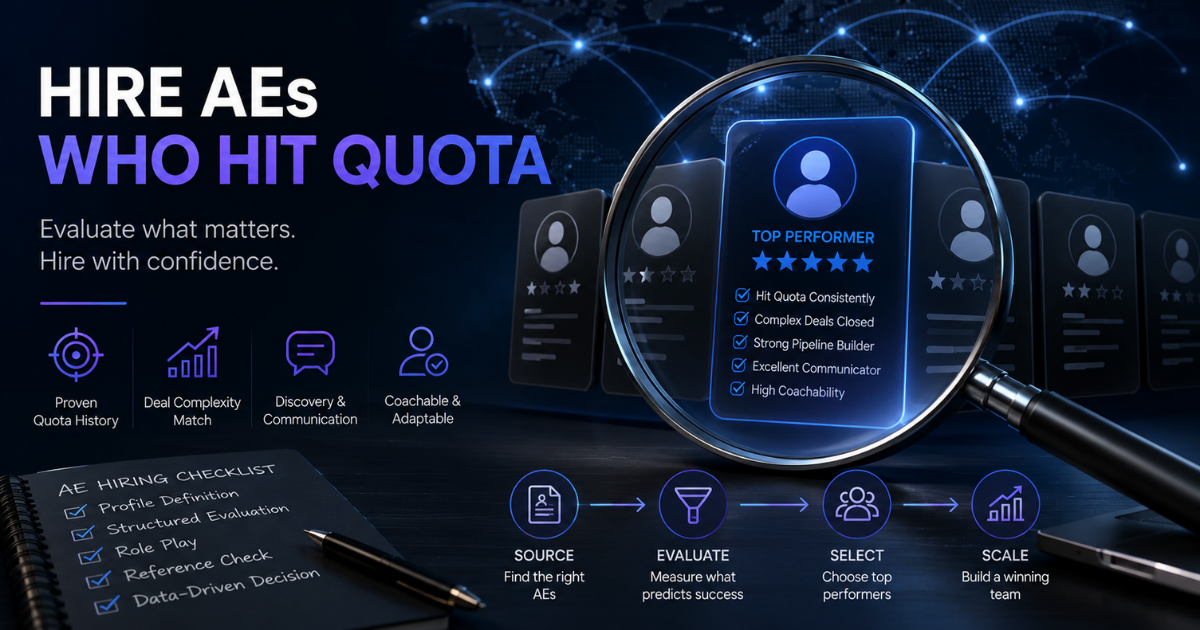
Only 51% of Account Executives hit quota (Bridge Group, 2024), and a significant share of that gap comes down to profile mismatch: hiring for the wrong motion, deal complexity, or ICP. This guide covers the competencies that actually predict quota attainment, how to evaluate them through a structured process, and the benchmarks for setting expectations.
Key Takeaways
- Average Account Executive ramp time in 2024: 5.7 months, up 32% since 2020.
- Only 51% of Account Executives hit quota: hiring precision matters more than hiring speed.
- Median ACV quota: $800K; median OTE: $190K with a 53:47 base-to-variable split.
- Average AE tenure: 2.8 years: longer than SDRs but still short enough to require deliberate retention.
- AE annual turnover: 30%: Every third Account Executive will need to be replaced in any given year.
Before You Write a Job Description: Define the AE Profile
Account Executive is not a single role. An Account Executive closing $30K SMB deals on a 30-day cycle is a completely different job than an Account Executive closing $300K enterprise contracts on a 6-month cycle. Hiring without this clarity results in candidates who are technically Account Executives but are the wrong fit for your motion.
Answer these before you post:
- What is the average deal size?
- What is the average sales cycle length?
- Is this primarily inbound, outbound, or both?
- How complex is the sale? (Number of stakeholders, technical depth, buying committee size)
- What's the territory structure? (Named accounts vs. geographic vs. segment)
- Is this a hunter, farmer, or hybrid role?
An AE who thrives on velocity (high-volume, short-cycle deals) will often fail in a complex enterprise environment. An enterprise AE used to 6-month deal cycles may not have the activity discipline required for a transactional SMB role. Match the candidate profile to the actual motion.
What to Look For
Quota Attainment History. By Year, By Context
This is the first and most important data point. Ask for the quota and attainment per year for the last three years. Top performers know their numbers and can tell you: the quota, the attainment, the rank among peers, and what the top accounts were.
The context frame matters. 90% attainment during a year when their quota was raised 40% mid-year is more impressive than 110% when territory conditions were favorable. Ask for context, but probe for specifics. Vague answers at follow-up are a signal.
The benchmark: median quota attainment for SaaS AEs in 2024 was below 60%, so 70%+ with legitimate context is competitive. 90%+ across multiple years in comparable roles is strong.
Deal Complexity Matching
An SMB AE who has only ever closed $20K deals may not have the skills to navigate a $250K deal with a five-person buying committee. Verify that the complexity of the deals they've closed matches or exceeds the complexity of your deals.
Probe specifically:
- "Tell me about your largest deal. How many stakeholders? What was your process for managing the buying committee?"
- "How long was your longest active opportunity before close? What drove the timeline?"
Prospecting vs. Relational Skills
Clarify whether your AE role requires outbound prospecting or primarily manages inbound pipeline. Many AEs have only worked inbound and will struggle on a team where they're expected to generate their own pipeline.
Ask directly: "What percentage of your pipeline has historically come from your own outbound efforts versus inbound or SDR-sourced?" Be honest in the job description about what percentage you expect from each source.
Discovery Quality
The AE's ability to run a thorough discovery call is often the strongest predictor of whether they'll close at the right margin. Rushed or perfunctory discovery leads to misaligned proposals, stalled deals, and discounting to close.
Assess through role play: give them a 5-minute overview of your product and a buyer persona. Have them open a discovery call. Watch whether they ask questions before pitching, how deeply they explore pain, and whether they adjust their approach based on your responses.
Coachability. Not Just Experience
An AE who joins with strong experience but can't adjust to your process, your product positioning, or your customer segment is a liability. The best AE hires are coachable; they bring their skills and apply them to your context, rather than expecting your context to adapt to their habits.
Test this directly: "Tell me about a time you changed your approach based on feedback from a manager or a lost deal. What changed and what happened?"
Where to Find AE Candidates
LinkedIn Recruiter sourcing: Search for AE title at companies in your market or adjacent verticals. Filter by tenure (2–4 years in current role = potentially open to a move without being a flight risk). Use "similar to" your current top AEs as a filter.
Your own customers: Some of the best AEs start as buyers. If a contact at one of your customer accounts consistently productively challenges you, understands your product deeply, and demonstrates commercial instincts, they may be an AE in the making.
Referrals from current AEs: Your best AEs know other good AEs. A structured referral program with a meaningful bonus (not just a nominal one) surfaces candidates who've been pre-vetted by people who know what good looks like.
RepVue and Bravado: Both platforms have active communities of salespeople evaluating their career options. AEs on these platforms are often high-performers with enough self-awareness to research the companies they join.
How to Structure the Interview Process
A four-stage process balances thoroughness with candidate experience:
Stage 1: 30-minute phone screen (with recruiter or hiring manager) Goals: Verify quota history, confirm comp alignment, assess communication quality, and preparation. Screen out immediately if they can't recall their own quota numbers. AE roles at actively hiring companies often draw 80 to 150 applicants, and every application that reaches Stage 1 without having passed a structured qualification check is a recruiter call that may not need to happen.
Running an automated pre-screen before Stage 1 (one that verifies deal size range, quota history, and role type fit) means the phone screen confirms rather than discovers whether a candidate is worth the hiring manager's time; Zyverno runs this layer via its AI agent, freeing the recruiter to focus on the candidates who already meet the criteria.
Stage 2: 60-minute structured interview (hiring manager) Goals: Deep behavioral questions on performance, process, and coachability using a structured rubric.
Stage 3: Role play (30 minutes) Goals: Live demonstration of discovery skills. Give them 5 minutes to review your product brief, then have them open a discovery call with you as the buyer. You're evaluating: do they ask before pitching? How do they handle an objection? Can they adapt to your responses?
Stage 4: Final interview + references Goals: Confirm culture alignment, address any open questions from previous stages, verify references (call former managers, not just professional connections). Ask references: "What would you change if you could go back and coach them differently?" You'll learn more from that question than any standard reference check.
Common AE Hiring Mistakes
Hiring for cultural fit over quota fit. A likable candidate who hasn't closed deals at your complexity level will not close them here. Fit matters, but quota attainment history at comparable deal size is the non-negotiable filter.
Inflating the territory in the pitch. AEs are experienced enough to diligence your claim. If they find the territory is weaker than described, they'll leave in 6 months and tell other AEs. Be honest about what they're inheriting and what they'll need to build.
Skipping the role play. More AE hires fail on discovery and deal management than on anything else. If you haven't seen them sell before they start, you're hiring on information that doesn't predict performance.
Setting quota from revenue need instead of productivity math. A quota set at "what we need to hit our ARR target" without accounting for what a single AE can realistically produce in your market drives attrition. Calculate quota from: average deal size × average cycle length × realistic close rate per rep.
Ramp Expectations
Based on the Bridge Group's 2024 benchmarks:
MonthExpected OutputMonth 1–2Full onboarding; product and process mastery; no close expectationMonth 3–4First qualified pipeline; first deal in late stagesMonth 5–6First closed deal; 40–60% of quotaMonth 7+Full ramp; 80–100% of quota on sustainable basis
These benchmarks assume a structured onboarding program. Without structured onboarding, ramp extends by 30–40% and first-year attrition increases significantly.
Frequently Asked Questions
How many years of experience should an AE have?
Match experience to deal with complexity. For SMB AE roles ($30K–$80K deals), 1–3 years of closing experience is enough with the right profile. For enterprise AE roles ($200K+ deals), 4–7 years with demonstrated complex deal navigation is a realistic floor. Experience in the same vertical is a plus, but not required.
Should you hire an AE from a competitor?
With caution. A competitor AE brings market knowledge and a customer network, both valuable. But they may also bring habits tuned to a different product, a different buyer, or a different comp structure that don't translate. Assess competency independently rather than assuming competitive experience is automatically an advantage.
What's a realistic time-to-first-close for a new AE?
5–7 months from start date for a role with a 30–90 day average cycle length. For enterprise roles with 3–6 month cycles, 9–12 months is more realistic. Set expectations internally, a new AE who closes nothing in month four is not necessarily failing; they may be three weeks from closing several deals that started in month two.
How do you evaluate an AE with a gap in employment?
Ask directly and listen to the answer. Career gaps for education, health, caregiving, or company closure are common and neutral. Gaps the candidate is evasive about or inconsistent in explaining deserve more scrutiny; use reference checks to triangulate.