
How to Hire Customer Success Managers Who Drive Expansion Revenue
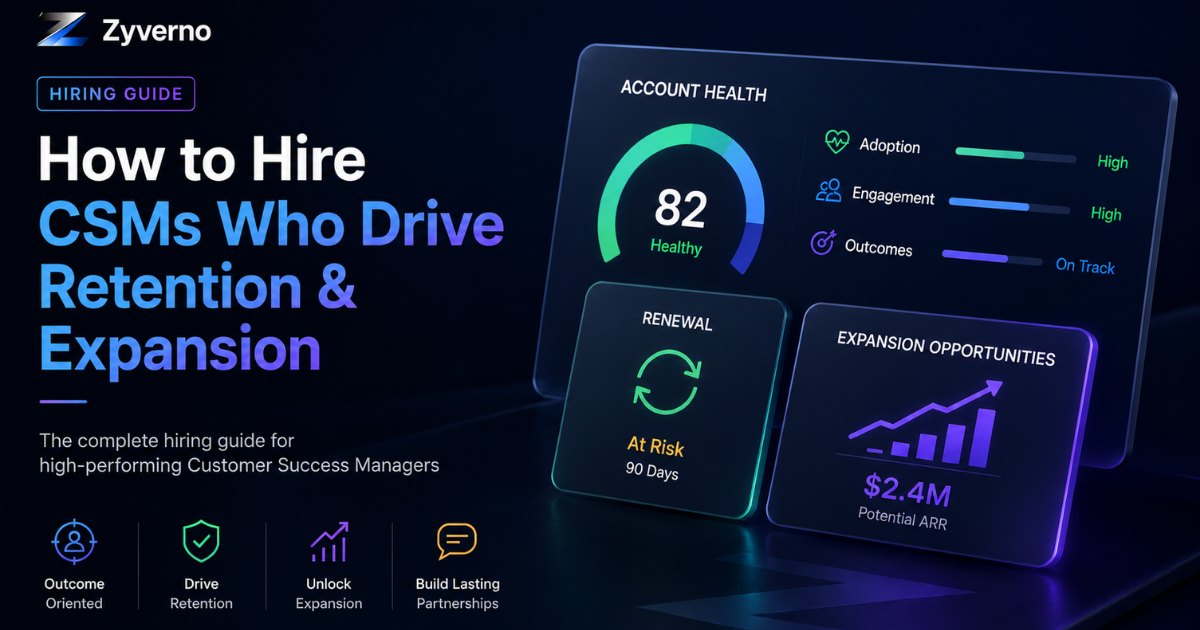
To hire Customer Success Managers who drive retention and expansion, stop evaluating them against AE criteria. The traits that predict CSM performance (outcome orientation, structured account management, willingness to deliver bad news) are different from what closes new business. Here's how to define the profile and evaluate it correctly.
Key Takeaways
- Customer Success Manager performance splits on one variable: whether the rep is oriented toward the customer's outcome or toward relationship maintenance as an end in itself.
- The highest-performing Customer Success Managers run accounts with the same structure that account executives use to run deals: defined success criteria, documented stakeholders, and regular executive reviews.
- Companies that hire Customer Success Managers without defined criteria routinely discover the problem at renewal time: the rep managed the relationship but couldn't influence the outcome; structured role definitions and evaluation criteria are the upstream fix.
- What to evaluate: structured account management process, commercial orientation, willingness to deliver bad news, and ability to quantify customer outcomes.
- What to skip evaluating: general "people skills," enthusiasm for helping, and the ability to describe a good customer relationship in the abstract.
Why Customer Success Manager Hiring Goes Wrong
The confusion starts with how the role is positioned internally. "Customer success" as a function spans everything from reactive support escalation to strategic account expansion. The same job title can mean an entry-level ticketing role or a commercial role responsible for $5M in ARR.
Before any hiring decision, define what the role actually entails. Three distinct profiles exist in the CSM market:
Reactive/relationship Customer Success Managers: Respond to customer needs, manage renewals as an administrative task, and escalate problems. This profile is for companies where CS is primarily a retention function, and expansion is owned by a separate sales motion.
Commercial Customer Success Managers: Own renewal revenue and expansion targets. Must be able to conduct a business review, identify expansion opportunities, and close expansion in a customer conversation. This profile requires sales competencies, not just relationship skills.
Technical/implementation Customer Success Manager: Lead onboarding, configure products, and own the technical health of accounts. The commercial skills are secondary; the technical depth is primary.
Hiring a reactive/relationship CSM for a commercial CSM role is one of the most common and expensive mistakes in SaaS. The candidate looks great in the interview; the NRR number tells the real story at year-end.
What Good Customer Success Manager Candidates Look Like
Structured account management
High-performing CSMs think in frameworks. They can describe how they segment their book of accounts by health and opportunity, what their cadence looks like with each tier, and how they measure success for each customer beyond "the relationship is good."
Ask candidates to walk through their current book management process. What signals tell them an account is at risk? How do they prioritize their time across 30 or 40 accounts? What does a business review preparation process look like? CSMs who can answer these questions precisely are managing accounts. CSMs who speak in relationship generalities are managing impressions.
For teams with high applicant volume across customer success roles, getting to this depth in every screen takes significant recruiter time. Zyverno screens applicants via voice or chat before the first recruiter call, scoring responses against role-specific criteria like account management structure, commercial orientation, and the ability to articulate customer outcome metrics. The hiring manager sees a ranked shortlist before any human screening time is invested.
Commercial awareness
For roles that involve renewal and expansion, ask directly about the commercial outcomes the candidate has achieved. How many expansions did they close in the last 12 months? What was the average ARR impact? How did they identify those opportunities?
A CSM who has never closed an expansion deal hasn't proven the commercial skill. A CSM who consistently closes expansion in their book has. This is verifiable in a reference call.
Willingness to deliver hard news
The customer relationship matters most when the news is bad. A CSM who avoids difficult conversations (churn risk, failed implementation, missed outcomes) until the situation becomes a crisis is a NRR liability. Ask candidates directly: Describe a customer relationship you saved. What had gone wrong? What did you say to the customer?
The candidate who describes proactive escalation and a clear conversation about unmet expectations is demonstrating the right behavior. The candidate who describes a relationship they maintained successfully because "things just went well" has no evidence that they can handle adversity.
The Interview Structure for Customer Success Manager Roles
Screen for commercial vs. relationship orientation first
One question separates the profiles quickly: "Describe how you handle a customer who is healthy, using the product, paying on time, and has been a customer for two years, but has never expanded."
The commercially oriented CSM sees this as an expansion opportunity. They describe how they identify the next use case, build a business case, and have a structured conversation. The relationship-oriented CSM describes maintaining the relationship and may flag it for sales to handle.
Neither answer is universally wrong; it depends on the role you're hiring for. But the answer tells you the candidate's default orientation.
Business review exercise
Ask the candidate to prepare a mock business review for a hypothetical account. Give them a scenario: the customer has been live for six months, adoption is at 60% of the target, the champion was promoted, and the renewal is in four months.
What you're evaluating: how they open the meeting, how they frame adoption data, how they address the at-risk elements, and what next step they propose.
A CSM who can run this exercise well, in a controlled environment, can run it in front of your actual customers. A CSM who can't do it in the exercise won't do it in the account.
Reference calls
Ask the hiring manager or executive sponsor from a past account, not a peer or report. Questions to ask:
- How did this person handle the account when there was a problem?
- Did they bring issues to you proactively or reactively?
- Did they ever propose or close an expansion?
- Would you work with them again?
The answers to these questions predict future performance better than any interview.
Compensation and Title Calibration
CSM compensation varies significantly based on whether the role is commercial (owns ARR targets) or relationship-focused.
Commercial CSMs with renewal and expansion targets should be compensated with a variable component tied to retention and upsell metrics. A split of 70/30 base-to-variable is common for roles with meaningful expansion responsibility.
Relationship-focused CSMs are more commonly fully salaried. The absence of variable compensation in a commercial CS role is a signal that the company hasn't decided whether CS is a revenue function, and that ambiguity tends to attract the wrong profile.
Title inflation in CS is significant. "Senior CSM" at one company may be equivalent to an entry-level CS role elsewhere. Evaluate the actual account portfolio size, ARR managed, and whether the role had commercial targets, not the title.
Onboarding the Customer Success Manager You Hire
The ramp window for CSMs mirrors that of AEs: 90 days is a reasonable period to expect initial account management competency; 6 months before a new CSM is fully independent on their book.
The leading indicators to track in the first 60 days:
- Have they conducted a structured business review with at least three accounts?
- Have they identified the at-risk accounts in their book and documented their health status?
- Have they opened at least one expansion conversation?
CSMs who haven't done any of these by day 60 are unlikely to become commercial performers at day 180. The pattern is set early.
Frequently Asked Questions
Should Customer Success Managers have prior sales experience?
For commercial CS roles: yes, it helps significantly. The skills required to identify an expansion opportunity, build a business case, and close a customer conversation are sales skills. CSMs who have never sold often struggle with this part of the role, even if they're excellent at relationship management.
For relationship-focused or technical CS roles: prior sales experience is less critical. The evaluation should focus on the competencies the specific role actually requires.
How many accounts should a Customer Success Manager manage?
Depends on the complexity of the accounts and the product. For high-touch enterprise accounts, 15 to 25 is manageable. For mid-market accounts, 40 to 60 is common. For SMB or tech-touch accounts, ratios above 100 are possible with tooling support. Hiring a CSM without agreeing on their book size and what that implies for their capacity is a setup for failure.
What's the biggest red flag in a Customer Success Manager interview?
The candidate who can only describe successful relationships. If every account story ends well and every challenge resolves smoothly, the candidate is either extremely lucky or selectively presenting. Ask specifically about an account they lost. How they describe that tells you more than any success story.