
How to Hire a Salesperson: The Complete Guide to Sales Recruiting
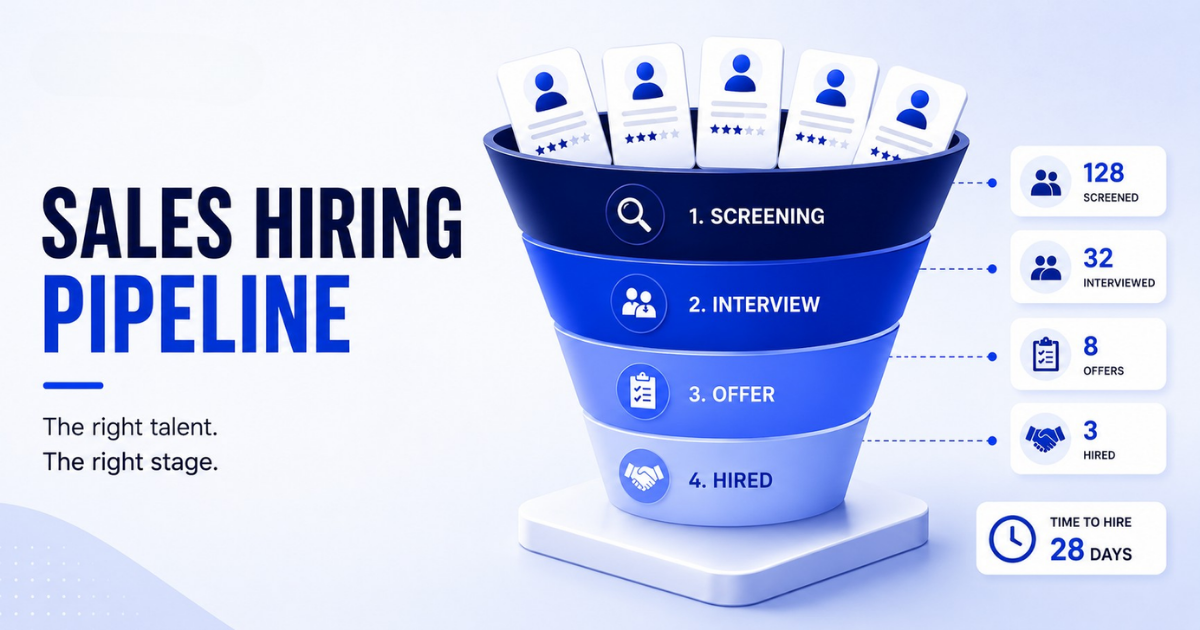
To hire a salesperson who actually performs: define the role competencies before you post, source actively (top performers aren't browsing job boards), use structured screening to separate candidates who can sell from those who interview well, run a process with behavioral questions and live role-play, and score against a rubric, not gut feel.
This guide covers every step in that sequence, from writing the job description to building a team that doesn't churn.
Key Takeaways
- Define before you post: A vague job description attracts unqualified applicants; a precise competency profile attracts people who match the role.
- The funnel is wide: According to CareerPlug's 2024 Hiring Report, the average company requires 180 applications to make one hire, and only 3% of applicants reach the interview stage.
- Quota attainment is a hiring signal: According to The Bridge Group's 2024 SaaS AE Metrics report, 51% of AEs hit quota, meaning the baseline expectation should be that roughly half your sales hires will underperform without a structured process for identifying the other half
- Structured interviews outperform unstructured ones: Research on selection method validity consistently shows that work sample tests and structured behavioral interviews predict job performance far better than unstructured conversations.
- Skills assessment is the new standard: LinkedIn's Future of Recruiting 2025 found that 93% of talent acquisition professionals believe accurately assessing candidates' skills is crucial for improving the quality of hire.
- Manager quality determines team outcomes: Gallup research found that 70% of the variance in team engagement is determined solely by the manager, meaning manager hiring is the highest-leverage decision in team-building
- AI is changing the screening layer: 37% of organizations are already actively integrating or experimenting with generative AI tools in their recruiting process, per LinkedIn's Future of Recruiting 2025
Part 1: Why Sales Hiring Is Hard
Sales is one of the few functions where the interview and the job measure completely different things.
In most professional roles, an interview can surface technical knowledge, communication ability, and a track record of relevant work. Those signals map reasonably well onto on-the-job performance. In sales, the interview is a social interaction where the candidate's primary job is to make a good impression. That's precisely the context in which the skills that produce good impressions (likability, verbal fluency, storytelling) diverge most sharply from those that produce closed deals.
The specific things that make a sales rep successful (prospecting discipline, objection handling under pressure, follow-up persistence, pipeline accuracy) barely come up in a standard interview unless you deliberately engineer the process to surface them.
That gap is why most sales hiring fails. Not because companies hire bad people, but because they run a process designed for the wrong signals.
The second structural challenge is volume. According to CareerPlug's 2024 Hiring Report, only 3% of applicants reach the interview stage, meaning that for every 33 applicants, only one gets an interview. Processing that volume manually is time-consuming enough that screening quality degrades under pressure, and the candidates who are fastest to respond often get priority over the candidates who are most qualified.
The third challenge is that sales roles turn over at unusually high rates. Early attrition is often a hiring fit problem: the candidate and role were mismatched from the start, and the mismatch surfaces within the first 90 days. Getting the front end of the process right, specifically the screening and assessment stages, is the most effective intervention available for reducing first-year churn.
Part 2: Mapping the Sales Role Landscape
"Hire salespeople" is not a single task. It describes at least a dozen distinct roles, each requiring a different competency profile, compensation structure, and assessment approach.
The Sales Role Landscape
Each role requires a different competency profile, compensation structure, and assessment approach
SDR / BDR
Pipeline generation
PersistenceCoachabilityAccount Executive
Full-cycle closing
Deal judgmentNegotiationSales Engineer
Technical selling
Technical depthCommunicationCustomer Success
Retention & expansion
Relationship continuityEmpathySales Manager
Team performance
CoachingAccountabilityVP of Sales
Strategy & org building
Process buildingForecastingSDRs and BDRs
Sales Development Representatives generate pipeline through outbound prospecting. They are measured on activities (calls, emails, sequences) and outcomes (meetings booked, qualified opportunities created). The skills that matter: consistency under rejection, process discipline, and the ability to learn and iterate on messaging quickly. SDRs are often early-career hires with shorter average tenure. Hiring them correctly means testing for coachability and persistence rather than polish.
Account Executives
AEs own the full sales cycle from qualified opportunity to close. They must be able to run discovery, build business cases, handle procurement and legal, and maintain pipeline hygiene across multiple simultaneous deals.
The competencies here are different from SDRs: structured thinking, negotiation skills, decision-making judgment, and emotional regulation to handle long cycles without losing urgency. According to The Bridge Group's 2024 SaaS AE Metrics report, the median AE carries a quota of $800K ACV and earns an OTE of $190K, making these among the most expensive and highest-stakes hires in the company.
Sales Engineers
Sales Engineers (also called Solutions Engineers or Pre-Sales Engineers) own the technical layer of a complex sale. They translate product capabilities into customer-specific proof points, run product evaluations, and handle the technical objections that AEs can't answer alone. Hiring a strong SE requires assessing both technical depth and communication ability, a rare combination.
Customer Success Managers
CSMs own the post-sale relationship: adoption, renewal, and expansion. The competency profile is distinct from pure sales: relationship continuity, proactive issue identification, product knowledge, and the ability to identify expansion signals before customers surface them explicitly. Confusing "CSM" with "sales" produces the wrong hire for both roles.
Sales Managers
The sales manager hire is among the highest-leverage decisions in team-building. Gallup research found that 70% of the variance in team engagement is explained solely by the manager, meaning the person running the team has more influence on its output than any individual rep.
Sales managers must be able to coach skill gaps, run pipeline reviews, recruit for their own team, and hold reps accountable without micromanaging. The most common hiring mistake is promoting the top AE, who may have no aptitude for coaching or management.
VP of Sales
The VP of Sales operates at the strategic layer: building processes, recruiting managers, interfacing with the executive team on go-to-market strategy, and forecasting at the organizational level. This role requires a different background than a front-line manager. Hiring too early (before the team has 8–15 reps), it adds overhead without traction. Hired from the wrong background (operational executer vs. builder), it produces process frameworks with no results.
Segment and Vertical-Specific Roles
Sales roles also vary by deal type and motion:
- B2B sales reps working complex deals require consultative skills, multi-stakeholder navigation, and patience for long cycles.
- SaaS sales reps must understand product-led signals, trial conversion, and metrics like NRR and expansion ARR.
- Field sales reps manage territory autonomously and must be assessed for self-direction and route discipline.
- Enterprise sales reps navigate procurement, legal, and security reviews that can extend cycles 6–18 months.
- Retail sales associates are high-volume, high-churn roles where consistent sourcing and fast onboarding matter more than deep assessment.
Defining which type of salesperson you actually need is the prerequisite to every step that follows.
Part 3: Build Your Hiring Infrastructure Before You Post
Most hiring processes are designed around the job description. The better approach is to design around the competency profile first, then derive the job description from it.
The Sales Competency Framework
A competency framework defines what "good" looks like in the role before you start evaluating candidates against it. Without it, interviewers default to gut feel, and gut feel in sales hiring reliably over-indexes on charisma.
A useful sales competency framework covers:
- Core skills specific to the role (prospecting, discovery, objection handling, closing, forecasting)
- Behavioral traits predictive of success in this environment (resilience, coachability, planning discipline, competitive drive)
- Background signals that correlate with performance at this company (industry familiarity, deal size experience, motion type)
- Culture signals that distinguish people who will stay from people who will churn within 90 days
The framework should be built before the job description is written. Every question in your interview process should trace back to one of these competencies.
The Sales Hiring Scorecard
The scorecard operationalizes the competency framework. It gives every interviewer on the panel the same rubric to score candidates against, converts subjective impressions into structured data, and reduces the influence of the last-impression bias that distorts hiring decisions.
A well-built scorecard enables something critical: the ability to look back at hires that worked and hires that failed, and identify which signals predicted which outcome. Over time, that data improves the process.
The Job Description
The job description is the first filter in your pipeline. A vague one (e.g., "we're looking for a motivated self-starter who is passionate about sales") attracts a high volume of unqualified applicants and filters out precisely the experienced candidates who can parse whether a role is worth their time.
An effective sales job description specifies: the motion type (inbound vs. outbound, SMB vs. enterprise), the quota structure, what success looks like at 90 days and 12 months, and the non-negotiable experience criteria. It should be written to a specific candidate, not to the broadest possible pool.
Part 4: Sourcing Sales Candidates
Most companies rely too heavily on inbound job applications. Inbound produces volume, but not necessarily quality. The candidates most likely to respond to an inbound posting are the ones most actively looking, which often means they've recently been let go, are close to being let go, or have been applying broadly without success.
Active sourcing (reaching out to candidates who are not actively applying) produces a fundamentally different pool. Top-performing reps are rarely applying to job boards.
Build a Sourcing Pipeline
A sales hiring pipeline is a repeatable system for generating candidate flow before you have an open role. It includes:
- A warm network of past colleagues, customers, and former managers, you can activate quickly
- A LinkedIn outreach process for reaching passive candidates in your target segment
- Referral incentives that make your current team invested in surfacing candidates
- A relationship-building approach with top performers at competitor companies that surfaces candidates when they're ready to move
A pipeline means you're never starting from zero when a seat opens. The best sales hiring teams run this as a continuous process, not a reactive one triggered by attrition.
High-Volume and Scale Scenarios
When you're filling 10 to 20+ roles simultaneously (a common situation during rapid expansion or after a funding event), the dynamics change. The bottleneck shifts from candidate quality to process throughput. Individual managers can't review 180+ applications per role manually without sacrificing quality or speed. The answer is a combination of structured sourcing, clear screening criteria, and technology that handles the volume layer.
Hiring at a Startup Without Brand Recognition
Startups face a specific disadvantage in sales hiring: candidates can't evaluate the opportunity using social proof, recognizable customer names, or Glassdoor reviews.
The sourcing approach has to compensate, typically by leading with mission and equity, being transparent about risk, and specifically targeting candidates at Series A/B companies who have experience in similar uncertainty and chose it deliberately.
Remote Sales Hiring
Remote-first or distributed companies face sourcing and assessment challenges that on-site companies don't. Remote sales rep hiring requires different sourcing channels, specific assessment criteria for self-direction and async communication, and a modified onboarding infrastructure.
Part 5: Screening, Finding Signal Without Wasting Time
Screening is where most companies lose the most time and make the most avoidable mistakes.
The standard screening approach (a 30-minute recruiter call, followed by a hiring manager phone screen, followed by a panel) works. But it doesn't scale, and it doesn't surface the candidates who look average on paper but perform at the top.
Structured Screening Criteria
Before any candidate reaches a human conversation, they should pass a set of structured criteria that reflects the competency framework. These criteria should be applied consistently, not adjusted based on who introduced the candidate or how strong the resume looks at a glance.
The criteria should separate must-haves (non-negotiable requirements) from nice-to-haves (factors that inform the decision but don't disqualify). Conflating these two categories produces either too-narrow a funnel or a process where subjective impressions fill in for missing criteria.
AI Screening at Scale
For roles with high applicant volume, manual screening creates a specific failure mode: reviewers process applications faster as the stack grows, quality degrades, and the best candidates often sit at the bottom of the pile. The solution is a screening layer that evaluates every applicant against consistent criteria before any human time is spent.
Tools like Zyverno evaluate candidates on role-specific criteria via voice or chat, generating scored assessments that reflect actual fit rather than resume formatting. One operations leader using it noted: "Lina screens candidates better than our junior recruiters ever did, and what used to take us 3 weeks now takes less than 7 days."
Using Data to Evaluate Candidates
A candidate's raw application tells you what they've done. Structured screening responses tell you how they think. Data-driven evaluation adds a third layer: how their behavioral and skills signals compare to role-specific benchmarks, and what those signals predict about on-the-job performance.
Part 6: The Interview Process
The interview process for sales roles should be designed around a specific objective: testing the candidate on the actual skills the role requires, not on how well they present in an unstructured conversation.
Interview Questions That Surface Real Signals
The most effective sales interview questions are behavioral (based on specific past situations) and situational (based on hypothetical scenarios that reflect real role conditions). Questions like "tell me about yourself" and "why do you want to work here" produce rehearsed answers, not signals.
The questions that work are more specific: "Walk me through the last deal you lost. What happened and what would you do differently?" Or: "Describe a time you were consistently behind on your pipeline goals. What did you diagnose as the cause, and what did you change?" These questions require real reflection and produce answers that differentiate candidates meaningfully.
LinkedIn's Future of Recruiting 2025 found that 93% of talent acquisition professionals believe accurately assessing candidates' skills is crucial for quality of hire, a shift away from credential-based screening toward competency-based evaluation.
Role-Play Scenarios
Role-play is the closest analog to a work sample test in sales interviewing. Ask the candidate to run a discovery call with you as the prospect. Give them a brief (a company name, a role title, a rough context) and let them drive the conversation.
Research on selection method validity has consistently found that work sample tests produce the highest predictive validity for job performance among all common assessment methods (Schmidt & Hunter, 1998). In sales, a role-play is the closest available work sample test.
What you're assessing: question quality, listening, objection response, adaptability, and whether they can take notes and advance the conversation at the same time.
Which Hiring Methods Actually Predict Job Performance?
Predictive validity of selection methods (r coefficient)
Source: Schmidt & Hunter, 1998
Red Flags to Watch For
Not all red flags in sales interviews are obvious. The obvious ones (inability to articulate a specific track record, vague answers about why they left previous roles, implausible quota attainment claims) are easy to catch. The subtler ones are harder.
Specifically, candidates who can describe their results but can't explain their process. Those who blame external factors (bad territory, bad product, bad management) for every shortfall without identifying anything they would have done differently. Who has a polished pitch for every question but deflects when the conversation goes off-script. Who can tell you what they would do in a scenario, but show no evidence of actually having done it?
Assessment Tools
Personality assessments and sales-specific tools (DISC, Predictive Index, Caliper, Gong's hiring analytics) can surface useful signals when used correctly. The key qualifier: used correctly means as one data point in a structured process, not as a primary filter or a disqualifier. Most standardized personality tests have limited predictive validity for job-specific performance when used in isolation.
Who Should Own the Interview Process
Whether the hiring process is driven by a dedicated sales recruiter or by the hiring manager directly is not just a resource question; it affects what gets tested and how consistently. The answer depends on hiring volume, role complexity, and organizational maturity.
Part 7: Onboarding and Ramp
Hiring the right person and then launching them without infrastructure is how companies turn good hires into expensive failures.
The single most common cause of early attrition in sales is a mismatch between what the candidate was told about the role and what they experienced in their first 90 days. That mismatch is usually not intentional. It's the result of onboarding that relies on ambient absorption rather than deliberate knowledge transfer.
Sales Onboarding Best Practices
Effective sales onboarding gives every new hire the same starting point: documented ICP, common objections and proven responses, deal stage definitions, CRM navigation, customer stories, and the information they need to hold an intelligent conversation with a prospect in week one.
The format matters less than the completeness and accessibility. Reps who can't find the information they need default to improvising, which produces inconsistency and extends the ramp period.
Ramp Time Benchmarks
Ramp time is the period between a rep's first day and the point where they're operating at full quota. Industry benchmarks vary by role type and deal complexity, but the variance within companies is often larger than the variance across companies, meaning ramp time is more controllable than most companies treat it.
Part 8: Building a Sales Team Over Time
Hiring one salesperson and building a sales team are different problems. The team-building question adds sequencing decisions (which role to hire first, when to add headcount, when to promote vs. hire externally for management) that don't arise in a single-hire context.
Sales Team Building Sequence
The right order matters more than the right people
Common Mistakes
Building from Scratch
The correct sequence is: prove the sales motion (founder-led sales), hire the first AE, scale to a second AE when the first is at quota, add SDRs when AEs are at capacity, hire a manager at 5–7 reps. Deviating from this sequence (hiring SDRs before AEs, or managers before the process is proven) compounds problems rather than solving them.
The First Hire
The first sales hire is the hire that establishes whether the company can sell without the founder. It's also the hire that sets the template for every subsequent one. Getting it right requires more caution than most startups apply.
Scaling the Team
Once the initial team is in place and the process is working, the scaling question is about maintaining hiring quality under velocity pressure. Companies that scale without maintaining hiring standards produce a larger team with a lower percentage of quota attainers, the opposite of the intended outcome.
Part 9: Retention Starts at Hiring
Turnover in sales is not primarily a compensation or management problem. The most durable form of retention is hiring fit: the degree to which a candidate's actual skills, motivations, and working style match the role's real requirements.
Candidates who were accurately assessed before hire tend to stay longer because the job matched their expectations. The screening and assessment stages of the recruiting process are the most effective upstream intervention available for reducing first-year churn.
The Cost of Getting It Wrong
Sales rep turnover is expensive. It includes the placement cost (if a recruiter was involved), lost productivity during the vacancy, ramp time for the replacement, and the deals that stalled or died during the transition. The total cost is rarely tracked explicitly, which is part of why it gets underestimated.
Why Reps Leave
The reasons sales reps quit fall into two categories: factors that were visible at hiring (the role wasn't what was described, the territory wasn't viable, the quota wasn't achievable) and factors that emerge post-hire (poor management, unclear career path, product-market issues). The first category is a hiring process failure. The second is a management and structure failure.
Reducing Turnover Structurally
Structural retention improvement requires intervention at three points: the hiring process (better fit), the onboarding process (better early experience), and the ongoing management process (better development). Compensation adjustments without fixing these three areas produce short-term retention and long-term attrition.
Part 10: AI and Technology in Sales Recruiting
Sales recruiting was a manual, time-intensive process for most of its history. The technology layer has changed what's possible at scale without changing what matters: finding the right person for the role.
What AI Tools Actually Do
The current generation of AI recruiting tools falls into several distinct categories: sourcing tools that identify passive candidates from public profiles, screening tools that evaluate candidates via conversation or structured responses, scheduling tools that remove the logistics of interview coordination, and analytics tools that surface patterns in hiring data.
These tools are not interchangeable, and combining them effectively requires understanding what each is designed to do. The most common mistake is deploying a sourcing tool and expecting it to solve a screening problem, or vice versa.
According to LinkedIn's Future of Recruiting 2025, teams using AI tools save an average of 20% of their time weekly, roughly one full workday per recruiter per week.
Automating the Screening Layer
The screening layer is where automation has the most immediate ROI. A human recruiter reviewing 180 applications per open role (the average, per CareerPlug's 2024 Hiring Report) is spending the majority of their time on candidates who will never advance. Autonomous screening tools evaluate every applicant consistently and surface only the candidates who meet the role's criteria, compressing the time-to-first-qualified-interview significantly.
Part 11: Metrics That Matter
Sales hiring produces data at every stage: application volume, conversion rates at each funnel step, time to fill, offer acceptance rate, 90-day attrition, and quota attainment by cohort. Most companies track a subset of these. The companies with the best hiring outcomes track all of them and connect hiring inputs to performance outputs.
Key Sales Hiring Metrics
The metrics that matter most are:
- Time to fill (how long seats stay open, which drives lost revenue and team pressure)
- Quality of hire (measured by 90-day retention, ramp time, and quota attainment in the first 12 months)
- Offer acceptance rate (a proxy for compensation competitiveness and candidate experience)
- Source quality (which sourcing channels produce the hires that actually perform)
- First-year attrition (the signal that connects hiring quality to retention outcomes)
LinkedIn's Future of Recruiting 2025 found that 89% of talent acquisition professionals believe measuring quality of hire will become increasingly important, though only 25% report high confidence in their ability to measure it today. The gap between the two numbers is a process problem.
Frequently Asked Questions
How do you tell if someone can actually sell before you hire them?
The most reliable method is a live work sample: a role-play where the candidate runs a discovery call or handles a specific objection in real time. This tests the actual skills the job requires rather than the candidate's ability to describe those skills. Research on selection method validity (Schmidt & Hunter, 1998) consistently identifies work sample tests as the highest-validity method for predicting job performance. Structured behavioral questions that ask about specific past situations provide the second strongest signal. Unstructured interviews and personality impressions provide the weakest signal.
How long does it typically take to hire a salesperson?
The average time to fill is one of the most controllable variables in the process, but it's also one of the most variable. Roles with a vague competency profile and a reactive sourcing approach take longer because the funnel is both wide and inefficient. Roles with a defined competency profile, a warm pipeline of passive candidates, and automated screening at the top of the funnel move faster. The practical range for most SMBs is 3–8 weeks from posting to offer accepted.
How much should you pay salespeople?
Compensation structure for sales roles is typically OTE-based: a base salary plus a variable component tied to quota attainment. According to The Bridge Group's 2024 SaaS AE Metrics report, the median SaaS AE OTE is $190K with a 53:47 base-to-variable split. Compensation varies significantly by role type, market, deal complexity, and experience level. The key design principle: the variable component should be large enough to motivate meaningful effort without creating a structure that's impossible to hit or too easy to exceed.
Should you promote from within or hire externally for sales leadership?
Both approaches have failure modes. Promoting internally (from top AE to manager) is fast and preserves institutional knowledge, but it optimizes for the wrong skills: the traits that make someone a top individual contributor are not the traits that make someone an effective coach and people manager. Hiring externally brings process and perspective but adds onboarding time and cultural risk. The best answer is usually: promote when you have someone internally who has demonstrated coaching ability; hire externally when you don't.
What's the biggest mistake companies make when hiring salespeople?
Hiring based on interview performance rather than role-specific competency assessment. A confident, articulate candidate who interviews extremely well creates a strong impression that's hard to override, even when the structured evaluation data says the fit is weak. Building a scoring rubric that every interviewer uses, and committing to weighting it alongside interview impressions rather than defaulting to gut feel, is the single highest-impact change most teams can make to their process.
How many salespeople do you need before you hire a sales manager?
The correct threshold is 5–7 productive reps. Below that, the management overhead is not justified, and the founder or revenue leader can still provide adequate coaching. Above 7, the coaching quality typically degrades without a dedicated manager, and the cost of that degradation in rep performance and retention exceeds the cost of the management hire.