
How to Hire SDRs: A Recruiter's Playbook for Sales Development Reps
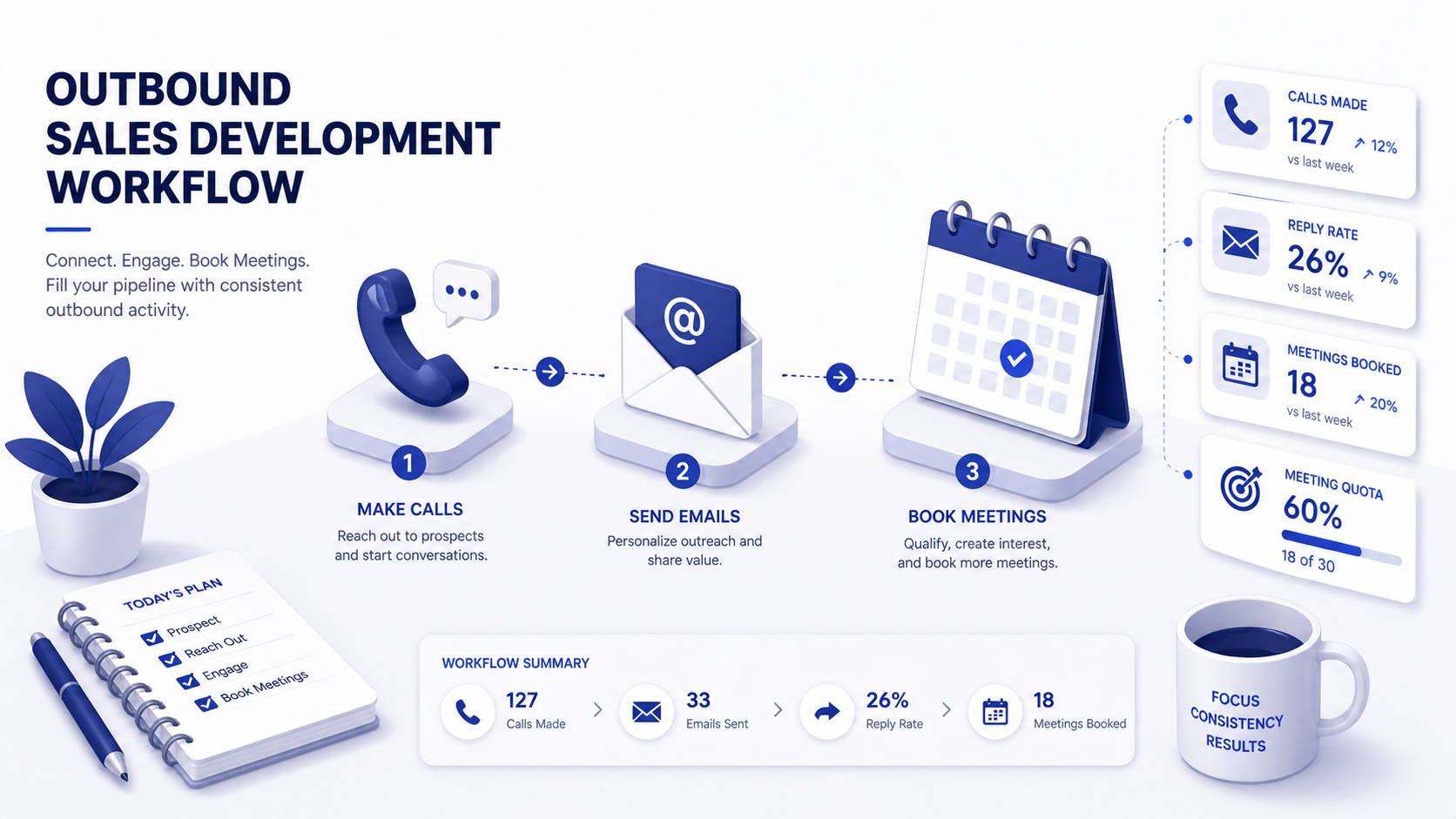
To hire SDRs who produce, evaluate for coachability, process discipline, and resilience under rejection, not polish. Average SDR tenure is 16 months, and quota attainment runs 63–68% industry-wide, so the cost of hiring wrong compounds fast. This playbook covers how to define the profile, source the right candidates, and structure an assessment that finds them.
Key Takeaways
- Average SDR tenure is 16 months. You're replacing most SDRs within 1.5 years (Bridge Group, 2024).
- Average SDR ramp time is 3.2 months, and the true annual cost per SDR is $100,000+ when salary, training, tools, and ramp loss are included.
- SDRs generate 30–45% of the pipeline in B2B SaaS companies. This role directly drives revenue.
- Average SDR quota attainment is 63–68%, meaning quota-setting is often the problem, not the rep.
- The best SDR candidates aren't experienced SDRs; they're people with evidence of competitive drive and resilience in adjacent contexts.
What You're Actually Looking For
The biggest mistake in SDR hiring: treating it like any other sales role hire. SDRs are rarely hired for their sales experience. Most haven't had any. You're hiring for the inputs that predict success in an outbound prospecting role:
1. Comfort with rejection: The core job function is cold outreach at scale. Most contacts won't respond. Of those who do, most will say no. An SDR who takes rejection personally will burn out within 60 days. You need someone who processes "no" as data, not as a verdict on their worth.
2. Competitive drive: The best SDRs are internally competitive. They care about their ranking on the leaderboard. They track their metrics daily, and they're genuinely frustrated when they fall below quota. This doesn't require aggression. It requires caring about the number.
3. Coachability above all else: An SDR's job changes constantly. The cold call script that works in month one may not work in month four. Managers run A/B tests on messaging. If a rep can't take feedback and adjust immediately, they plateau. Look for specific evidence that they've received critical feedback and demonstrably changed their approach.
4. Communication clarity: SDRs write emails and make cold calls. Their emails need to be clear, brief, and value-oriented. Their calls need to be conversational and not robotic. Test this in the hiring process, not after.
5. Organization and consistency: An SDR managing a 100-contact outreach sequence across multiple channels can't rely on memory. They need to be systematic. Reps who can't describe their prospecting system haven't developed one.
SDR Role: Key Benchmarks & Hiring Profile
What the data says about who to hire and what to expect
Average Tenure
16 mo.
Plan to replace most SDRs within 1.5 years
Ramp Time
3.2 mo.
Before reaching target productivity
Pipeline Contribution
30–45%
Of B2B SaaS pipeline generated by SDRs
Quota Attainment
63–68%
Industry-wide average — quota-setting is often the problem
What predicts SDR success (hire for these, not experience)
Benchmarks: Bridge Group 2024 SDR Metrics Report
Where to Find SDR Candidates
College Senior Programs
SDRs don't need prior sales experience. College seniors or recent graduates with part-time jobs in customer-facing roles (retail, service, campus organizations) often have the right raw materials. Partner with career centers at schools with strong business programs.
Sales bootcamp graduates
Intensive sales training programs produce candidates who understand the role, have done mock cold calls, and self-select into a hard job before they understand the full picture. They've already demonstrated persistence.
Customer service and support roles
CS and support reps who've been handling inbound tickets and want to earn more have adjacent skills. They know the product. They talk to customers daily, and they're comfortable with rejection. Targeted LinkedIn sourcing for "customer support → SDR" transitions finds motivated candidates.
LinkedIn sourcing
Search for "SDR" or "BDR" at companies in your competitive space or adjacent verticals. Sort by 12–18 month tenure, those are reps who've ramped and may be looking for the next step. Also search for "account management" or "inside sales" at small companies where the role may have had SDR-like outbound components.
Job boards with sales-specific reach
LinkedIn, Indeed, and your own careers page are baselines. Reach also extends to SalesGravy, RepVue, and Bravado for candidates who are actively researching sales roles specifically.
How to Screen SDR Candidates Before the Interview
The SDR role has a clear skill floor: can they write a compelling cold email? Can they handle an objection without freezing? You should test this before spending time on a live interview. SDR roles at growth-stage companies routinely attract 100 to 200 applications, and manually working through that volume before identifying who is worth a call is where most hiring timelines stall. Teams that automate this initial qualification layer, screening every applicant against the skill floor criteria before any recruiter time is spent, compress the pipeline significantly; Zyverno handles this via structured voice or chat conversations that assess the communication signals SDR screening depends on.
Screen 1: Written outreach exercise (asynchronous)
Give candidates a one-page description of a fictional product and a target persona. Ask them to write:
- A cold email subject line
- A 3-sentence cold email body
- A LinkedIn connection request
Score against: personalization (do they reference the persona's likely problem?), clarity (no buzzwords, no padding), and call-to-action (is there a specific, easy next step?).
This test takes the candidate 15–20 minutes. It eliminates candidates who can't write and gives you something concrete to discuss in the live interview.
Screen 2: Short asynchronous video or phone screen
Ask one question: "Tell me about a time you had to keep doing something difficult even though you weren't getting the results you wanted. What happened?"
You're listening for: specific example, ownership language, and a clear connection between effort and outcome. Vague or entirely positive answers (no struggle) are a signal to probe harder.
The Live Interview: What to Assess
Performance history (adapted for entry-level)
For candidates without quota history, look for competitive proxies: athletic performance, academic ranking, sales competition results, and performance metrics from a previous customer-facing role. Ask: "What's something you've tracked your performance on obsessively?" You'll learn a lot from what they track and how they talk about it.
Process and organization
Ask: "If you were given a list of 50 prospects tomorrow, how would you approach the first week of outreach?" This reveals whether they're systematic or reactive. A strong candidate describes a sequenced approach, research, personalization, cadence, and follow-up timing. A weak candidate says, "I'd reach out to all of them."
Handling rejection (live test)
After the behavioral questions, tell them: "I'm going to say no to whatever you suggest next. You're going to try to convince me otherwise. Let's go." Then give them a simple scenario ("Can I have 30 minutes on your calendar?") and push back twice. You're not expecting perfection; you're watching for freeze vs. adapt.
Compensation and Offer Structure
Base salary range: $43,000–$65,000 depending on market and role complexity (inbound vs. outbound, market segment)
Variable comp: $15,000–$30,000 OTE upside based on meetings booked and pipeline generated
Key benchmark: A common standard for outbound SDRs is 15 meetings booked per month, with a 70–80% show rate, netting approximately 12 held meetings. Set quota against this benchmark.
SDR Compensation Benchmarks
Market ranges for outbound SDR roles (B2B, US market)
| Component | Range | Notes |
|---|---|---|
| Base Salary | $43,000 – $65,000 | Higher end for outbound roles in competitive markets |
| Variable (OTE upside) | $15,000 – $30,000 | Tied to meetings booked and pipeline generated |
| Total OTE | $58,000 – $95,000 | At 100% quota attainment |
| Monthly quota (outbound) | 15 meetings booked | ~12 held meetings after 70–80% show rate |
Avoid:
- Quotas set by what you need rather than what's achievable given the territory and cadence
- OTE that looks good on paper but is practically unachievable
- Comp plans that change mid-year. SDRs will notice, and they'll leave
The Promotion Path Conversation
One of the most powerful retention tools for SDRs is explicit clarity about what the AE promotion looks like. Have this conversation in the first interview, not after they've accepted.
The rep should leave the offer with answers to:
- What are the promotion criteria (pipeline generated, meetings held, deal contribution, time in role)?
- How often are SDRs promoted to AE here?
- What support is available to develop AE skills?
SDRs who join with a clear path stay 20–30% longer than those who join without one. This conversation costs you nothing and has real retention value.
Red Flags Specific to SDR Candidates
- Can't explain what an SDR does: if they don't know what they're interviewing for, they don't actually want the job
- Immediately asks about the AE timeline before asking about the SDR role: ambition is good, but candidates who are only thinking about the next step won't invest in mastering this one
- No metrics from any previous role: the best candidates track something; if they've never measured their own performance, they'll struggle in a metrics-driven environment
- Describes their best quality as "I'm a people person": this is not a differentiator. Ask them what they mean; vague answers mean there's nothing more specific beneath it
Benchmarks to Validate Your Hire
After the first 30 days:
- Has the rep completed all onboarding milestones?
- Can they articulate the ICP and the top three objections?
After 60 days:
- Have they booked their first qualified meeting?
- Are they at 50%+ of target activity (calls, emails, LinkedIn touches per day)?
After 90 days:
- Are they at 80%+ of target activity?
- Are they generating pipeline at a rate that projects to quota attainment?
A rep at 90 days who is still below 50% activity with no meetings booked is not going to ramp. Address it directly: is this a skill issue, a motivation issue, or a structural issue (bad territory, broken tools)?
Frequently Asked Questions
Should you hire an SDR without prior sales experience?
Yes, in many cases, prior SDR experience is not the best predictor of success. The traits that predict success (coachability, resilience, competitive drive, and communication clarity) are identifiable in candidates from other backgrounds. Many of the best SDRs come from sports backgrounds, competitive academic environments, or high-volume customer-facing roles.
How many SDRs should you hire before your first AE?
Depends on your pipeline math. One outbound SDR typically generates 10–15 qualified meetings per month. If your AE closes 20–30% of qualified meetings and your average deal size supports the revenue target, work backward. Most early-stage companies hire their first AE before or alongside their first SDR. The SDR role comes once the AE has validated repeatable demand.
What's a realistic first-year quota for an SDR?
In the first 3 months (ramp period), quota should be set at 50–70% of full productivity. After ramp, a realistic full-quota target for an outbound SDR is 10–15 held meetings per month generating $X pipeline, where X is derived from your average deal size and conversion rates, not from what you need in revenue.
How do you screen for resilience before hiring?
The behavioral question: "Tell me about a time you kept doing something difficult without getting the results you expected." The live simulation: tell them you're going to say no, then do it twice and watch their response. Neither is a perfect test, but both are better than relying on how confident they seem.