
How to Reduce Sales Turnover: A Practical Guide for Sales Leaders
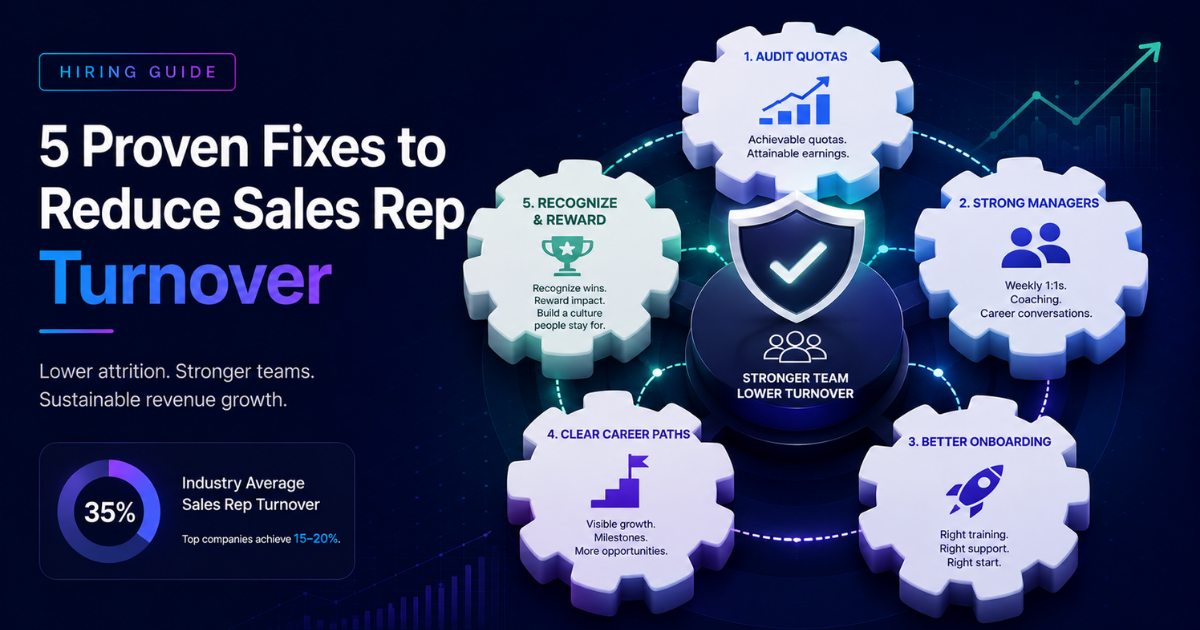
35% annual sales rep turnover is the industry average, not the floor. Companies that treat it as manageable rather than fixed consistently run at 15-20%. The difference comes from structural decisions: quota design, manager quality, onboarding, career visibility, and recognition. This guide covers the levers with evidence behind them.
Key Takeaways
- Pay transparency and achievable on-target earnings are among the fastest structural levers for improving rep retention.
- Managers who run consistent weekly one-on-ones see measurably lower voluntary turnover on their teams.
- According to Spekit, 52% of top-performing sales professionals have left a job because of poor onboarding — first-year attrition that is entirely preventable.
- Top performers are disproportionately likely to leave when there is no visible path to promotion.
- Reducing attrition from 35% to 20% can cut sales team operating costs by 15-20%
Retention Intervention Timeline
Where to start depends on your highest-impact problem. Each fix has a different time-to-impact.
Fix 1 — Quota & Comp
Audit quota attainability and OTE structure
- Calculate 8-quarter attainment distribution by rep
- Check % hitting OTE — below 60% means the math is broken
- Audit territory quality for equal viability
- Publish transparent OTE mechanics
Fix 2 — Manager Quality
Add retention to manager accountability metrics
- Track voluntary turnover at team level, not just company level
- Mandate weekly 1:1s; measure completion rate at 85%+
- Train managers on coaching vs. status-checking
- Require quarterly career conversations per rep
Fix 3 — Onboarding
Implement a structured 30-60-90 day program
- Replace informal "shadow a rep" with explicit milestone criteria
- Add skills practice (mock calls, role plays) in weeks 2–4
- Assign manager as primary onboarding driver, not HR
- Track ramp-to-first-deal as a program success metric
Fix 4 — Career & Hiring
Explicit promotion criteria and honest hiring
- Define SDR-to-AE criteria with specific timelines and targets
- Create senior IC paths alongside management tracks
- Audit recruiting pitch for accuracy on territory, OTE, and product
- Add realistic job previews to late-stage interviews
Fix 1: Audit Your Quota Attainability
The fastest way to lose a top performer is to give them an unachievable quota. They are the ones with options.
A healthy quota structure should produce 65-75% attainment across the team in any given quarter. If you are below 50%, your quota is driving attrition, not your product, not your market.
Steps to audit your quotas:
- Calculate historical attainment rates: by rep, by quarter, for the last eight quarters. If the distribution is flat at the bottom, the quota is the problem. If it is bimodal (some hitting, most not), you have a talent or onboarding problem.
- Check on-target earnings attainability: what percentage of reps hit on-target earnings last year? If it is below 60%, your total compensation is less than it appears, and recruiter outreach to your team is landing differently than you think.
- Compare territory quality: are all reps working equally viable territories? Unfair territory assignment looks like individual underperformance but is actually a structural problem.
- Set quotas from capacity, not aspirations: quotas should be based on what a fully-ramped rep can realistically produce given territory conditions, deal size, and average cycle length, not what you need in revenue.
Compensation transparency matters too. Reps who trust the compensation plan stay. Reps who feel it is manipulated leave.
Fix 2: Hold Managers Accountable for Retention
Turnover analysis at the team level almost always shows unequal distribution. Some managers have 10-15% turnover, others have 50%+. The variance is a manager problem, not a market problem.
What high-retention managers do differently:
- Weekly one-on-ones consistently: Teams with managers who run one-on-ones every week have lower voluntary turnover. The mechanism: reps feel seen, coached, and invested in rather than managed through a dashboard.
- Deal coaching, not just deal review: There is a difference between asking "where is this deal?" and asking "what is the buyer's actual decision process, and where are you getting stuck?" The former is a scorecard. The latter builds skill.
- Career conversations: High-retention managers have explicit conversations about where each rep wants to go and what is needed to get there. This isn't annual review territory. It should be a recurring topic.
- Protection from organizational noise: When internal processes, unnecessary meetings, and admin overhead are eating rep time, high-retention managers actively work to shield their team from it.
How to operationalize this: Add retention rate to manager performance metrics alongside pipeline and quota attainment. Managers who consistently lose good people should not be exempt from accountability just because their team is hitting quota.
Fix 3: Fix Onboarding Before You Fix Anything Else
According to Spekit, 52% of top-performing sales professionals have left a job due to poor onboarding. This is first-year attrition that is entirely preventable.
Most sales onboarding fails in two ways:
Too compressed: A week of product training followed by "go sell." The rep is in the field before they understand the buyer, the objections, or the internal processes they need to close deals. They struggle, they get discouraged, and they leave.
Too focused on product, not process: Reps need to know the product, but they also need to understand the ideal customer profile in depth, the most common objections and how to handle them, how to get internal deal support, and where to go when they are stuck. Most onboarding programs cover the first and ignore the rest.
Fix 4: Make Career Paths Explicit
The people most likely to leave for lack of a promotion path are also your top performers. They have options, and without a visible trajectory, they use them.
The fix isn't complicated, but it requires intentionality:
- Define promotion criteria explicitly: "Sales development representative to account executive after nine months of consistent attainment and X pipeline generated" is better than "when a role opens up." Vague criteria drive out ambitious people.
- Create milestone reviews: At six months and 12 months, sit down with every rep and review where they are against career criteria, what is needed to advance, and what support is available. This is not the same as a performance review.
- Build lateral paths: Not everyone wants to manage. Senior individual contributor tracks, specialist roles (enterprise, strategic accounts), and team lead roles provide advancement without requiring every promotion to go through management.
The signal that this is working: your sales development representatives are excited about the account executive path at your company, not just watching for openings at competitors.
Fix 5: Build a Recognition Culture
According to a Robert Half survey, 66% of workers say they would leave a job if they did not feel appreciated. Companies with formal recognition programs consistently see lower turnover and higher productivity.
Recognition in sales is particularly high-stakes because results are visible and measurable. When a rep closes a hard deal, and the response is silence, they recalibrate quickly. They start questioning whether strong performance is valued or just expected.
What works:
- Weekly recognition of specific wins, not quarterly awards. Frequency matters more than formality.
- Specificity over generality: "You converted that stalled deal by finding the real budget holder" is more motivating than "great quarter."
- Peer recognition, not just top-down. Teams where reps acknowledge each other's wins have higher cohesion and lower voluntary turnover.
Build recognition into recurring routines. Sales leaders who treat appreciation as a quarterly ritual rather than a weekly habit are leaving a retention lever unused.
Fix 6: Reduce Administrative Load
Salesforce (2023) found that sales reps spend less than 30% of their time actually selling. Every hour spent on non-selling work is an hour of productivity lost and an hour of frustration accumulated.
Audit where admin time is going:
- CRM data entry (can be automated or reduced through call recording integrations)
- Internal reporting and forecast updates (can the manager pull this data without requiring rep input?)
- Unnecessary meetings (pipeline reviews where reps present data the manager could have read)
- Manual scheduling and follow-up (can be handled with scheduling automation)
When technology adds work instead of removing it, it signals organizational dysfunction. Reps notice, and they remember it when a recruiter calls.
Tools that reduce admin load (scheduling automation, AI screening, CRM integrations) also signal investment in the rep's success, which independently improves retention.
Fix 7: Improve Hiring Selection to Reduce Mismatch Attrition
Some first-year attrition is not caused by the job. It is caused by the gap between what the candidate was told in the interview and what the role actually is.
Territory conditions were described as established when they were greenfield. The on-target earnings were quoted without explaining how hard accelerators are to hit. The product's market fit was overstated.
Honest hiring doesn't just reduce attrition. It attracts candidates who are self-selecting into the actual role, not an idealized version. Screening tools like Zyverno help here by running structured voice and chat screens that surface role-fit signals consistently across every applicant, reducing the chance that a mismatch slips through because a recruiter call felt positive.
What to Measure
Track these metrics quarterly to know whether your turnover interventions are working:
Retention Health Dashboard — Quarterly Tracking Targets
Use these as benchmarks to identify where to investigate first
| Metric | Target | Warning Zone | Investigate When |
|---|---|---|---|
|
Annual voluntary turnover Primary retention KPI | < 20% | 20–30% | Above 30%: structural issue with quota, manager, or comp |
|
Involuntary turnover Low performers exiting — healthy if managed | < 15% | 15–20% | Above 20%: hiring selection or onboarding failure |
|
First-year attrition Within 12 months of hire | < 25% | 25–35% | Above 35%: expectation mismatch or onboarding gap |
|
% reps hitting OTE Comp plan believability signal | > 60% | 50–60% | Below 50%: OTE is fiction; drives top-performer attrition |
|
% reps hitting quota (quarterly) Quota attainability signal | > 65% | 50–65% | Below 50%: quota is broken; rebuild from capacity |
|
Manager 1:1 completion rate Leading indicator of rep engagement | > 85% | 70–85% | Below 70%: rep-manager relationship is at risk |
|
Ramp to first deal Onboarding effectiveness indicator | SDR < 60d / AE < 90d | +25% over target | Exceeds target consistently: skills gap or territory problem |
Any metric running significantly above or below these ranges tells you where to investigate first.
Frequently Asked Questions
What's the fastest lever to reduce sales turnover?
Quota design and compensation transparency, because they are systemic. A single change affects every rep on the team. Manager accountability is second: one manager change affects five to eight reps simultaneously. Onboarding improvements have the largest long-term impact on first-year attrition.
How do you reduce turnover without increasing base salary?
Improve on-target earnings attainability. A $70K base with a realistic $130K on-target earnings is more retentive than an $80K base with an on-target earnings figure nobody reaches. Reps value earning potential more than guaranteed compensation, as long as they believe the upside is real. Pay transparency that proves the upside is achievable matters more than the number itself.
Is some turnover healthy?
Yes, but not 35%. Involuntary turnover (low performers exiting) is healthy and positive. Voluntary attrition among your top performers is never healthy. A good target: 5-10% involuntary turnover per year, less than 10% voluntary. At 35% total, something structural is broken.
How long does it take to see improvement after making these changes?
Quota and compensation changes show retention impact within one to two quarters. Reps who were passively looking stop looking when the math gets better. Manager accountability and onboarding changes take one to two full cycles (six to twelve months) to produce measurable retention improvements in the data.
Frequently asked questions
Related articles
The Holiday Hiring Horror Story
Discover how Zyverno can streamline your holiday hiring process, ensuring you don't lose top candidates during peak times.
salesAI recruitment is only for tech roles?
Discover how AI recruitment helps streamline hiring for all roles, not just tech. Improve efficiency and decision-making with Zyverno.
salesWhere candidate experience starts
Improve your candidate experience from the job ad to interview. Discover tips to streamline hiring and engage applicants effectively.