
Remote Sales Hiring: How to Recruit, Screen, and Assess from Afar
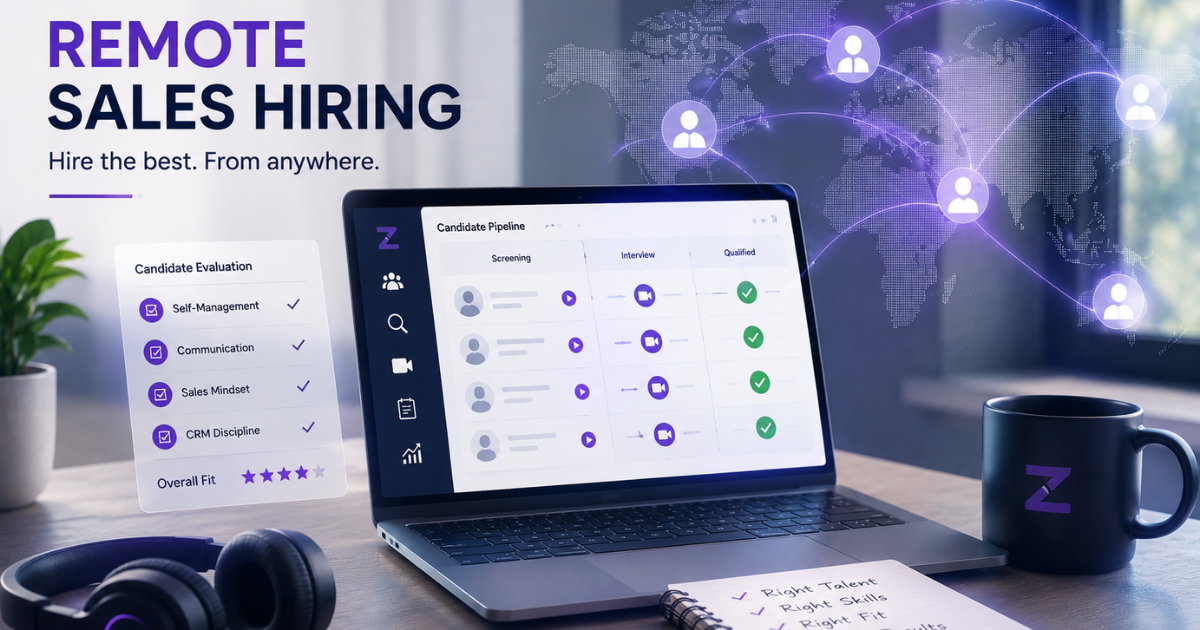
Remote sales hiring expands your candidate pool and removes the ambient in-person signals most evaluation processes rely on. The companies that do it well don't try to replicate in-person hiring on a screen. They design an evaluation specifically for the signals that predict remote sales performance: self-management, async communication, and the ability to build credibility with prospects who will also be on a camera. This guide covers how.
Key Takeaways
- Remote sales hiring expands the candidate pool significantly, but the evaluation criteria should include remote-specific signals, not just standard sales competencies.
- According to LinkedIn's Future of Recruiting 2025, 37% of organizations are actively integrating or experimenting with AI tools in hiring, and the remote hiring workflows that expanded post-2020 have normalized the video-first candidate experience that remote sales roles require
- The highest-risk hire in remote sales: a rep who performs well in a structured office environment but lacks the self-management to sustain activity without peer accountability
- What to evaluate for remote roles: home setup and camera presence, self-management evidence, written communication quality, and CRM discipline (a proxy for accountability when nobody is watching)
- Automated screening for remote roles works particularly well because candidates can complete the screening from wherever they are, without travel or scheduling friction.
What Makes Remote Sales Evaluation Different
In-person sales evaluations benefit from ambient information. You see how the candidate carries themselves. You observe how they interact with the receptionist and other team members. You notice whether they arrived prepared. These signals accumulate without formal evaluation structures.
Remote evaluations don't provide ambient information. What you see is what the candidate deliberately presents to you. The evaluation process has to be more structured to compensate for what the environment doesn't reveal naturally.
Three signals that matter in remote sales hiring and rarely get evaluated explicitly:
Self-management under observation. In a remote environment, the manager can't see what a rep is doing when no meeting is scheduled. The rep who consistently logs activity, updates the CRM without being asked, and hits daily outreach targets without external accountability is a remote hire that works. The rep who needs floor presence and peer momentum to stay active will underperform at home.
Camera presence. Remote sales reps spend their entire selling day on video. A candidate who is uncomfortable, poorly framed, awkwardly lit, or clearly in a distracting environment on a hiring call is showing you exactly what your prospects will see. How someone shows up on camera in a hiring context tells you how they'll show up in a prospect context.
Written communication quality. Remote selling requires more written communication than office selling. Emails, Slack messages, and follow-up correspondence carry more weight when there's no in-person relationship to lean on. Evaluate written communication quality explicitly: ask candidates to send a follow-up email after a given scenario, not just talk through it.
Setting Up the Remote Screening Process
Remote sales hiring produces applicant pools from a wider geography, which often means more applicants and more screening work. A structured screening layer that runs asynchronously handles this volume without creating a recruiter bottleneck.
Zyverno works well in a remote context precisely because it requires no in-person presence: Lina conducts voice or chat screening for every applicant wherever they are, whenever they apply, scores them against the role criteria, and schedules qualified candidates automatically. A candidate who applies from Denver at 10 pm can complete their screening that evening and appear on the recruiter's ranked shortlist the next morning.
For the evaluation stages that require human judgment, video calls are the medium. The structure of the evaluation should compensate for the absence of in-person signals.
Designing the Remote Evaluation
Stage 1: Asynchronous qualification screen
Before any video call, qualify the candidate on the basics: relevant experience, deal size, schedule, compensation, and remote-specific requirements (home office setup, reliable internet, no regular background noise from home circumstances).
For remote roles, add one question in the screening: "Describe your home working setup. Do you have a dedicated workspace? What does your background look like on a video call?" The answer to this question eliminates a predictable category of poor hires before any recruiter time is spent.
Stage 2: Video screening call
The first human interaction in a remote hiring process should be a video call, not a phone call. The video call surfaces camera presence signals that the phone doesn't provide.
Evaluate explicitly:
- How is the setup? Is the camera at eye level? Is the lighting adequate? Is the background professional or at least neutral?
- How is the candidate framed? Do they look like they've thought about how they appear on camera?
- Are they making eye contact with the camera (which prospects experience as eye contact) or with their own image on the screen?
A candidate who has done remote selling before will have thought about these things. A candidate who hasn't may need coaching, or may not have the self-awareness to develop good video presence.
Stage 3: Structured role-play via video
For remote sales roles specifically, the role-play should happen over video, not in person. You are evaluating how the candidate performs in the medium they'll be selling in. An in-person role-play for a remote sales role is the wrong evaluation environment.
Give the candidate the same materials you'd give for any role-play (pitch deck, buyer persona, 24 hours' advance notice). Evaluate against the same criteria: call structure, discovery question quality, listening and adapting, objection handling, and next step quality. Add one criterion specific to remote: how are they using the video medium? Are they presenting materials clearly? Are they reading the prospect's reactions through the screen?
Stage 4: Written communication sample
Ask the candidate to write a follow-up email based on the role-play scenario. Give them 24 hours. What you're evaluating: Do they write clearly and professionally? Is the email the right length (not too long)? Do they advance the conversation rather than summarize it? Does the email reflect what actually happened in the role-play, or is it a template?
For remote sales reps, this is a direct preview of what your prospects will receive after every call.
Stage 5: Self-management discussion
Ask the candidate directly: how do you structure your workday when no one is managing your schedule? What does your typical morning look like? How do you maintain focus when you're working alone? How do you handle slow days where the outreach isn't generating responses?
The candidate who can describe a real routine and who can articulate how they maintain accountability without external pressure is telling you they have the self-management skills remote work requires. The candidate who hasn't thought about this question hasn't built a system.
Remote Hiring Logistics
Coordinate reference calls across time zones
For remote hires from different time zones, reference calls require more scheduling coordination. Build this into the process timeline rather than treating it as an afterthought.
Compensation for remote roles
Remote roles often generate compensation expectation divergence: a candidate in a lower cost-of-living city may expect a different number than a candidate in a major metro. Companies that have geography-adjusted pay bands for remote roles should communicate this policy early in the process to avoid late-stage offer friction.
The equipment question
For remote sales roles, clarify who provides equipment before the offer stage. Does the company provide a computer, headset, and lighting? Or is the rep expected to supply their own? This matters to candidates and should not be a surprise at the start date.
Common Mistakes in Remote Sales Hiring
Relying on a phone screen instead of a video call. The phone screen tells you about the communication quality on audio. It tells you nothing about video presence, camera professionalism, or how the candidate looks to your future prospects.
Not evaluating the home setup. Hiring a remote rep who has no dedicated workspace means they'll be fielding prospect calls from a kitchen table with background noise. Ask about the setup early.
Skipping the written sample. Teams that evaluate oral communication carefully and skip written communication evaluation hire reps who speak well and write poorly. In remote sales, written communication is load-bearing.
Underweighting self-management signals. The candidate who references external structures ("I need the office environment to stay productive") is telling you something important about whether they'll perform remotely. Weight this appropriately.
Frequently Asked Questions
Can you hire a remote sales rep you've never met in person?
Yes. Many high-performing remote sales teams are built entirely through remote hiring processes. The evaluation process needs to be more deliberate to compensate for the absence of in-person signals, but the outcome is achievable.
How do you build culture with a remote sales team you've hired remotely?
Remote team culture requires more intentional structure than office culture. Scheduled team meetings with an agenda beyond deal reviews, recognition of wins in shared channels, and periodic in-person gatherings (if geographically feasible) are the most effective inputs. Hiring candidates who have worked on remote teams before tends to select for people who know how to build connections without proximity.
Should commission structures differ for remote roles?
Not because of the remote nature itself. The commission structure should reflect the role's market value and the company's sales motion. Where remote hiring creates compensation complexity is geography-adjusted base salaries, not variable compensation design.
Related articles
The CV Graveyard
Stop starting from zero. Use Zyverno to match past applicants to new roles based on skills and experience. Reengage your existing talent pool effectively today.
salesThe Holiday Hiring Horror Story
Discover how Zyverno can streamline your holiday hiring process, ensuring you don't lose top candidates during peak times.
salesAI recruitment is only for tech roles?
Discover how AI recruitment helps streamline hiring for all roles, not just tech. Improve efficiency and decision-making with Zyverno.