
Sales Personality Tests: What Works, What Doesn't, and What to Use Instead
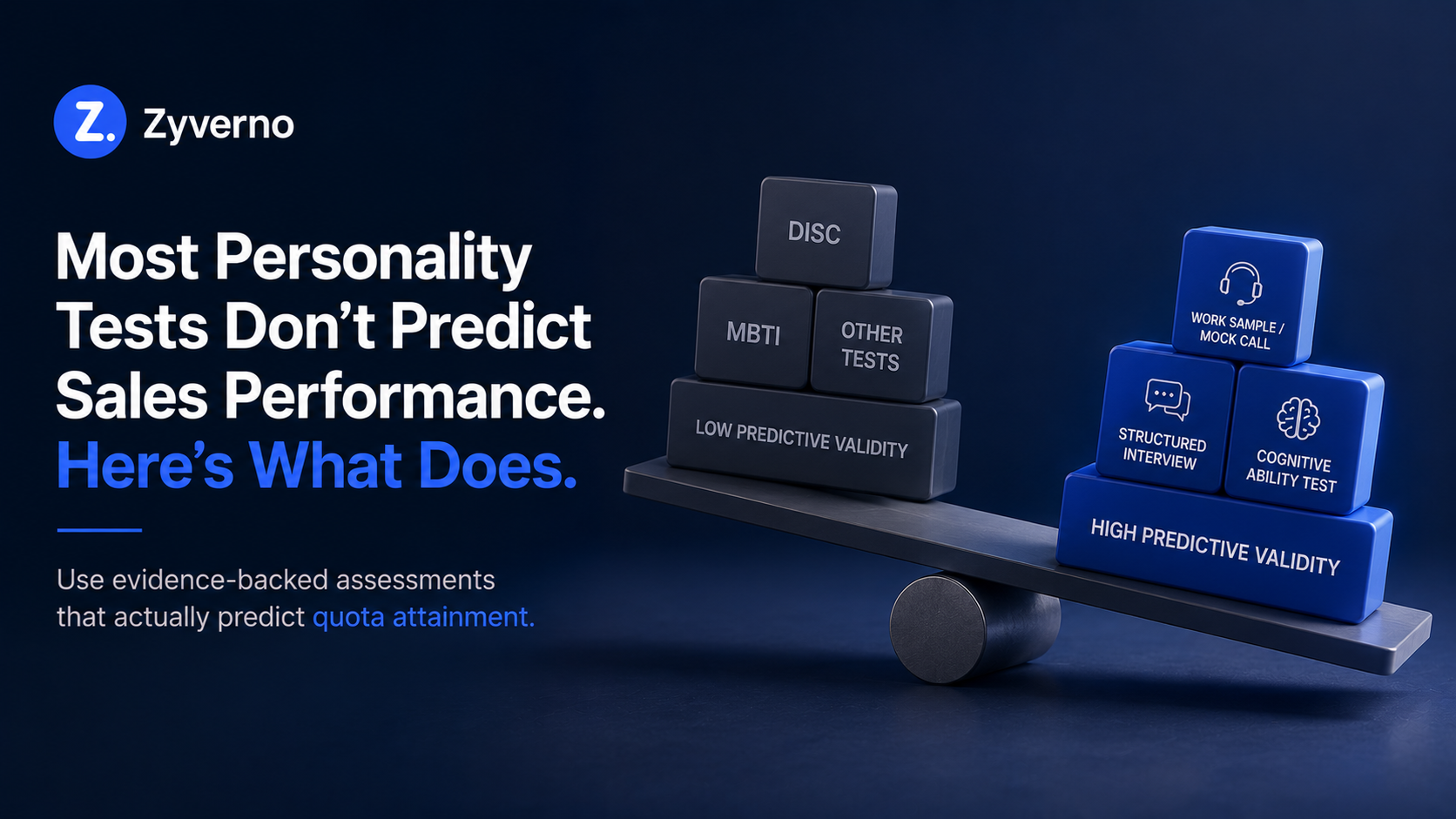
Most personality assessments used in sales hiring have weak predictive validity for quota attainment. Big Five personality assessments provide a moderate signal as one of several inputs. Structured interviews and work samples should replace most others. Here's what the evidence supports and what to use instead.
The Validity Problem
Not all assessments are created equal. The central question is predictive validity: does a high score on this instrument correlate with better job performance over time?
The research on this is detailed. Big Five personality instruments (those measuring Openness, Conscientiousness, Extraversion, Agreeableness, and Neuroticism) have moderate predictive validity for job performance. Conscientiousness is the strongest predictor across most roles. The validity coefficients are real but modest. Personality explains some of the variance in performance, not most of it.
DISC (Dominance, Influence, Steadiness, Conscientiousness) is widely used in sales hiring. It is not backed by the same level of validation research as Big Five instruments. DISC categorizes communication styles and behavioral tendencies, but does not have a validated correlation with sales performance outcomes.
Its usefulness is in communication coaching and team dynamics. Using it as a hiring screen is a misapplication. The TheThe
Myers-Briggs Type Indicator has even less support as a predictive hiring tool. It was designed as a personal development instrument, not a job performance predictor. A candidate's personality type designation tells you nothing reliable about whether they'll close quota.
Assessment Tools: Predictive Validity for Sales Hiring
How each instrument performs when measured against quota attainment
| Assessment | Validity for Quota Attainment | What It Measures | Recommended Use |
|---|---|---|---|
| Work sample / mock call | Highest | Direct selling behavior in a simulated task | Primary evaluation for all quota-carrying roles |
| Structured behavioral interview | High | Past behavior patterns scored against a consistent rubric | Replace unstructured conversations with a scored rubric |
| Cognitive ability test | High | Learning speed, problem-solving, adaptability | Supplement for complex or enterprise account executive roles |
| Big Five (validated) | Moderate | Conscientiousness is the strongest single trait predictor | Interview supplement only — never a standalone filter |
| Achievement orientation measure | Moderate | Drive to exceed targets; narrower than broad personality | Supplement for high-outbound or commission-heavy roles |
| Hogan / SHL / Caliper | Moderate | Validated instruments with published technical manuals | Use only if the vendor provides validity data for your role type |
| DISC | Minimal | Communication style and behavioral tendencies — not job performance | Team dynamics coaching only; not a hiring filter |
| Myers-Briggs | Not validated | Personal development instrument; not a performance predictor | Do not use for hiring decisions |
| Proprietary "sales DNA" tools | Unverified | Varies; many do not publish methodology or validity data | Request the technical manual before use; decline if unavailable |
Ratings reflect correlation with job performance in peer-reviewed occupational psychology research, not vendor claims. Ask any vendor for their technical manual and adverse impact data before purchasing.
What Personality Can and Cannot Predict
Personality traits associated with sales performance in the research literature include:
- Conscientiousness: following through on commitments, organized pipeline management, consistency in outreach activity. This is the strongest Big Five predictor for sales roles.
- Low Neuroticism (emotional stability): handling rejection without extended demoralization. Particularly relevant for outbound roles with high rejection volume.
- Extraversion: correlated with comfort in social interaction. Less predictive of actual selling skill than often assumed.
- Competitive drive: not a Big Five trait, but frequently measured in sales-specific assessments. Research on its predictive value is mixed.
What personality cannot predict: whether a rep can structure a discovery call, identify business impact, handle objections, or close for the next step. These are procedural skills that require evaluation through structured interviewing and role-play, not personality measurement.
The pipeline problem in sales hiring is that personality tests are often used as a replacement for structured evaluation when they should function, at most, as a supplement to it.
A Guide to Specific Instruments
Not all personality tests are equivalent. Here is how the most commonly used ones hold up under scrutiny.
Big Five personality assessments
The most scientifically grounded category. Instruments that use this model measure five dimensions: Openness, Conscientiousness, Extraversion, Agreeableness, and Neuroticism. There is peer-reviewed evidence that Conscientiousness predicts performance across many job types, including sales.
These instruments are appropriate as one input among several.
Hogan Assessment Systems
One of the more legitimate sales-specific options. Hogan publishes technical manuals with validity data and has been used in occupational psychology research. The Hogan Personality Inventory measures six occupational scales relevant to sales roles, including sales potential.
It is one of the few instruments where you can request and evaluate the technical validation documentation.
Occupational Personality Questionnaire
Published by SHL, it measures 32 characteristics across three domains: relationships, emotions, and thinking style. It has a larger validation base than most proprietary tools and is commonly used in structured selection programs. Like Big Five assessments, it is best used to inform interview questions rather than to screen candidates in or out.
Caliper Profile
The Caliper Profile assesses a range of personality traits and motivational factors. It has been used in sales hiring research and offers role-specific norms. The instrument is comprehensive but requires trained interpretation. Self-service use by hiring managers without psychometric training tends to produce misapplication.
DISC
DISC classifies behavioral tendencies into four categories: Dominance, Influence, Steadiness, and Conscientiousness. It is widely used, fast to administer, and easy to interpret. It is not validated as a predictor of sales quota attainment.
Its appropriate use is communication style coaching after hire, not candidate screening before hire.
Myers-Briggs Type Indicator
Designed as a personal development instrument by Isabel Briggs Myers and Katharine Briggs. It classifies people into 16 types based on four dichotomies. There is no credible evidence base for using it as a sales performance predictor. Many organizations use it for team-building and self-awareness. That is a defensible use. Using it to screen sales candidates is not.
SalesGenomix and similar proprietary tools
Some vendors offer tools branded as "sales aptitude" or "sales DNA" instruments. These assess 100 or more attributes specific to sales roles. The quality of these tools varies significantly. Before using any such instrument, ask for the technical manual, request the validity coefficients, and ask what population the norms were established on. A vendor who cannot produce this documentation is not ready for high-stakes hiring use.
Where Personality Assessments Add Value (and Where They Don't)
Useful as a coaching tool after hire. Understanding a new rep's behavioral tendencies helps managers coach more effectively. A rep with low Conscientiousness scores may need more structure and accountability frameworks. This is a legitimate use of personality data.
Useful as an interview preparation tool. Seeing that a candidate scores high on certain traits (competitive drive, openness to feedback) before the interview gives the hiring manager targeted questions to explore. The assessment informs the conversation. It doesn't replace it.
Not useful as a knock-out filter. Eliminating candidates based on personality scores before any structured interview or work sample evaluation is one of the most common misapplications. A candidate who scores low on an Extraversion scale can still be an excellent sales development representative. A candidate who scores high on "Influence" in DISC is not necessarily a closer.
Not useful for senior roles without supplementation. The higher the role, the more specific and complex the skill set being evaluated. A personality profile contributes proportionally less to the evaluation as role complexity increases.
What to Use Instead (or In Addition)
The highest-validity evaluation tools available in sales hiring, in order of predictive power:
Sales Hiring: Evaluation Methods by Predictive Strength
Relative validity for predicting quota attainment — strongest first
Bar widths are proportional representations based on relative validity in occupational psychology research, not exact coefficients. Personality assessments are most useful when they inform the structured interview — not replace it.
1. Work sample tests (mock calls/role-plays). Simulate the actual selling task. A candidate running a 20-minute mock discovery call is demonstrating the skill directly, not reporting on it. This is the most predictive single evaluation for sales roles.
2. Structured behavioral interviews with scored rubrics. Questions that ask candidates to describe specific past behaviors ("Tell me about the most complex deal you've closed in the last 12 months. Walk me through how you managed the stakeholder map") are evaluated against a consistent scorecard. Structured interviewing significantly outperforms unstructured conversation on validity.
3. Reference calls with former managers. Particularly: did they hit quota? Were they consistent or streaky? How did they respond to coaching? Former managers tell you what actually happened. The candidate tells you how they'd like to be remembered.
4. Quota attainment history (verified). Past quota attainment is a strong predictor of future quota attainment when the context is comparable. The data point must be verified. Self-reported attainment is not sufficient.
Legal Considerations
Assessments used in hiring must comply with Equal Employment Opportunity Commission guidelines in the United States. According to the Equal Employment Opportunity Commission's guidance on employment tests and selection procedures, if a selection procedure produces an adverse impact against a protected group, the employer must demonstrate it is job-related and consistent with business necessity. The burden falls on the employer, not the candidate.
Many personality assessments used in hiring have not been validated for the specific role being hired. This creates legal risk that most teams underestimate.
Before using any instrument at scale, ask the vendor two questions. First, does the assessment produce disparate impact by race, gender, or other protected characteristics? Second, has it been validated specifically for the role type and industry in which you are using it? If the vendor cannot answer both questions with data, the tool is not ready for high-stakes hiring decisions.
Evaluating Sales-Specific Instruments
Several assessments are marketed specifically for sales hiring. Some are legitimate. Many are not. Criteria for evaluating any instrument before using it:
Published validation studies. Does the vendor publish peer-reviewed research showing that scores correlate with actual sales performance outcomes? Ask for the technical manual. A legitimate psychometric instrument has one.
What the instrument actually measures. Is it measuring personality traits, cognitive ability, situational judgment, or something proprietary the vendor has branded as a "sales aptitude score"? Understanding what is actually being measured matters.
Population norms. Were the norms established on a population similar to the candidates you're evaluating? A tool normed on enterprise software sales reps may not translate to sales development representatives at an early-stage startup.
Adverse impact data. Does the vendor publish data on whether the assessment produces disparate impact by race, gender, or other protected characteristics? This is both a legal and an ethical consideration.
Instruments with reasonable evidence bases for sales-adjacent measurement include Hogan Assessment Systems, the SHL Occupational Personality Questionnaire, and Caliper. Instruments that should be used with caution as primary hiring tools include DISC (for reasons above) and any proprietary "sales DNA" tools that don't publish their methodology.
Frequently Asked Questions
Should we use a personality test at all?
If you have access to a validated instrument, understand how to read the results, and use it as an input to the interview rather than an independent decision maker: yes, with appropriate caveats. If you're using DISC or Myers-Briggs to screen out candidates before they're interviewed: no. This is both legally risky and predictively weak.
Are personality assessments legally defensible?
Only if the instrument has been validated for the specific role and produces no significant adverse impact on protected groups. Most teams using off-the-shelf personality tests have not verified either of these conditions. That is a meaningful legal exposure, particularly at the hiring scale.
What does a good sales-specific assessment actually look like?
A good instrument measures traits with demonstrated correlation to sales performance in a comparable context, is administered consistently to all candidates, has published technical data on validity and adverse impact, and is used to inform human decision-making rather than replace it. If a vendor cannot produce a technical manual with validity coefficients, the instrument is not ready for high-stakes hiring decisions.
How should a personality assessment fit into the overall hiring process?
Use it after an initial screening pass and before the structured interview stage. The output of the assessment should generate two or three targeted questions that the interviewer will explore. It should never be the basis for eliminating a candidate without an interview. The assessment is a prompt for better conversations, not a replacement for them.