
Healthcare Onboarding: What the First 90 Days Decide
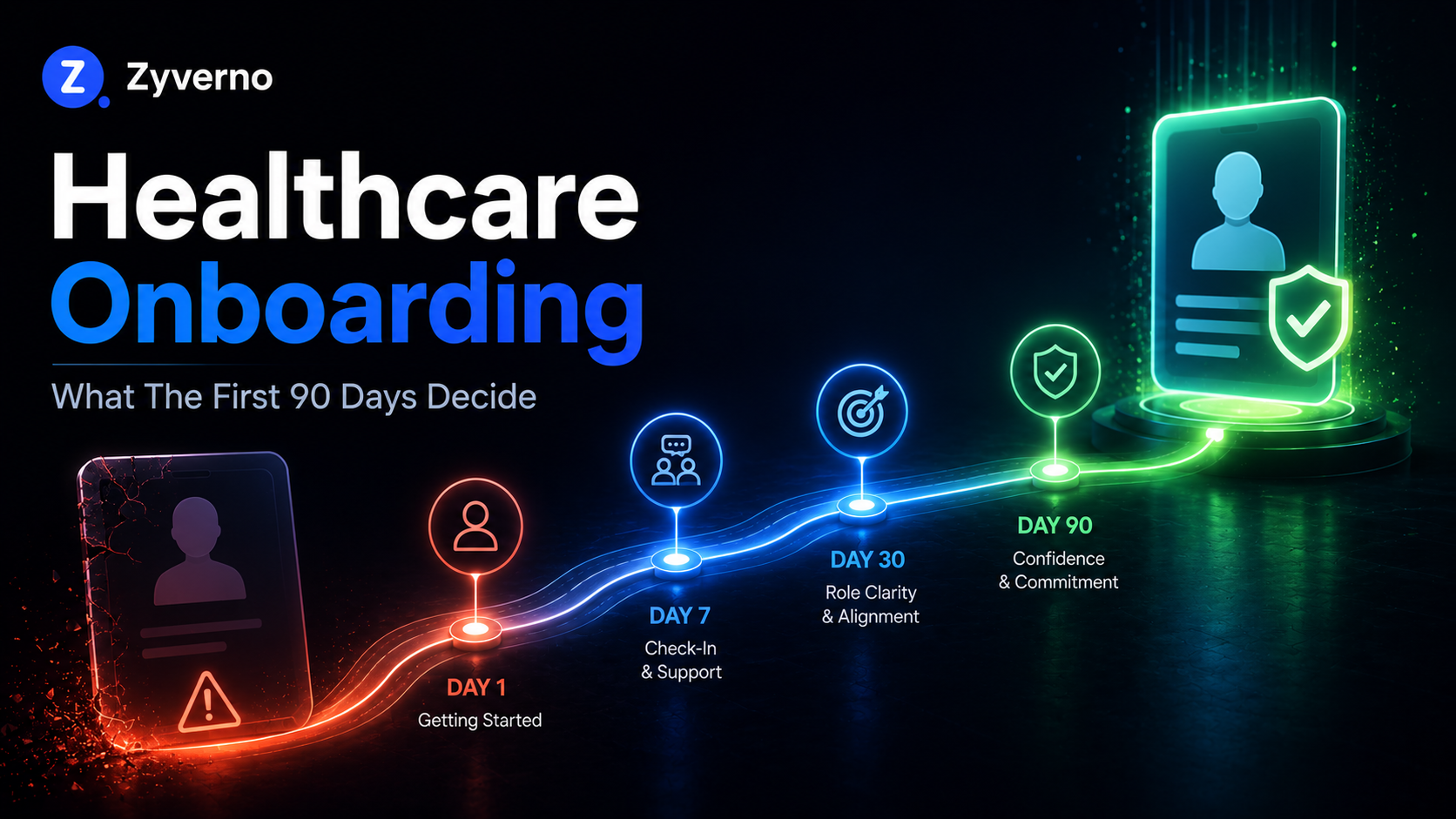
Most healthcare hires who leave do so before the 90-day mark. The 2025 Enboarder HR Leader Survey found that 20.5% of HR leaders report losing up to half of new hires within that window. The standard response is to tighten the compliance checklist: credentials submitted, training modules assigned, probation form signed. That fixes the paperwork. It does not fix the exits.
Key Takeaways
- Most early exits in healthcare happen because the role did not match what was described, not because of pay or working conditions.
- Compliance onboarding and culture onboarding are two separate tracks. Running only the compliance track leaves the retention gap open.
- A check-in conversation at day 7 costs nothing and catches misalignment before it becomes a resignation.
- The month 3 retention conversation is the single highest-leverage moment in the onboarding window. Most managers skip it.
- Mandatory onboarding requirements vary across Australia, the United Kingdom, and the United States. The compliance track must be built for each market.
Why the First 90 Days Are When Most Healthcare Hires Leave
The exits are not evenly distributed across the first year. They cluster in weeks three through six. By that point, a new hire has completed most of the formal compliance requirements. They know the system logins. They have sat through the infection control training. But they are now doing the actual job, and the job often does not match what they were told it would be.
According to People Element's analysis of healthcare exit interview data, the single most cited reason for leaving in the first 90 days is that the day-to-day role was not what the candidate expected. That is a structural problem. It means something said during recruitment did not hold up once the person started working. The compliance track has no mechanism for catching that gap.
A 187-bed community hospital in Washington, DC, documented this dynamic directly. After implementing a structured onboarding program that went beyond mandatory training, new hire turnover dropped from 39.1% to 18.4% for registered nursing staff. The intervention was not a new pay structure. It was a more intentional first 90 days.
The implication is straightforward. You cannot solve a culture and clarity problem with a compliance process. Both tracks have to run together.
The second-most common driver is insufficient support in the first weeks. Healthcare environments move fast. A new hire who cannot quickly identify who to ask for guidance will disengage before the month is out. The research from Hospital Recruiting found that 25% of healthcare employees said the absence of a mentor made their work significantly harder. That is a solvable problem that most onboarding processes simply never address.
Schedule mismatch is the third most common exit driver. A registered nurse or care worker who was told they would have consistent weekend rotations and arrive to find random shift assignments will begin looking elsewhere within weeks. These are not abstract dissatisfactions. They are concrete promises that did not hold.
The Compliance Track: What Week One Must Lock In
The compliance track is the foundation. Without it, nothing else runs. Requirements differ by market, but in all three, they must be confirmed before a hire can begin direct patient or client contact.
Australia
Week 1 must confirm AHPRA registration, a current national police check (no older than six months), Working with Vulnerable People registration for relevant roles, vaccination status verification, and completion of any state-mandated mandatory training modules. For NDIS support workers, Working with Vulnerable People registration is a legal requirement before the person can provide care in the Australian Capital Territory and Tasmania.
United Kingdom
All National Health Service staff must attend corporate induction within eight weeks of starting, with the local induction beginning from day one. The corporate induction covers statutory and mandatory training, health and safety, risk management, and legal obligations. As of May 2025, staff moving between NHS organisations no longer need to repeat core training. New starters still complete the full local induction cycle.
United States
Mandatory training requirements vary by state, but all healthcare employers must complete Form I-9 employment verification, confirm professional licensure with the relevant state board, and complete any federally mandated training for specific roles (infection control, patient rights, HIPAA compliance are universal across settings).
These requirements are non-negotiable. Completing them does not make someone ready to stay.
Alongside the compliance steps, day one should also assign a buddy. This is not a formal mentor. It is a specific named person on the team whom the new hire can ask basic questions without feeling like they are slowing anyone down. The buddy relationship does not need to be permanent. It needs to cover the period when a new hire is most likely to feel isolated, which is the first two to three weeks.
System access should be active before the person arrives. A new hire who spends their first shift waiting for logins to be provisioned learns immediately that this organisation is not well-coordinated. It sets a tone that is difficult to undo.
The Culture Track: What Month One Must Accomplish
The culture track starts at day seven. Not day fourteen. Not at the end of month one. Day seven.
The Day 7 Check-In
A short, structured check-in conversation at day seven serves one purpose: surfacing misalignment before it calcifies into a decision to leave. The questions are simple. Is the role matching what you expected? Is there anything in the first week that surprised you? Do you know who to go to when you need help?
This conversation does not need to be long. Fifteen minutes is enough. The value is not the conversation itself. It is the signal the conversation sends: that the organisation notices whether the person's experience matches what was described, and that someone is paying attention.
The Day 30 Conversation
At day 30, the conversation changes. This is the role clarity conversation. By this point, the new hire has done enough real work to have an informed view of the role. Ask them to describe what their job actually involves in practice. Compare that with what was in the position description. Where they differ, address it directly. Do not wait for the person to raise it.
A hire who reaches month one without anyone asking whether the role is what they expected will assume that their experience is either normal or irrelevant. Both assumptions accelerate exit decisions.
The month one milestone also requires a named point person for ongoing questions. Not a general "feel free to ask anyone" instruction. A specific person. Research consistently shows that ambiguity about who to ask is one of the fastest ways to make a new hire feel unsupported.
For recruiting teams managing high volumes, Zyverno's AI screening agent can automate pre-start check-in messages and structured touchpoints before day one, so the culture track begins before the hire even walks through the door.
Month Three: The Retention Conversation
The third-month conversation is the most important and the most skipped.
Why Most Organisations Get This Wrong
Most organisations treat month three as the probation confirmation meeting. A form gets signed. The person is confirmed. The formal process ends. That framing misses the entire point of the window.
Month three is when a healthcare hire has enough information to make a genuine long-term decision. They have seen the roster in practice. They have navigated a difficult shift or a challenging patient situation. They have formed opinions about their manager and their team. They are in a position to tell you exactly what would make them stay and what does not match what they expected.
What to Ask
Ask directly. What would need to be true for you to still be here in two years? What is not matching your expectations right now? What do you need from your manager that you are not currently getting?
These questions feel direct because they are. That directness is the point. A hire who is asked those questions explicitly, and who gets a genuine response to their answers, experiences something most healthcare workers have rarely encountered from an employer: the sense that their long-term presence is being planned for rather than assumed.
The cost of not having this conversation is an exit that happens at month four or five, after the person has decided quietly that nothing is going to change.
The two tracks are not in competition. Compliance requirements are non-negotiable. But compliance onboarding alone produces a legally covered, disengaged workforce. Adding the culture track does not require a specialist programme or a budget line. It requires three conversations at defined points: day 7, day 30, and day 90. Most healthcare managers are capable of having those conversations. Most are never asked to.
High turnover in healthcare is driven heavily by the recruiting and onboarding experience. Poorly executed onboarding is one of the most significant drivers of recruiter burnout in healthcare organisations, because the same roles cycle back to the hiring funnel repeatedly. Better retention starts before the first shift and extends through the first quarter.
Frequently Asked Questions
How long should healthcare onboarding last?
The compliance track typically spans the first two weeks, with some credential verifications requiring longer lead times. The culture track runs through the first 90 days, with structured touchpoints at day 7, day 30, and day 90. Beyond that, retention conversations should happen regularly, but are most critical in the first quarter.
What is the difference between compliance onboarding and culture onboarding?
Compliance onboarding covers the legally required elements: credential checks, mandatory training, system access, and background verification. Culture onboarding covers the human experience of starting a new role: role clarity, supervisor relationship, team integration, and alignment between what was promised during recruitment and what the job actually involves in practice. Both are necessary.
Why do healthcare hires leave in the first 90 days?
The most common reason is that the day-to-day role did not match what was described during recruitment. The second is insufficient support or supervision in the early weeks. Schedule and terms mismatches are also significant. Pay is cited less often than operators expect. The interventions that make the biggest difference are structured early conversations, not financial adjustments.
What is required for healthcare onboarding in Australia?
Australian healthcare employers must verify AHPRA registration for registered professionals, conduct a national police check dated within six months, confirm vaccination status, verify Working with Vulnerable People registration for relevant roles, and ensure completion of mandatory training modules before direct care begins. Requirements vary by state and territory.
What happens if onboarding is only compliance-focused?
Early exit rates remain high. Compliance onboarding confirms a person is legally permitted to work. It does not confirm they understand their role, feel supported, or intend to stay. Organisations that run compliance-only onboarding tend to see exits peak at weeks three through six, after mandatory training is complete but before any genuine connection to the role or team has formed.
How does the month 3 retention conversation work in practice?
It is a direct, one-to-one conversation between the new hire and their manager. The manager asks three questions: what would make you stay long-term, what does not match your expectations, and what do you need from me that you are not getting. The conversation is documented and followed up on within two weeks. It is not a performance review. It is a retention investment.