
Healthcare Time to Fill: What's Actually Slowing Hiring
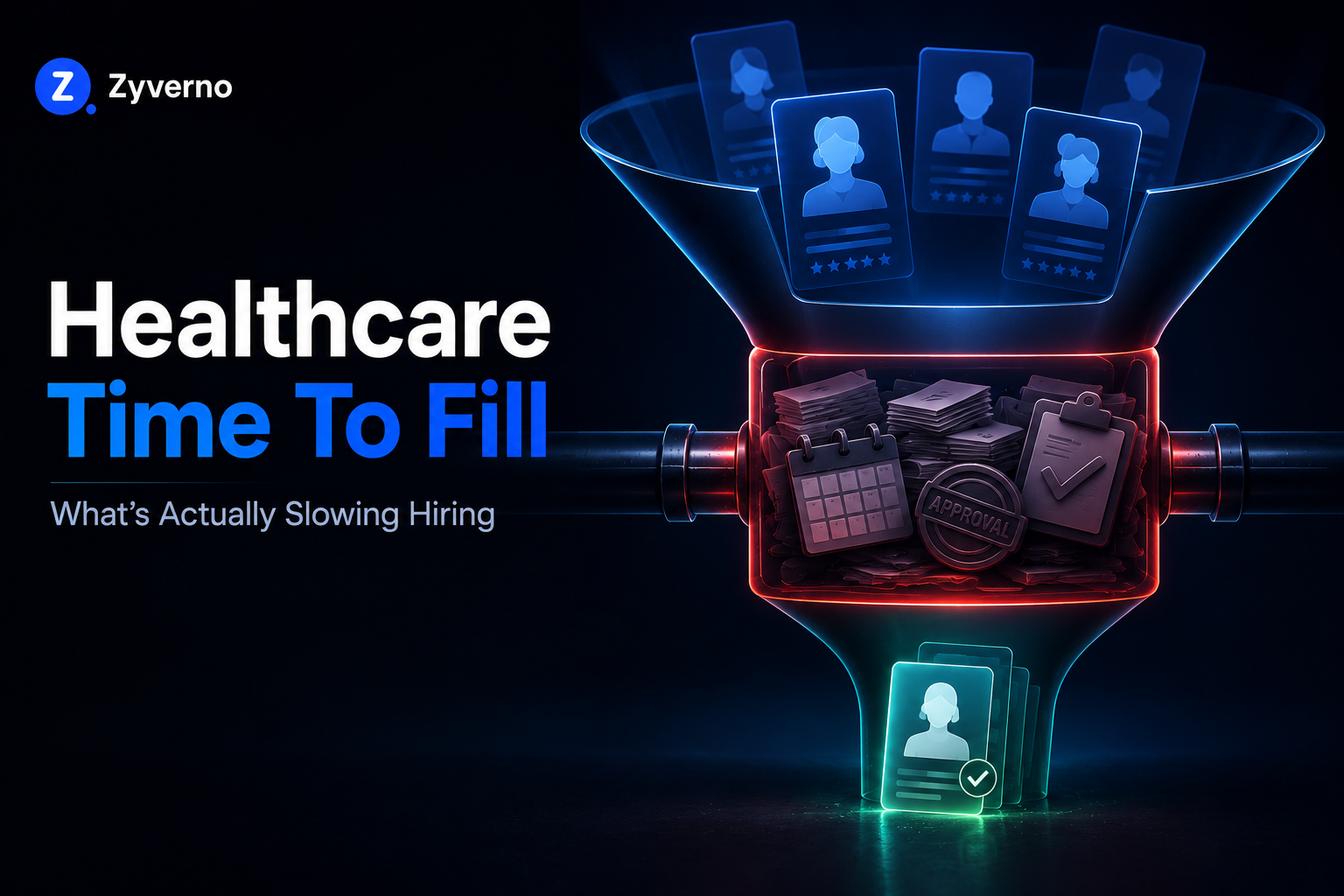
Most operations managers assume a slow hire is a sourcing problem. Sometimes that is true. But in a large share of healthcare vacancies that drag past six weeks, the bottleneck is internal: an approval waiting on a senior leader, a hiring manager who has not returned interview feedback, an offer letter stuck in a review queue, or a background check that nobody chased.
This article is for operations managers and human resources teams with a role that has been open longer than it should be, and who need to find exactly where the hold-up is.
Key Takeaways
- Healthcare roles average 56 days to fill. Most of the delay sits in the middle of the funnel, not at sourcing.
- The four internal bottlenecks are approval chains, hiring manager feedback lag, offer generation delays, and background check timing.
- Most organizations find the drag concentrated in stages three and four after auditing their funnel.
- Target a verbal decision within 48 hours of the final interview and a written offer within two business days.
What Time to Fill Measures
Time to fill counts the days between a job requisition being approved and a candidate accepting an offer. It is a funnel measure, not a quality measure. A long time to fill means the pipeline moved slowly, not that you hired the wrong person.
The distinction matters because it tells you where to look. Quality problems require screening fixes. Speed problems require a funnel audit.
According to Checkr's 2024 Healthcare Hiring Trends analysis, it takes an average of 56 days to fill an open healthcare position, with 37 of those days between application receipt and hire date. Most of the delay is not at the top of the funnel. It is in the middle, where candidates are already identified.
For registered nurse roles, the 2026 NSI National Health Care Retention and Registered Nurse Staffing Report puts the average recruitment time at 78 days. Entry-level roles (medical assistants, care assistants) fill in 15 to 30 days. Specialty roles run 90 to 130 days.
The range maps directly to where approvals, credential checks, and decision-making authority are bottlenecked in each organization.
Average time to fill by healthcare role type
Calendar days from approved requisition to accepted offer
Sources: Checkr 2024 Healthcare Hiring Trends; NSI 2026 National Health Care Retention and Registered Nurse Staffing Report. Bar widths are proportional.
The Real Bottlenecks
A candidate shortage and a slow process produce the same outcome. They require completely different interventions.
Approval chains that stall before the process starts
In many healthcare organizations, a role cannot be posted until a department head, finance lead, and sometimes a clinical committee have all signed off on the requisition. Each of those handoffs adds days. If approvals sit in email inboxes, a single unavailable stakeholder can add two weeks before a job is even visible to candidates.
The fix is simple in principle: build a parallel approval workflow with a deadline. Approvals that do not move within three business days escalate automatically.
Hiring manager availability and feedback lag
When hiring managers are running wards and coordinating patient care, interview scheduling falls to the bottom of their day. A candidate finishes a first-round interview. The hiring manager means to review it, but is pulled into a shift emergency. Three days pass. The candidate has moved on.
Feedback lag compounds this. The process moves at the speed of the slowest scorecard. Set a 24-hour submission window with a hard escalation path.
Interview scheduling as a hidden delay
Interview scheduling sounds like a minor administrative task. It is not. Research into recruiting operations consistently shows that coordination between candidate availability and clinical staff calendars consumes a disproportionate share of total hiring time.
Nurses and allied health candidates are often interviewing at multiple facilities at once. A scheduling exchange that takes four or five emails back and forth, spanning two or three days, can cost you the candidate entirely. The operations teams using automated scheduling tools cut this to under two hours. The ones relying on email chains can lose four to seven days at this stage alone.
Time Consumed per Funnel Stage: Registered Nurse Example
Bar width shows the maximum typical days for each stage. Stages three and four account for most avoidable delay.
Offer generation and approval delays
Once a hiring decision is made, the time between "we want to hire this person" and "offer letter in their inbox" is frequently longer than it needs to be.
In organizations where compensation requires HR approval, finance sign-off, and sometimes a clinical director review before a letter can go out, a candidate can wait five to eight business days after a verbal decision before they see anything in writing. In a tight market, that window is enough for a competing offer to land and be accepted.
The candidate is not waiting because they are undecided. They are waiting because your organization has not produced the paperwork.
Background check and credential verification timing
Healthcare background checks cover license verification, criminal history, exclusion screening, drug testing, and prior employer references. The process is not the problem. The timing is.
Many organizations begin credential verification only after an offer is accepted. That pushes 10 to 21 days of background check time entirely outside the hiring window and into the pre-start period. If a result requires review, the start date slips further.
Organizations that run preliminary license verification and exclusion screening during the final interview round, using a conditional offer process, move that work into a parallel track. The post-offer period is shortened by the same number of days.
How to Audit Your Funnel
Pull your last 15 to 20 hires and calculate the average time at each of these four stages:
- Days from requisition approval to job posting going live
- Days from first application to first screening call or interview invite
- Days from screening to final interview to decision
- Days from verbal decision to signed offer letter
Stage one over five business days: the bottleneck is upstream, approval chains, or position control.
Stage tw,o over three to five days: recruiter capacity or manual review queue.
Stage three over 14 days for a non-specialty role: interviewer availability or scorecard completion speed.
Stage four over five business days: offer generation workflow, compensation approval, or background check sequencing.
Most organizations find the drag concentrated in stages three and four.
Funnel audit: what your numbers are telling you
If your average stage time exceeds the threshold, the bottleneck column identifies the likely cause. Pull data from the last 15 to 20 hires.
Approval chain or position control delay. Missing backup approver.
Recruiter capacity. Manual review queue. Business-hours-only outreach model.
Interviewer availability. Scheduling lag. Slow scorecard submission. Panel format with no deadline.
Compensation sign-off. No offer template. Background check sequencing starting after offer rather than in parallel.
Run this audit on your last 15 to 20 hires. Most organizations find avoidable drag in stages 3 and 4. Fixing both together typically cuts 10 to 18 days off total time to fill.
The Candidate Window
Nurses and allied health professionals in active searches typically interview at three to five facilities at once. Nursing forums consistently reflect this reality: candidates report receiving only one to two days to accept before a facility moves to the next person on the list.
Candidates who do not hear back within a week of their final interview assume they were not selected. They accept elsewhere. By the time your process produces an offer, the candidate has moved on.
The Bullhorn GRID Recruitment Trends Report found that 70% of healthcare candidates have given up on a promising opportunity because the hiring process took too long. That is not a sourcing failure. It is a process failure.
Target a verbal decision within 24 to 48 hours of the final interview and a written offer within two business days. Pre-building offer templates with approved compensation bands eliminates most of the letter generation delay.
For a closer look at what this process looks like for registered nurse roles specifically, see how to hire registered nurses.
What Compressing Each Stage Looks Like
For requisition to posting: automate approvals with a maximum three-day window and a designated backup approver when the primary is unavailable.
For application to first contact: set a 24-hour maximum response time. Automated screening and qualification calls can happen outside business hours, which matters because many healthcare applicants submit after shifts.
For screening to decision: build structured interview templates that let hiring managers evaluate in 15 to 20 minutes. Enforce scorecard submission within 24 hours and assign a backup reviewer when that window is missed.
For the decision to offer: pre-approve compensation bands by role so the offer letter requires no new financial sign-off. Use templates. Target a signed letter within 48 hours of verbal decision.
For credential and background check: run preliminary license verification and exclusion screening during the final interview round using a conditional offer process. This converts background check time from a post-offer delay into a parallel track.
Tools like Zyverno can help compress the screening and scheduling stages. Lina, Zyverno's AI agent, screens and schedules candidates around the clock, removing the email back-and-forth that commonly adds four to seven days between first contact and interview.
For a broader view of what reduces cost alongside speed, see the guide to reducing healthcare hiring costs.
Frequently Asked Questions
What is a good time to fill a benchmark for healthcare roles?
For non-specialty clinical roles, 30 to 45 days is achievable with a streamlined process. The industry average is 56 days, and 78 days for experienced registered nurse hires, according to NSI benchmarks. Consistently above 60 days for a standard clinical role means fixable process inefficiencies, not an unfilled talent gap.
How long do healthcare candidates typically wait before accepting another offer?
Nurses and allied health professionals in active searches commonly give employers one to two days before moving on. Candidates who do not hear back within a week of a final interview assume rejection and accept elsewhere. Target a verbal decision within 24 to 48 hours of the final interview.
Does starting background checks earlier reduce time to fill?
Yes. Healthcare background checks typically run 10 to 21 days. Running preliminary license verification and exclusion screening during the final interview round, under a conditional offer framework, moves that work out of the post-offer period entirely. The start date is compressed by the same number of days.