
How to Hire Field Sales Reps That Actually Perform
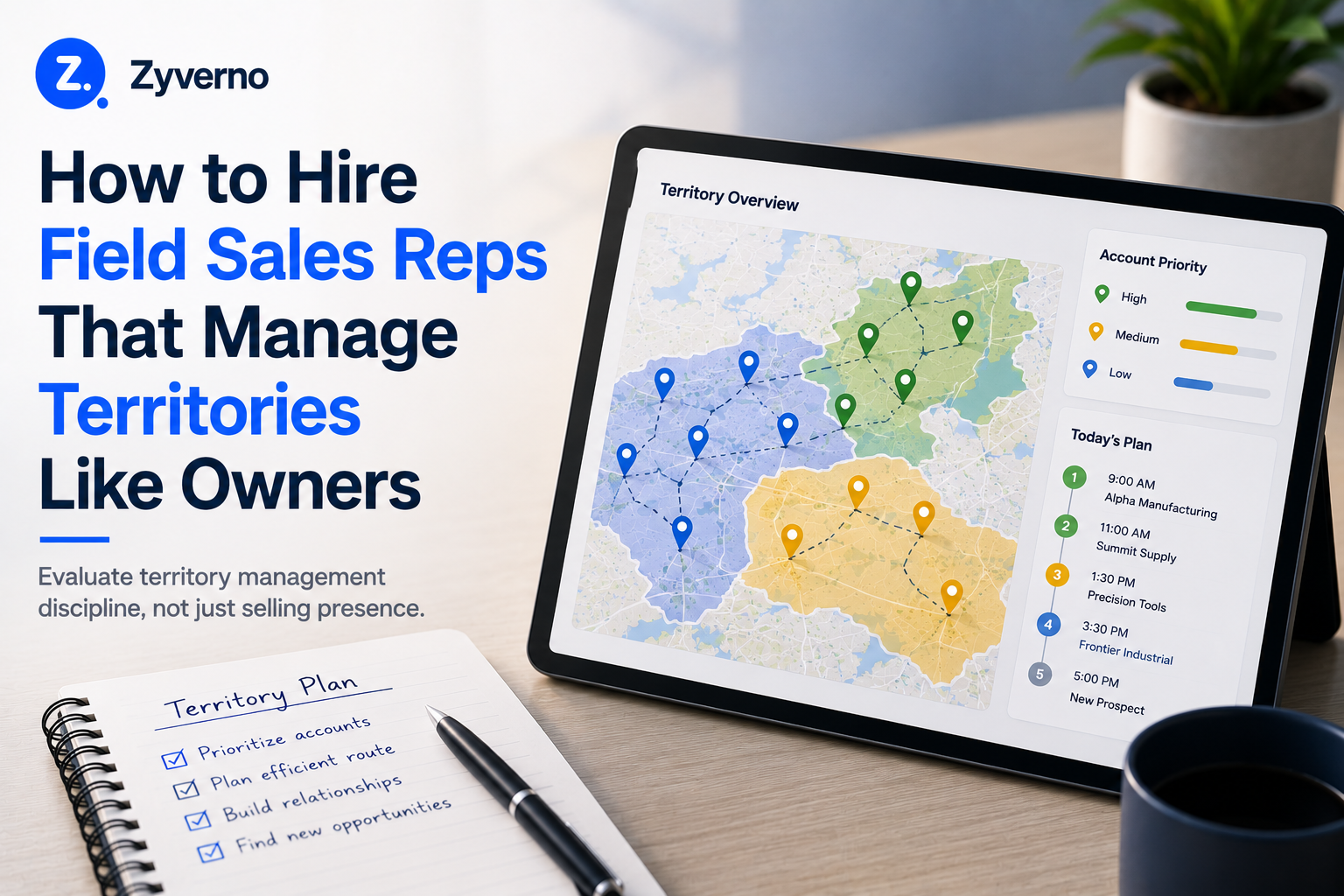
To hire field sales reps who build sustainable revenue, evaluate territory management discipline, not just selling presence. The competency that separates reps who hit quota from those who stay busy is methodical account prioritization, documented coverage planning, and self-management across geography. This guide covers how to evaluate for it and what the interview process should include.
Key Takeaways
- Field sales performance depends on territory management as much as selling skill; evaluate both, not just selling presence.
- According to the U.S. Bureau of Labor Statistics Occupational Outlook Handbook, sales representative roles requiring significant travel remain in stable demand, but rep retention in these roles is consistently lower than inside roles due to isolation and self-management challenges.
- The highest-signal interview exercise for field sales candidates is a territory planning exercise, not a mock call.
- What to test: account prioritization logic, customer relationship management system discipline, time management across geography, and the ability to source net-new accounts within a territory
- Physical territory roles have specific attrition risks that don't apply to inside roles: isolation, driving fatigue, and the absence of peer accountability.
What Makes Field Sales Harder to Evaluate
Inside sales candidates can be evaluated on structured phone or video calls. The evaluation is logistically clean, and the skills being tested (call structure, discovery questions, objection handling) translate directly to the day-one work. Remote sales roles follow a similar model with some adaptation for asynchronous selling.
Field sales is different. The rep will be working alone, covering accounts spread across geography, making judgment calls every day about which accounts to prioritize, when to call ahead versus drop in, how to manage multi-site accounts, and how to fill gaps in their schedule efficiently.
How the Interview Process Differs: Inside Sales vs. Field Sales
Same evaluation stage, different method. The job is different.
Evaluation Stage
Inside Sales
Field Sales
Initial Screen
Structured phone screen testing call tone and pitch clarity
Phone screenStructured phone screen testing territory logic and tolerance for daily driving
Phone screenSkills Assessment
Mock discovery call (15 to 20 minutes) testing question structure and listening
Role-playMock cold call combined with territory account prioritization question-and-answer
Role-play + territory Q&APractical Exercise
Objection handling scenario: candidate responds live to a common pushback
Live scenarioTerritory planning exercise: 200 accounts, four field days, 60-day plan with account tiers and routing logic
Territory exerciseKey Red Flags
Talks more than listens; skips agenda-setting at the start of the mock call
Watch for thisNo system for account tiering; cannot explain routing logic or how they allocate field days
Watch for thisThese are not skills that appear in a conventional interview. A rep can describe their territory approach in compelling terms and still have no real system. The evaluation has to go further.
Before reaching the interview stage, the applicant pool for field sales roles still needs basic qualifications: relevant experience, territory type match, available to travel, and compensation aligned. For teams managing significant application volume, Zyverno handles this layer before a recruiter gets involved, screening every applicant via voice or chat and scoring against the role criteria. The recruiter's first interaction with the candidate is already past the triage stage.
Writing the Job Description
Field sales job descriptions frequently underspecify the role. They list generic selling skills when the role-critical information is geographic: territory size, expected days in the field per week, account type mix, and whether the rep is building from scratch or inheriting an existing book.
Candidates coming from field roles want to know these specifics. A rep who has been managing 150 accounts across a regional territory is evaluating whether your 300-account national territory is a step up or an overextension. A rep who has only managed inherited accounts wants to know whether they'll be expected to open net-new business.
Include in the job description: travel percentage, territory geography, account tier breakdown, and a description of what a successful first 90 days looks like in terms of observable activity. This level of specificity attracts candidates who are genuinely suited to the role and filters those who aren't.
What Good Field Sales Candidates Look Like
Territory management system
Ask every candidate: "Describe how you manage your territory week to week. How do you prioritize which accounts to visit? How do you make decisions about time allocation?"
A candidate with a real system can answer this precisely. They segment accounts by opportunity and relationship status. They have a call cadence.
They track coverage across their geography so they're not neglecting one region while over-servicing another. They know which accounts are strategic versus transactional.
A candidate without a system will describe territory management in impressionistic terms: "I try to stay organized," "I know my territory well," "I focus on the relationships that matter." These are descriptions of intentions, not systems.
Self-sourcing behavior
Field reps in most territories are expected to develop some net-new business, not just manage a transferred account list. Ask directly: what percentage of your current book did you personally open versus inherit? How do you approach generating net-new leads in a geographic territory?
Reps who have only managed inherited accounts haven't proven they can build. The skill sets are related but not identical.
Customer relationship management system discipline
A field rep with poor customer relationship management system hygiene is invisible to their manager. If the notes aren't in the system, the manager can't coach on what they can't see.
Ask how candidates describe their system. Do they log call notes the same day? Do they track next steps and use activity data to plan their coverage?
The honest answer to this question reveals a lot. "I try to keep it updated" is different from "I log every interaction the same day, including drop-in visits, and I set a follow-up task before I close the record."
Retention under isolation
Field sales is structurally isolating. The rep works alone most of the day. They rarely have the team environment that inside reps get from a shared floor. This isolation is a significant driver of attrition in field roles.
Ask about motivation and self-management directly. How do they maintain focus on a day when their first three calls cancel, and they're driving between appointments alone? What's their approach to processing rejection when there's no team around to decompress with?
The candidate who has a real approach to this is more likely to stay.
Route and time efficiency
A field rep who doesn't plan geography spends a significant portion of their week in transit between appointments that could have been clustered. Ask candidates how they plan their routing.
Do they batch appointments geographically by day? Do they factor in drive time when setting their call cadence? Do they use any system for route optimization?
This is a practical skill with direct revenue impact. A rep who visits accounts in the order they're called rather than grouping them by geography loses hours per week.
The Territory Planning Exercise
The highest-signal single evaluation for field sales candidates is a territory planning exercise.
Give the candidate a hypothetical territory: 200 accounts of varying sizes across a defined geographic area. They have four days per week for in-person visits and one day for administrative work and phone follow-up. They have access to basic account data: annual revenue, current product usage, and last visit date.
Ask them to describe how they would approach the first 60 days. Which accounts do they prioritize first? How do they structure the geography to minimize drive time?
What does their call cadence look like for different account tiers? How do they handle accounts they haven't been able to reach?
A candidate who can answer this coherently is demonstrating territory management thinking. The candidate who defaults to "I'd visit the biggest accounts first and go from there" has a much thinner system.
This exercise can be done live in the interview or assigned as a take-home and reviewed in a follow-up conversation.
What a Strong Territory Plan Looks Like
A candidate with a real system can describe this structure in five minutes. Use it as a benchmark when evaluating the territory planning exercise.
Account Tier Structure
200 accounts across a defined territory
Tier 1: Strategic
Top 20 accounts
Quarterly in-person visits minimum. Decision-maker mapped and logged. Proposal pipeline active.
Tier 2: Growth
Next 50 accounts
Monthly in-person or phone visit. Opportunity sized. Moving toward first proposal or expanded order.
Tier 3: Maintenance
Remaining 130 accounts
Quarterly contact cycle. Transactional relationship. Monitored for signals of growth potential.
Weekly Schedule Template
4 field days, 1 admin day
Monday
Tier 1 accounts, east cluster. No cold drops. Pre-booked visits only.
Tuesday
Tier 2 accounts, north cluster. Mix of booked and warm drop-in visits.
Wednesday
Admin day. Phone follow-ups, customer relationship management system updates, proposal prep, pipeline review.
Thursday
Tier 1 and Tier 2 mixed, south cluster. Anchor on one Tier 1 visit, fill route with Tier 2.
Friday
Pipeline review, week close-out, next week route planning. Customer relationship management system fully updated before end of day.
A candidate who can describe this level of structure in 5 minutes has a real system. A candidate who says "I'd start with the biggest accounts" does not.
Role-Specific Interview Questions
On territory prioritization: "Describe how you divided your last territory into tiers. What criteria did you use to decide which accounts got the most of your time?"
On new business development: "Tell me about an account you opened from scratch in the last 18 months. How did you first identify them, and what was your approach to getting the first meeting?"
On rejection and isolation: "Walk me through a week where nothing went right: cancelled appointments, no-shows, a deal you were counting on fell through. How did you handle it?"
On multi-site account management: "If you have an account with locations in three different cities within your territory, how do you manage the relationship and ensure coverage at each site?"
On customer relationship management system and reporting: "Describe what your system looks like at the end of a typical field day. What do you log, and how do you use the data for planning?"
On route efficiency: "How do you plan your weekly schedule? Walk me through how you structured a recent week with multiple accounts across a spread geography."
Field Sales Interview Questions: What to Ask and What to Listen For
Standard interview questions don't surface field-specific competencies. Use these instead.
Territory prioritization
"Describe how you divided your last territory into tiers. What criteria did you use to decide which accounts got the most of your time?"
Listen for: Named criteria (revenue potential, relationship stage, last visit date) and a clear segmentation method. "I focused on the best accounts" is not a system.
New business development
"Tell me about an account you opened from scratch in the last 18 months. How did you first identify them?"
Listen for: A specific account with a specific sourcing method. Reps who have only managed inherited accounts won't have this story.
Isolation and resilience
"Walk me through a week where nothing went right: cancelled appointments, no-shows, a deal you were counting on fell through. How did you handle it?"
Listen for: A concrete routine or reset mechanism, not generic persistence. Reps who can't describe this don't have one.
Customer relationship management system discipline
"Describe what your customer relationship management system looks like at the end of a typical field day. What do you log, and how do you use the data for planning?"
Listen for: Same-day logging, specific note types, follow-up tasks set before closing the record. "I try to keep it updated" signals a problem.
Compensation Structure for Field Sales Reps
Field sales compensation typically includes a higher base than equivalent inside roles to account for travel burden and associated expenses. Variable compensation tied to territory performance is standard. The base-to-variable split depends on the role's emphasis on new business versus account management.
Clarify expense reimbursement structures early. Mileage reimbursement, car allowances, and per-diem arrangements vary widely and affect total compensation expectations. Candidates coming from roles with different expense structures may have different assumptions about what the package actually covers.
Onboarding Field Reps Differently
Field reps need a different onboarding approach than inside reps. They don't have a floor to learn from by observation. They're not sitting next to experienced reps whose calls they can hear. Their learning environment is largely self-directed.
The first 30 days should be structured to avoid the worst outcome: putting a new field rep into their territory without product knowledge, competitive context, or any ride-along time with an experienced rep. Ride-alongs with top performers in adjacent territories are one of the most valuable investments in field rep onboarding.
Define what success looks like at 30, 60, and 90 days in terms of observable activity: accounts visited, proposals delivered, and existing accounts contacted. Not sales necessarily; pipeline development is the leading indicator during ramp. For a breakdown of how ramp timelines vary by role type, see sales rep ramp time industry benchmarks.
Frequently Asked Questions
How do you hire field reps in a new territory where there's no existing team to ride along with?
Bring the candidate to your headquarters for a week of structured product and sales training before they go into the territory. Assign a more experienced remote mentor for weekly check-ins during the first 90 days. The absence of a local team increases the onboarding investment required, not decreases it.
What's the realistic ramp time for a field sales rep?
For business-to-business field roles with complex products: four to six months to generate initial pipeline, six to nine months to first-year quota contribution. For simpler transactional field roles, two to three months is achievable. The ramp is longer than inside sales for most role types because territory coverage takes time to build.
How do you verify a field rep's territory performance claims?
Reference calls with their prior manager. Ask specifically: how was this person's territory coverage? Did they build their own book or primarily manage what was handed to them? What was their attainment against the territory quota? Managers who have managed field reps will know the right questions to answer.
How important is local market knowledge for a field rep hire?
More important than in inside roles. A field rep who knows the geography, has existing relationships with local businesses, and understands regional buying patterns has a meaningful advantage in the early months. For new territories where local knowledge doesn't exist, prioritize self-generation track record and territory-building experience over industry familiarity.