
How to Use Data to Evaluate Sales Candidates Before the First Call
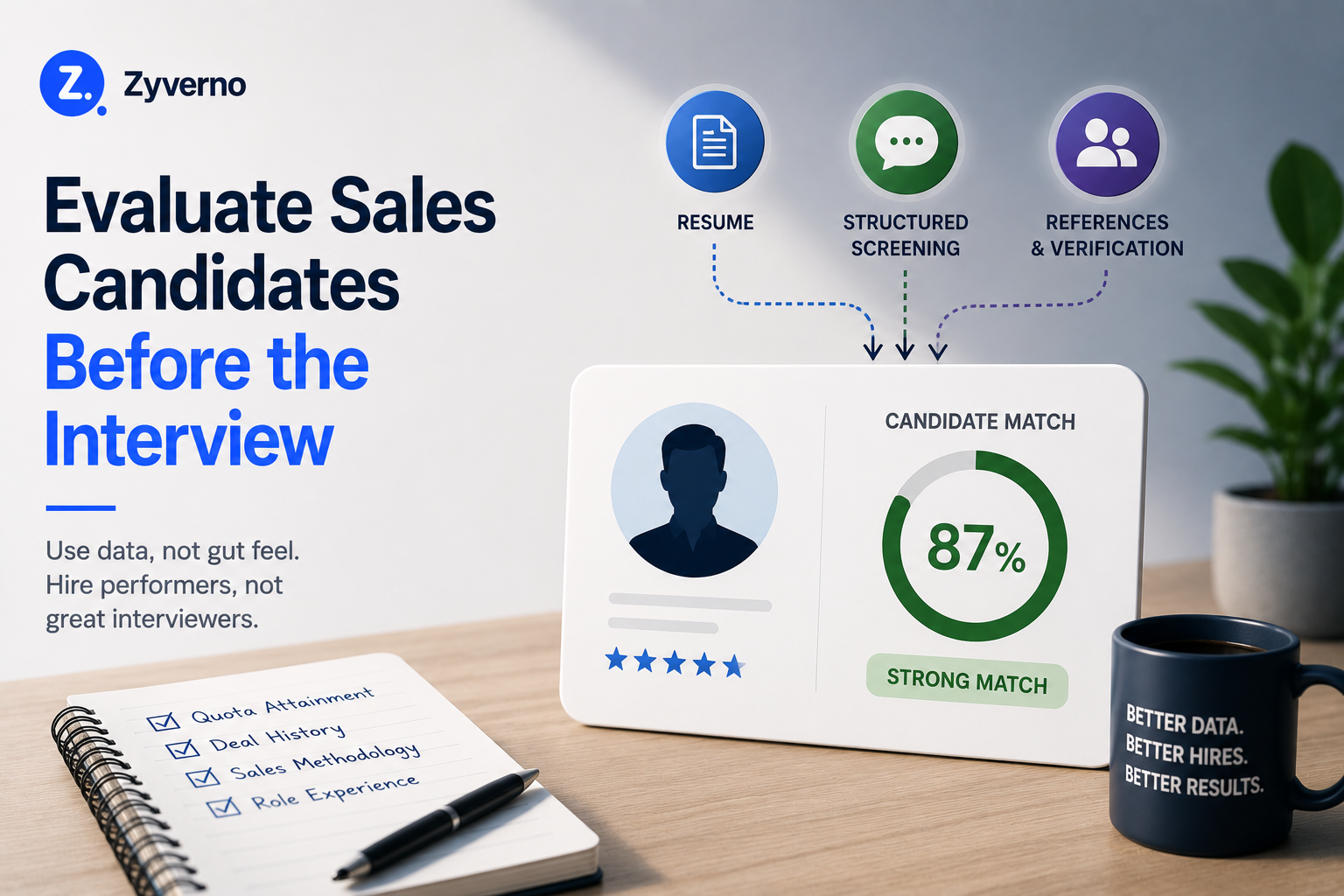
Evaluating sales candidates primarily in interviews selects for confident self-presentation. That skill overlaps with, but is not identical to, the ability to prospect, manage a pipeline, and close. Data-driven pre-interview evaluation adds an objective signal before anyone has invested an hour: structured responses about performance history and role-specific qualifications that interviews do not naturally surface. This guide covers what to collect and how to use it.
Key Takeaways
- Interviews favor confident self-presentation, not demonstrated performance. Pre-interview data adds an objective layer before any recruiter's time is spent.
- Quota attainment is the single most important pre-interview data point and the one most frequently skipped.
- Resume evaluation should focus on tenure patterns and quantified accomplishments, not company brand or title.
- Reference calls are the most reliable pre-offer data source and the most consistently underused; treat them as an interview, not a checkbox.
- Pre-interview data changes the interview itself: it enables targeted, specific questions rather than generic background reviews.
What Data Can You Collect Before an Interview
There are three sources of pre-interview data for sales candidates:
1. The application and resume. Contains career history, role titles, companies, tenure, and any quantified accomplishments the candidate chose to include. Useful as a baseline, but self-reported and self-curated.
2. Structured screening responses. Responses to specific questions about sales performance, methodology, and role-specific experience. These can be collected via chat, voice, or a written questionnaire. Unlike the resume, these responses are generated specifically for this role and reveal how the candidate thinks and communicates. Tools like Zyverno collect this layer automatically: Lina asks every applicant the same structured questions via voice or chat, scores responses against role criteria, and delivers a ranked profile before any recruiter time is spent.
3. Reference and verification. Quota attainment, performance relative to peers, and specific deal history, confirmed by a third party who worked with the candidate. The most reliable source, and the one most commonly skipped.
Each source answers different questions. Used together, they form a profile that goes meaningfully deeper than what a resume alone shows.
How Easy Is Each Data Source to Manipulate?
Candidates can control what they present, but not equally across all three sources. Understanding which signals can be coached against changes how you weight them.
Resume and application
Easiest to curate
The candidate chooses what to include, how to frame it, and what to leave out. There is no real-time pressure. A professional resume coaching industry exists to optimize every line of language. Treat resume claims as hypotheses to verify, not facts to rely on.
Structured screening responses
Harder to coach
Responses are generated in real time to specific questions the candidate can't fully predict. Nervous hedging, vague language, and inconsistencies surface naturally under specific questioning. A coached candidate can still give strong answers, but coaching to all six screening questions is difficult. High signal for communication quality. Medium signal for factual claims about performance.
Reference calls
Hardest to control
The candidate controls only who they submit as a reference, not what the reference says. A well-structured question like "Would you hire them again?" is very difficult to coach against. The reference is a third party with no incentive to be protective. Highest signal for factual performance claims. A reference who speaks only in generalities is itself a signal worth noting.
The Resume: What to Use and What to Ignore
Most resume evaluation for sales roles focuses on company brand and title, which is the least predictive combination available.
What to use from a resume:
Tenure patterns. A candidate who has spent less than 12 months at each of the last four sales roles has a pattern worth understanding. In some cases, it reflects promotions or company closures. In others, it reflects performance problems or a failure to ramp. Ask about it directly.
Company sales context. Was this a high-growth startup with inbound lead flow and a short sales cycle, or an established enterprise company selling into complex procurement processes? The skills required are different. The deal size, cycle length, and selling motion shape that the candidate has developed.
Quantified accomplishments. When a candidate writes "exceeded quota by 140% in FY2024," that is a claim worth investigating. When they write "responsible for managing the Eastern region," that is a description that reveals nothing about performance. Resumes with no quantified results are missing the most relevant information.
What to minimize:
- School or degree, unless the role has a technical knowledge requirement directly linked to academic background.
- Awards and recognition that are not quantified (for example, "top performer" without specifying what that means).
- Job function descriptions that repeat the job posting back in different words.
Structured Screening: The Questions That Produce Useful Data
Structured screening questions, delivered before the recruiter call, convert the information-gathering that currently happens in the first 20 minutes of every phone screen into a format that can be reviewed at scale and compared across candidates.
The questions that produce the most differentiated data for sales candidates:
Quota and attainment: "What was your quota in your most recent role? What percentage did you attain in your last full year?"
This is the most important question in pre-interview sales evaluation. The candidate's answer is self-reported but creates a reference point. The follow-up: verify it with a reference call.
Pipeline generation: "What percentage of your closed-won deals in the last 12 months came from opportunities you sourced yourself (not from inbound or sales development representative-generated leads)? How did you generate them?"
This separates reps who can sell from those who can sell when the opportunity is handed to them. Both have value, but they are not the same profile.
Deal complexity: "What is the most complex deal you have closed in the last 18 months? Describe the stakeholders involved, the timeline, and what you had to do to advance it."
The specificity and quality of this answer reveal whether the candidate has genuine enterprise selling experience or is describing a more transactional process with complex-sounding language.
Setback recovery: "Walk me through a deal that you were confident you would close but lost. What happened, and what did you do next?"
Candidates who have clean narratives about losses they did not experience, or who describe losses as entirely outside their control, have a signal worth investigating. Strong candidates describe specific mistakes, specific learning, and specific behavioral changes.
Fit motivation: "What specifically attracted you to this role? What in your current or most recent role is not working for you?"
This is not a warm question. It is a data question. A candidate who can articulate specifically why this role fits their career trajectory and what they are moving toward (not just away from) has thought about fit more carefully than one who gives a generic answer.
Pre-Interview Assessment Tools
Structured screening responses are one data layer. Assessment tools add a second layer that is independent of self-reporting.
Cognitive and aptitude assessments. Tools like Wonderlic measure reasoning ability and learning speed, which predict performance in roles with a learning curve. For sales roles with complex products or long sales cycles, cognitive ability is a meaningful predictor of ramp speed.
Situational judgment tests. These present candidates with realistic sales scenarios and ask what they would do. The responses reveal judgment and a decision-making approach. A situational judgment test calibrated for your specific sales motion (enterprise versus transactional, inbound versus outbound) produces a more relevant signal than a generic sales aptitude test.
Role-specific skills exercises. For sales roles, this typically means a cold call role-play, a discovery call simulation, or a deal strategy exercise. These are not screening tools (they require human time to evaluate), but they are more predictive than most interview questions.
The best approach combines multiple data sources. Research on structured hiring consistently shows that combining cognitive ability, relevant experience data, and work sample exercises produces more accurate predictions of performance than any single source alone.
Structuring the Data for Comparison
Pre-interview evaluation is most useful when the data is structured enough to compare across candidates. That means the same questions asked in the same format, with responses scored against a defined rubric.
A simple scoring rubric for quota attainment responses:
What Each Score Sounds Like in a Real Screening Response
The rubric tells you the criteria. These examples show the rubric applied to actual language, with the specific signals that determined each score.
Strong signal
Specific number, 90%+ attainment, context offered
"My quota was $840K in new revenue. I hit 112% in the last full fiscal year, so $943K closed. That was in enterprise software, average deal size around $180K, five to seven month sales cycle. The territory was mostly financial services accounts, 12 strategic targets plus inbound."
Signals present
Exact dollar quota stated. Attainment above 90%. Deal size and cycle length offered without being asked. Territory type named. The candidate explains the conditions that shaped the result, not just the outcome number itself.
Usable signal
Specific number, 70%+ attainment, limited context
"I was above quota last year, I think around 105%. My quota was roughly $600K. I was in a software sales role, mostly mid-market accounts."
Signals present
Specific if approximate number. Attainment above 70%. Limited context: deal size and cycle length not mentioned. Worth exploring in the interview. The "I think" qualifier is worth noting but is not a disqualifier on its own.
Weak signal
Vague, no number, or attainment below 70% without explanation
"I've always been a top performer. I consistently hit or exceeded my targets. Last year was a tough market for everyone, which affected the numbers, but my manager was very happy with my results."
Signals present
No specific quota figure. No attainment percentage. External attribution for the gap. "Top performer" stated without any number to support it. Ask directly in the interview: what was the actual quota figure, and what did you close?
No performance data available
No response or disclosure refused
"I'm not able to share specific numbers due to a non-disclosure agreement with my employer."
What to do
No performance data from this source. This answer is legitimate in some enterprise roles where non-disclosure agreements cover compensation structure. Do not assume it is a red flag. Weight the reference call more heavily and ask the reference directly for quota and attainment figures.
- 3 points: Specific number provided, attainment above 90%, context offered (deal size, cycle, territory type).
- 2 points: Specific number, attainment above 70%, limited context.
- 1 point: Vague ("top performer") or attainment below 70% without context.
- 0 points: No response or unable to provide numbers.
This is not a final decision. It is a comparison tool. A candidate who scores 2 on attainment but 3 on pipeline generation and 3 on deal complexity is a different profile from a candidate who scores 3 across the board. The structured data gives you a basis for that comparison before anyone spends an hour in a room together.
Using Data During the Interview, Not Just Before It
Pre-interview data changes the interview itself. When the recruiter and hiring manager have already reviewed structured screening responses, the interview does not need to gather information that the screening already captured.
Instead of: "Tell me about your sales background."
The question becomes: "You mentioned you generated 60% of your pipeline through outbound in your last role. What was your specific approach to breaking into accounts that had no existing relationship with the company?"
The pre-interview data makes the interview more targeted, more efficient, and more revealing.
How to Interpret the Answers You Get
The article shows which questions to ask. This shows what different answer types reveal, so you know what you are listening for after each data-driven follow-up question.
Pipeline generation
After asking: "You mentioned X% of your pipeline was self-sourced. How did you generate it?"
Strong positive signal
They lead with volume: calls made, emails sent, sequences run
Process-oriented seller. Reliable for outbound roles with clear activity targets. May struggle when the path to pipeline is not pre-defined and requires them to create their own approach from scratch.
Strong positive signal
They lead with a specific account type, persona, or trigger event
Target-oriented seller. Better fit for complex or enterprise selling where quality of outreach outweighs volume. They think about who to contact before thinking about how many to contact.
Explore further
They cannot explain specifically how they generated the pipeline
The pipeline may have come primarily from inbound leads or sales development representative hand-offs they are now attributing to their own outbound effort. Ask directly: "What percentage came from accounts you identified yourself versus leads that were assigned to you?"
Quota attainment follow-up
After getting their attainment number, watch what they do next without prompting
Strong positive signal
They immediately add deal size, cycle length, or territory context
They understand what drove performance, not just what the outcome was. This is a seller who can self-diagnose. Easier to coach because they can identify variables independently.
Strong positive signal
They compare themselves to team average without being asked
They track their own relative performance, not just the absolute number. A rep who knows they were third out of twelve understands how they fit into a competitive environment.
Explore further
Low attainment attributed entirely to external factors
Bad market, management changes, product gaps. These can all be real. But a rep who cannot name their own role in a miss is harder to develop. Ask: "What did you change about your approach in response to those conditions?"
Flag
They get defensive or change the subject
The number is likely unfavorable and they know it. This is not disqualifying on its own, but it does suggest the screening response number may have been optimistic. Weight the reference call heavily before advancing.
Deal complexity
After asking about a specific complex deal they described in screening
Strong positive signal
They name specific stakeholders by role and describe what each person cared about
Genuine multi-stakeholder experience. They were not just present in the deal. They were navigating it. The ability to name what the head of finance cared about differently from the operations lead is not something that can be fabricated convincingly.
Explore further
They describe the deal as a series of things that happened to them
They were present in the deal, but may not have been driving it. Ask what they did specifically to advance each stage. If they can't name a moment where they changed the deal's direction, they were likely not in the driver's seat.
Explore further
The deal they describe is significantly smaller or shorter than what this role requires
A good sign when deal size and complexity match. If their most complex deal is materially below what this role demands, ask why. The gap may be role structure, not capability, but you need to know which before advancing.
It also makes it harder for the candidate to reframe their background, because the interviewer already knows the specifics. For a structured approach to assessing sales skills in an interview, pairing pre-interview data with the right in-room questions produces the most accurate read of a candidate.
Reference Calls as Data
Reference calls are the most reliable pre-offer data source available, and the most commonly underused. Most companies treat them as a checkbox. The companies that use them well treat them as an interview.
Useful reference call questions for sales candidates:
"What was this person's quota in the role where you worked together? What did they attain?"
"Where would you rank them among the reps you have managed in your career? Top quartile? Top half?"
"What was this person's primary strength as a salesperson? What held them back from being even better?"
"Would you hire them again if you had an appropriate role?"
The answer to the last question tells you more than any of the preceding ones.
Reference Call Answer Guide
Four questions to ask every sales reference, and how to read what you hear
"What was this person's quota, and what did they attain?"
Specific number, matches what the candidate said
The reference answers without hesitation and the figure aligns with or exceeds the candidate's own claim. Confirms consistency under third-party questioning.
Vague, deflects, or contradicts the candidate's claim
"I'm not sure of the exact number" from a direct manager is a flag. So is a figure that is meaningfully lower than what the candidate reported in screening.
"Where would you rank them among the sales representatives you have managed in your career? Top quartile? Top half?"
Clear quartile answer with a specific comparison
"Top 10% of everyone I've managed" or "best on the team by revenue in year two." The reference has enough conviction to give a number, not just a compliment.
Hedges the ranking or pivots to personality
"Hard to say, everyone has different strengths" or an immediate pivot to attitude and coachability. Praising character while avoiding performance ranking is a pattern worth probing.
"What was their primary strength as a salesperson? What held them back from being even better?"
Specific strength and a real, bounded limitation
"Best at discovery, sometimes rushed the close" or "strongest on outbound, less patient with long procurement cycles." A specific strength plus a genuine limitation that does not disqualify them is a sign the reference is being honest.
Only positives, or the "limitation" is a non-answer
"They could sometimes be too driven" or "nothing held them back, really." A reference who cannot name a single real limitation is either protecting the candidate or has not managed them closely enough to know.
"Would you hire them again if you had an appropriate role?"
This question tells you more than any of the others combined.
Immediate and unconditional yes
"Without question" or "I actually tried to rehire them last year." No hesitation. No qualifying conditions. A manager who has managed someone through real difficulty and would still take them back is giving you the clearest signal available.
Pause, a conditional yes, or a redirect
"It depends on the role" or a long pause before answering. Redirecting to a positive memory instead of answering the question directly is an answer. A conditional yes from a former direct manager is a signal to take seriously before advancing to an offer.
One specific signal: reference calls where the person speaks very generally ("great attitude, worked hard, really coachable") without any specific performance data are worth noting. They can mean the reference is being protective, or they can mean the candidate's accomplishments were not memorable. Either signal is worth investigating.
What the Data Does Not Tell You
Pre-interview data evaluation surfaces the candidates worth talking to. It does not make the hire.
The things that only emerge in human conversation:
- How the candidate handles pressure in real time.
- Whether their presence, energy, and communication style fit the role's demands.
- Whether there is genuine motivation for this specific opportunity or just generic job searching.
- How they treat people who are lower in the hiring hierarchy (often more revealing than how they treat the hiring manager).
Pre-interview data is the qualification layer. The interview is the evaluation layer. Both are necessary. The purpose of improving the data layer is to make the evaluation layer more precise, not to replace it.
Frequently Asked Questions
Is it legal to ask candidates about their compensation history?
In many US states, asking about prior compensation history is restricted or prohibited. Asking about quota and attainment is different: it is about performance metrics, not compensation. Consult current state-specific requirements and legal counsel if unsure.
How do you handle candidates who refuse to provide quota numbers?
Some candidates, particularly those in enterprise roles with non-disclosure agreements, may be unable to share specific numbers. This is legitimate and should not be treated as an automatic disqualifier. In those cases, ask about performance relative to peers ("were you above, at, or below team average?") and weight reference call information more heavily.
How many screening questions should you ask?
For a sales development representative or inside sales role: 4 to 6 targeted questions. For an account executive: 6 to 8. For a manager: 6 to 8 with a different focus. More than 10 questions creates a drop-off in completion rates. If you cannot qualify the candidate in 8 questions, the questions need to be sharper, not more numerous.
Should you use the same screening questions for every sales role?
No. The questions should reflect the specific selling motion of the role. A sales development representative's screen focuses on outbound activity discipline and early pipeline signals. An account executive screen focuses on deal complexity and quota attainment. A sales manager's screen focuses on team development and coaching approach. Using a generic sales screen for all three produces data that is too blunt to be useful.
Frequently asked questions
Related articles
The Holiday Hiring Horror Story
Discover how Zyverno can streamline your holiday hiring process, ensuring you don't lose top candidates during peak times.
salesAI recruitment is only for tech roles?
Discover how AI recruitment helps streamline hiring for all roles, not just tech. Improve efficiency and decision-making with Zyverno.
salesWhere candidate experience starts
Improve your candidate experience from the job ad to interview. Discover tips to streamline hiring and engage applicants effectively.