
Why Sales Reps Quit: The Real Reasons and What to Do About Them
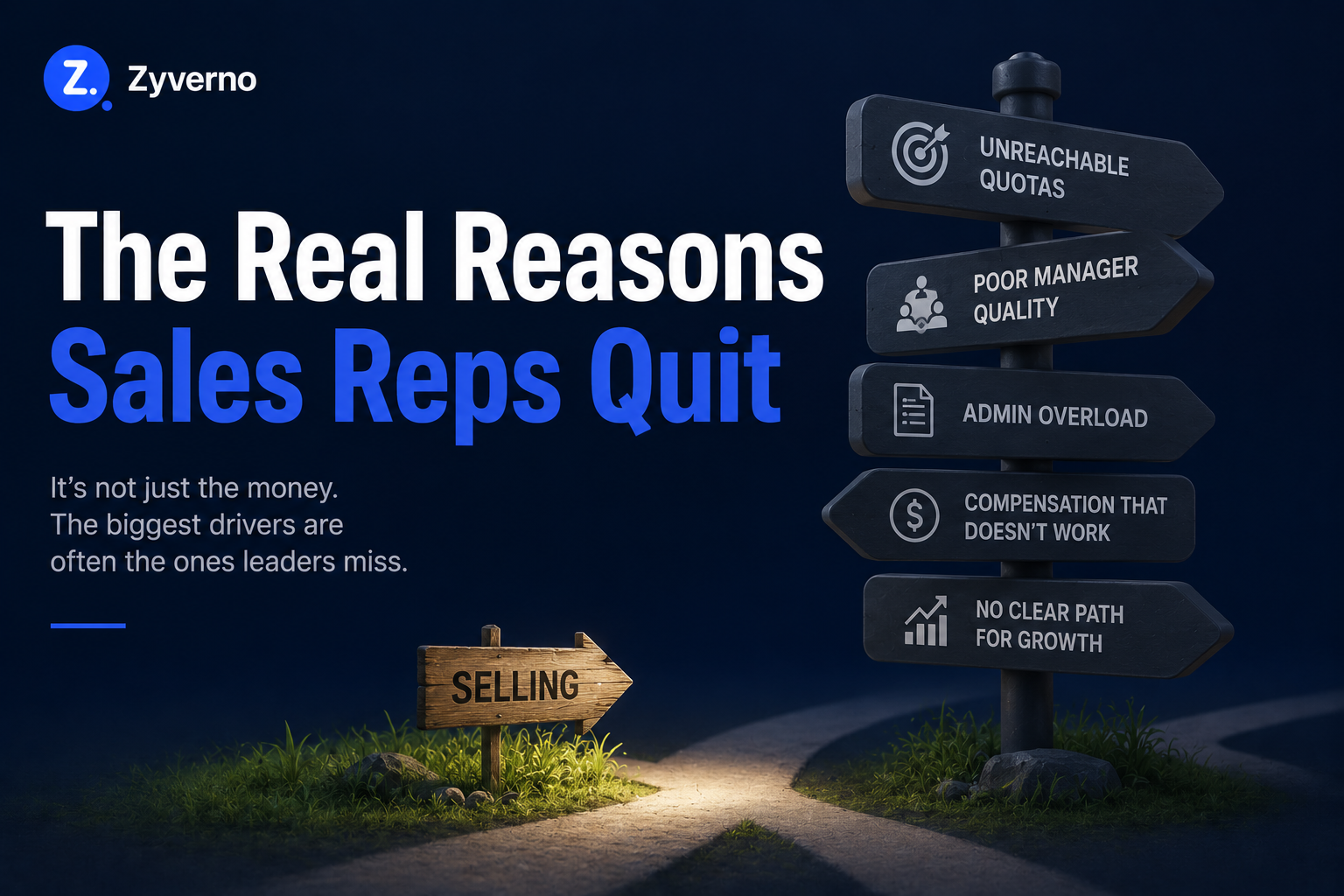
The real reasons sales reps quit are usually specific: an unachievable quota, a manager who doesn't invest in their development, or a role where 65% of the week goes to admin rather than selling. Understanding the actual causes is the only way to address them. The answer is rarely the one most sales leaders assume.
Key Takeaways
Why Sales Reps Quit: Ranked by Frequency and Impact
Based on Salesforce, Xactly, and Gallup attrition research. Manager quality is the hardest to see and often the biggest driver.
Compensation that doesn't work in practice Comp
On-target earnings unreachable in practice, not just low base pay.
Unreachable quotas Comp
Only 28% of reps hit annual quota industry-wide. Best performers leave first because they have the most options.
Manager quality Management
79% would quit due to lack of appreciation. Teams with consistent weekly check-ins see lower turnover.
Admin overload eating selling time Operations
Reps spend less than 30% of their week actually selling. Many cite lack of appropriate tools as a reason to leave.
No visible career path Development
45% of employees would stay with more skills development. Sales development representatives watch competitors for account executive openings.
Role delivered doesn't match what was sold Hiring
Early attrition (first 6 to 12 months) is often an expectation gap set during recruiting.
Note: percentages reflect survey and research data from multiple studies; individual categories overlap. Sources: Salesforce State of Sales 2025, Xactly 2025, Gallup Workplace Research.
Reason 1: Compensation That Doesn't Work in Practice
Money is the most cited reason, but it is more nuanced than "pay them more."
Research consistently shows that the specific trigger is not the base salary. It is the on-target earnings structure:
- The variable compensation percentage is too low to motivate the extra effort
- Quotas are set so high that the on-target earnings figure is theoretical, not achievable
- Accelerators kick in at thresholds that nobody actually hits
- Commission changes mid-year after strong performance in Q1
Top performers are most acutely sensitive to this dynamic. They do the mental math early: "If I hit 130% of quota here, I make X. If I move to this competitor, hitting 100% pays me more." When the math favors leaving, they leave.
What it signals: Review your on-target earnings attainability annually. If fewer than 60% of your team is hitting their on-target earnings, your quota structure is driving attrition, not your compensation package.
Reason 2: Unreachable Quotas
Closely related to compensation but distinct: even reps who aren't primarily motivated by money will disengage when quota feels impossible.
According to Salesforce State of Sales 2025, only 28% of sales reps hit their annual quota. That is a massive signal that quota-setting is broken across the industry.
When a rep misses quota for two straight quarters through consistent effort, they don't conclude they need to work harder. They conclude the goal isn't real, and they start looking.
The problem compounds when the quota is unattainable: your best performers leave first because they have the most options. The reps who stay tend to be less mobile and less productive. The team gets worse as attrition selects for underperformers.
What it signals: Quotas should be aspirational but achievable. Industry standard for a healthy team is 65-75% of reps hitting quota in any given quarter. Below 50%? Your quota-setting needs to be audited. See how to reduce sales turnover for the structural fixes.
Reason 3: The Manager Problem
A study of over one million employees found that the direct manager is the primary reason people stay or leave. This holds true above the company brand, the product, and the compensation plan.
79% of people say they would quit their jobs because they don't feel appreciated by leadership (Gallup). In sales specifically:
- 26% of reps who stayed long-term attributed their tenure to good management
- 15% of sales leaders said they had personally changed jobs due to poor management
Teams with managers who maintain consistent one-on-ones see lower voluntary turnover than those who don't. The mechanism is simple: reps who feel coached and invested in don't look for other options. Reps who feel ignored or micromanaged do.
The worst managers in sales tend to follow one of two patterns:
- The absentee manager: never available, no coaching, no deal support, just a scorecard reviewer
- The micromanager: in every call, second-guessing every decision, removing rep autonomy
Both patterns accelerate departure among your strongest people.
Two Manager Patterns That Drive Top Performers Out
The absentee and the micromanager look different on the surface. They produce the same outcome.
The Absentee Manager
Never available, no coaching, deals sink unassisted
What they say
"You've got this. You don't need me on the call." "Let me know if anything comes up." "Just update the pipeline by Friday."
What the rep experiences
Stuck deals go nowhere. There is no one to escalate to. A tough prospect rejects the pitch and no one helps work out why. The rep is on their own in every difficult situation.
The outcome
Best performers interpret absence as a ceiling, not freedom. They find a manager who will invest in them. Average performers stay because they have fewer options.
The Micromanager
On every call, corrects in real time, removes autonomy
What they say
"I want to join that call." "Why did you say it that way?" "Send me the email draft before you send it to the prospect."
What the rep experiences
Every decision is second-guessed. Wins feel like luck. Losses feel like failure plus a debrief. The rep stops trusting their own judgment and starts feeling like an administrator executing someone else's plan.
The outcome
Confident, high-performing reps hit their limit fast. They leave for a role where they are trusted to do the job. Those who stay tend to be conflict-averse, not high-performing.
Both patterns select against top performers. The reps with the most options leave. The reps who remain are the ones with nowhere to go.
What it signals: If you are losing top performers disproportionately to low performers, management quality is the most likely cause. Manager effectiveness needs to be measured, not assumed.
Reason 4: Administrative Work Is Eating Their Selling Time
This is the one that doesn't show up in exit surveys but is real. Sales reps spend less than one-third of their time actually selling. 65% of their week goes to meetings, customer relationship management updates, internal processes, and reporting.
Where the Sales Week Actually Goes
Reps spend less than one-third of their time selling. The rest is absorbed by admin, meetings, and reporting.
Source: Salesforce State of Sales 2025
Reps who were hired to sell and spend most of their week doing everything else are the first to look for a role that lets them do the job they signed up for.
For a rep hired to sell, this creates a constant tension between what the role was sold to them as and what it actually is. They took the job to be in front of customers. Instead, they are writing call notes, sitting in pipeline reviews, and updating forecasts for a sales manager who needs the data.
This isn't just a productivity problem. It is a retention problem. When technology creates work instead of reducing it, reps associate the company with inefficiency and start wondering if the next place runs things better.
What it signals: Audit your sales team's time allocation. Any task that could be automated, eliminated, or moved to an operations function is costing you rep time and rep engagement. Tools that automate screening, scheduling, and pipeline maintenance directly address this.
Reason 5: No Recognition for Results
Recognition is underestimated as a retention driver. The dynamic is especially sharp in sales, where results are measurable and visible.
When a rep closes a difficult deal or hits a strong quarter, and the response is silence, they recalibrate. They start questioning whether strong performance is genuinely valued or just expected. Companies with consistent recognition programs see meaningful reductions in voluntary turnover.
Weekly recognition of specific wins is more effective than quarterly awards. The keyword is specific: "you converted that stalled deal by finding the real budget holder" lands differently than "great quarter."
What it signals: If your top performers are leaving quietly rather than loudly, lack of recognition is often the cause. Build explicit recognition into team routines, not just annual reviews.
Reason 6: No Career Path Forward
For early-career reps, the reason they stay is often less about money and more about trajectory. Where do they go from here?
Sales development representatives who see a clear path to account executive stay longer. Account executives who see a path to team lead or manager stay longer. When the only way up is out, to a competitor who will give them the title, they leave.
45% of employees say they would stay if their employer offered more skills development and training. In sales, this means:
- Formal promotion criteria (not informal "if something opens up")
- Investment in skill development (sales training, deal coaching, industry conferences)
- Exposure to senior-level deals and strategy
What it signals: If you have sales development representatives who have been in the role for 12+ months with no advancement, you are building a pipeline of people who are about to leave. Define and communicate promotion timelines.
Reason 7: Misalignment Between the Role Promised and the Role Delivered
A significant slice of early turnover traces back to expectation gaps set during the hiring process. This is turnover within the first 6 to 12 months.
The rep was told the territory was established when it was effectively greenfield. The product was described as market-ready when it still needed significant customer education. The team was "high-performing" but actually struggling.
This isn't always deception. It is often optimism in the hiring pitch. But optimism that doesn't match reality destroys trust fast. A rep who feels misled doesn't just leave. They leave angry, and they talk.
What it signals: Sales hiring is a two-way sale. Be honest about territory conditions, product gaps, and team challenges in the interview process. Reps who join with accurate expectations are far more likely to stay through the difficult early months.
Structured screening that asks candidates directly about their expectations before the first interview helps surface misalignment early. Tools like Zyverno run those structured conversations, so expectation gaps are caught before an offer is made rather than after a rep's first 90 days.
What Doesn't Cause Attrition
Myth: Top performers leave for higher base salaries. They leave for higher on-target earnings attainability. A compensation plan with a $70K base and a realistic path to $150K on-target earnings beats a $90K base with an on-target earnings figure nobody hits.
Myth: Remote work options solve retention. Remote access matters, but it doesn't substitute for manager quality, achievable quotas, or a career path. Remote bad management is still bad management.
Myth: Reps leave because of the product. Reps can sell a hard product if the compensation is fair, the manager is good, and the quota is achievable. The product is often cited, but rarely the root cause.
The Hiring Connection
Some turnover is unavoidable, but a meaningful portion starts with a hiring mismatch.
Reps hired for the wrong role, whether too senior, too junior, or from the wrong industry background, struggle during ramp and disengage before they have had a chance to succeed. Reps hired with inflated expectations about territory or compensation resign when reality sets in. Understanding red flags when hiring a salesperson is one of the clearest ways to reduce this pattern.
Better hiring selection, specifically testing for fit with the actual role conditions rather than an idealized version, directly reduces first-year attrition. Slow ramp is another compounding factor: see sales rep ramp time industry benchmarks to understand how long integration genuinely takes and what good looks like.
Frequently Asked Questions
What's the number one reason sales reps quit?
The most consistently cited reason is compensation, specifically compensation plans where the on-target earnings figure is theoretically achievable but practically isn't. But manager quality is arguably the bigger structural driver. It is just harder to quantify and less likely to surface in exit interviews where the rep doesn't want to burn a bridge.
Do sales reps quit because of quota?
Unreachable quotas are a major driver, particularly for your best performers who have the most options. When only 28% of reps industry-wide hit their annual number, it signals that quota-setting is systematically broken at many companies.
How do you know if a rep is about to quit?
Behavioral signals: dropping out of meetings, declining call volume, reduced customer relationship management activity, shorter average call times, and less proactive communication with management. Pipeline stages are stagnating. These signals typically appear 60-90 days before a resignation.
Is it ever the rep's fault?
Yes, not all attrition is a management or systems failure. Some reps are a genuine mismatch for the role: the skills aren't there, the work ethic isn't there, or the fit is wrong. But if you are consistently losing good performers, the problem is structural, not individual.