
Healthcare Job Posting: What Qualified Candidates Must See
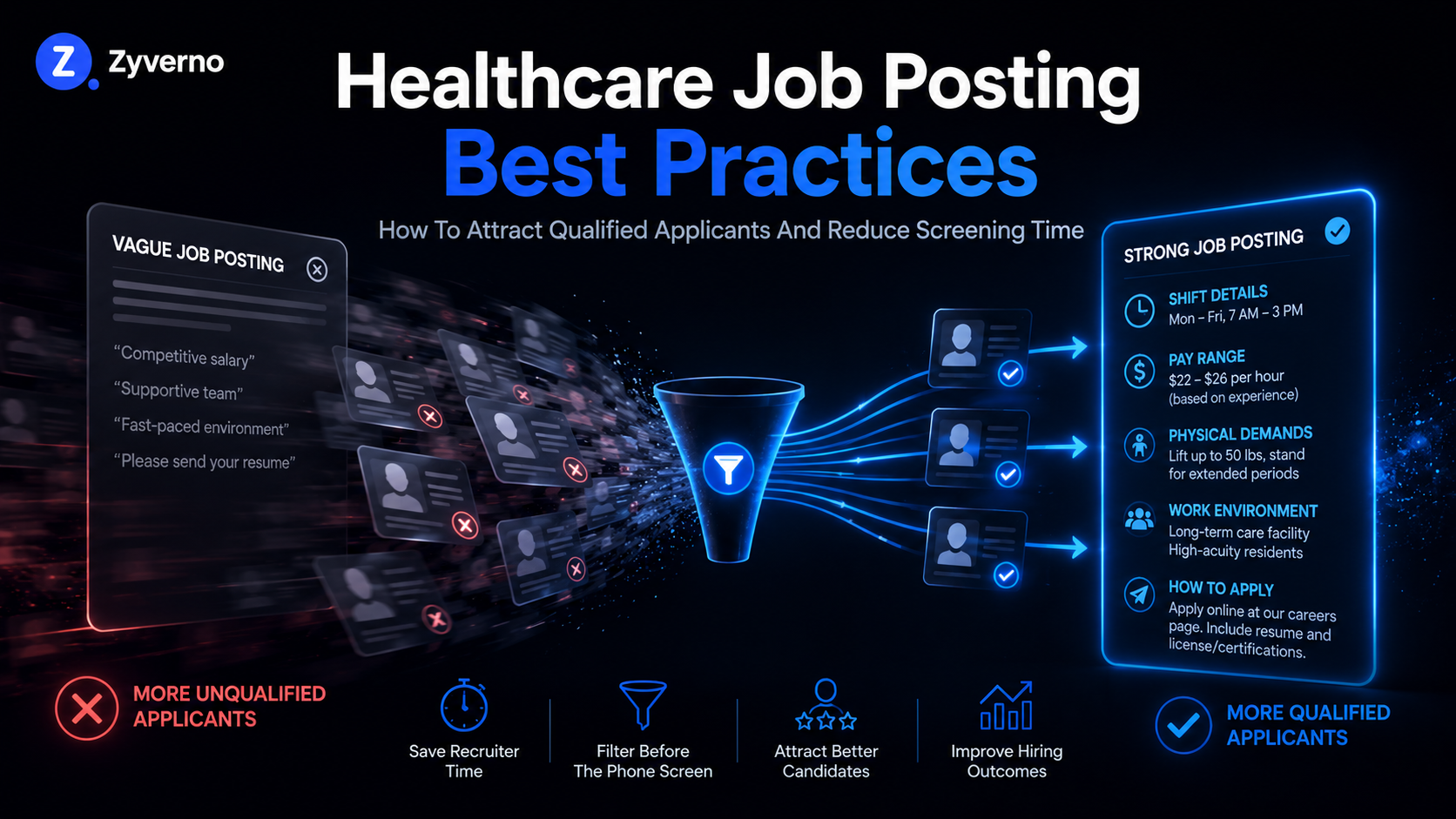
A strong healthcare job posting answers the candidate's three most urgent questions before they decide whether to apply: what the shift looks like, what the pay is, and what the work actually demands. Most postings skip at least one of these, which means qualified candidates opt out while unqualified candidates apply anyway.
Key Takeaways
- Qualified candidates stop reading a posting that omits shift times, pay range, or physical demands.
- Unqualified candidates are not deterred by vague postings. They apply regardless.
- Pay transparency alone is not enough. Shift specifics and working environment details do the filtering work.
- A simple test before publishing: would a bad-fit candidate still apply after reading this? If yes, the posting is not doing its job.
- Specific application instructions reduce drop-off from strong candidates who will not chase unclear next steps.
What Qualified Candidates Look for Before Applying
Qualified healthcare candidates read job postings differently from general job seekers. They are not searching for a role. They are evaluating whether a role fits their life. That means they check specifics first.
The first thing a registered nurse or certified nursing assistant scans is the shift pattern. Is it day shift or night shift? Fixed or rotating? Three twelve-hour days or five eighths? If that information is missing, many qualified candidates close the tab. They cannot confirm schedule compatibility without it, and they will not call to ask.
Pay range comes next. According to Stacker, citing SHRM 2023 research, 82% of workers are more likely to consider applying when a pay range is listed in the job posting. In healthcare, this matters more than in most sectors, because experienced candidates have a number in mind. A posting that says "competitive salary" signals nothing. It can mean $18 an hour or $28 an hour. Without a range, the candidate cannot assess fit, and many do not bother.
Physical demands follow closely. A certified nursing assistant who has a back injury needs to know whether the role involves regular patient lifting. A home health aide considering a full-time position needs to know whether the setting is residential or clinic-based and what the patient acuity level is. This information tells qualified candidates whether their body and background match the role.
Team size and supervision structure matter too, though they rank lower than the above three. A nurse who has worked on a 40-person team may not want to move to a solo practitioner setting without knowing in advance. A certified nursing assistant who needs close supervision will self-select out of a posting that describes a high-autonomy environment, which saves the recruiter a phone screen.
What Most Healthcare Job Posts Get Wrong
The most common failure is using the same language across every posting. "Competitive pay." "Supportive team." "Fast-paced environment." These phrases carry no information. They describe every healthcare role and therefore describe none of them.
The second failure is listing requirements without describing the role. A posting that says "three years of clinical experience required" tells the reader about the candidate, not about the job. What does a typical shift look like? What is the patient load? What documentation system is used? Experienced candidates want to know what they are walking into, not just whether they are technically eligible.
The third failure is burying the application step. Some postings end with "please send your resume to" followed by an email address. Others link to a careers page with no guidance on what to include. Strong candidates, who have options, are not going to hunt for instructions. A clear, specific application step at the end of the posting keeps them moving forward.
The fourth failure is ignoring the working environment. Healthcare settings vary enormously. A long-term care facility runs differently from an emergency department. A home health role differs from an in-clinic position. Describing the environment, the patient population, and the general pace of the unit helps candidates assess whether it fits their experience and preference. This detail filters before the interview, which reduces time spent on phone screens with candidates who would have declined the offer anyway.
Five Elements That Filter Before the Phone Screen
These five elements, when included in a posting, reduce the number of unsuitable applications without reducing total volume from qualified candidates.
Exact shift hours and days
State the start time, end time, and days of the week. "Monday to Friday, 7 AM to 3 PM" is more useful than "day shift." If the role involves rotating shifts, say so explicitly and describe the rotation pattern. Candidates with childcare constraints, second jobs, or commute limitations will self-screen at this stage.
Pay range stated clearly.y
Give a minimum and a maximum. If the range reflects experience level, say that. "Between $22 and $26 per hour, depending on years of clinical experience" is clear and honest. It attracts candidates in that band and filters out candidates whose expectations are significantly higher or lower.
Physical demands are listed explicitly
State the lifting requirement, standing duration, and any repetitive motion involved. "Must be able to lift up to 50 pounds and stand for extended periods" is straightforward. Candidates who cannot meet those demands self-select out. Those who can continue reading without uncertainty. This also protects the employer by establishing that the requirements were disclosed upfront.
Working environment described
Describe the setting, the patient population, and the general staffing structure. "A 20-bed medical-surgical unit with a 1:5 nurse-to-patient ratio, operating within an integrated electronic health record system," gives experienced candidates a real picture of the role. Vague environment descriptions attract candidates who will be surprised after they start, which shortens tenure.
Specific application step stated
Tell the candidate exactly what to submit, where to submit it, and what happens next. Submit your resume and a brief note about your clinical experience via the link below. A recruiter will contact shortlisted candidates within five business days." Candidates who want clear processes appreciate this. It also reduces the volume of incomplete applications, which costs recruiters time to sort.
The complete guide to healthcare hiring covers how these elements connect to the broader recruitment process, from posting to onboarding.
Market Considerations: Australia, the UK, and the United States
Disclosure norms differ across markets. In Australia, pay transparency in job postings is common practice, particularly in aged care and community health. Employers who omit a pay range on a role in New South Wales or Victoria tend to receive fewer qualified applications than those who include one.
In the United Kingdom, while no universal law currently mandates salary disclosure in job postings, National Health Service band structures mean that many public sector roles are understood through their band, for example, Band 5 registered nurse. For private or independent sector roles, stating pay explicitly remains important because candidates cannot look up a band equivalent.
In the United States, pay transparency laws now cover employers in California, Colorado, New York, Washington, and several other states. Whether or not a law applies, the practical effect is the same: postings with pay ranges attract candidates whose expectations are aligned, which reduces the chance of an offer falling through at the final stage.
For the credential verification side of this process, see the guidance on screening nursing candidates for credentials to understand what to check once applications come in.
How to Test a Posting Before Publishing
Before posting, read it as a bad-fit candidate. Ask: Would someone who cannot meet the physical demands still apply? Would someone who needs a 9-to-5 schedule still apply? Would someone whose pay expectations are significantly higher still apply?
If the answer to any of these is yes, the posting is too vague. Add the missing detail.
Then read it as a strong candidate who has two other offers on the table. Ask: Does this posting answer the questions I need answered? Does it give me enough information to decide whether to invest time in applying?
This two-reader test takes five minutes. It catches the most common failures before they generate weeks of unproductive phone screens.
High-volume healthcare roles are where weak postings cost the most. When dozens of applications arrive per week, even a moderate reduction in unqualified applicants translates to significant recruiter time saved. For teams managing this volume, automated screening tools like Zyverno can handle the initial filtering layer so recruiters only spend time on candidates who have already confirmed they meet the core requirements.
For a breakdown of how posting quality connects to the total cost of hire, see the article on reducing healthcare hiring costs.
Frequently Asked Questions
How long should a healthcare job posting be?
Long enough to answer the key candidate questions, and no longer. A posting that covers shift details, pay range, physical demands, environment, and application steps can do this in 300 to 500 words. Padding with generic company statements or lengthy benefit lists adds length without improving applicant quality.
Should I list every credential requirement in the posting?
List the genuinely non-negotiable requirements. If a registered nurse license is required, state it. If a background check and drug screen are required, state that too. Avoid listing preferred qualifications as if they are required. This creates confusion and may discourage otherwise qualified candidates from applying.
What is the difference between a job description and a job posting?
A job description is an internal document that defines the role, responsibilities, and reporting structure in full detail. A job posting is the external-facing version, written to attract a specific type of candidate. The posting draws from the description but focuses on what the candidate needs to know to decide whether to apply.
Do I need to include benefits in a healthcare job posting?
Including benefits is useful if they are genuinely competitive, for example, above-market health coverage, pension contributions, or flexible scheduling. Generic benefit statements add little value. Specific benefits that address common concerns, like paid parking in a hospital setting or a clinical development allowance, help differentiate the posting without adding noise.
How should a healthcare job posting handle shift flexibility?
Be honest. If the role is fixed nights, say fixed nights. If the role involves rotating shifts, describe the rotation in detail. Candidates who need a specific schedule will self-screen based on this information. Overstating flexibility creates mismatched expectations and increases early attrition.