
Cost Per Hire in Logistics: Benchmarks and Where to Cut
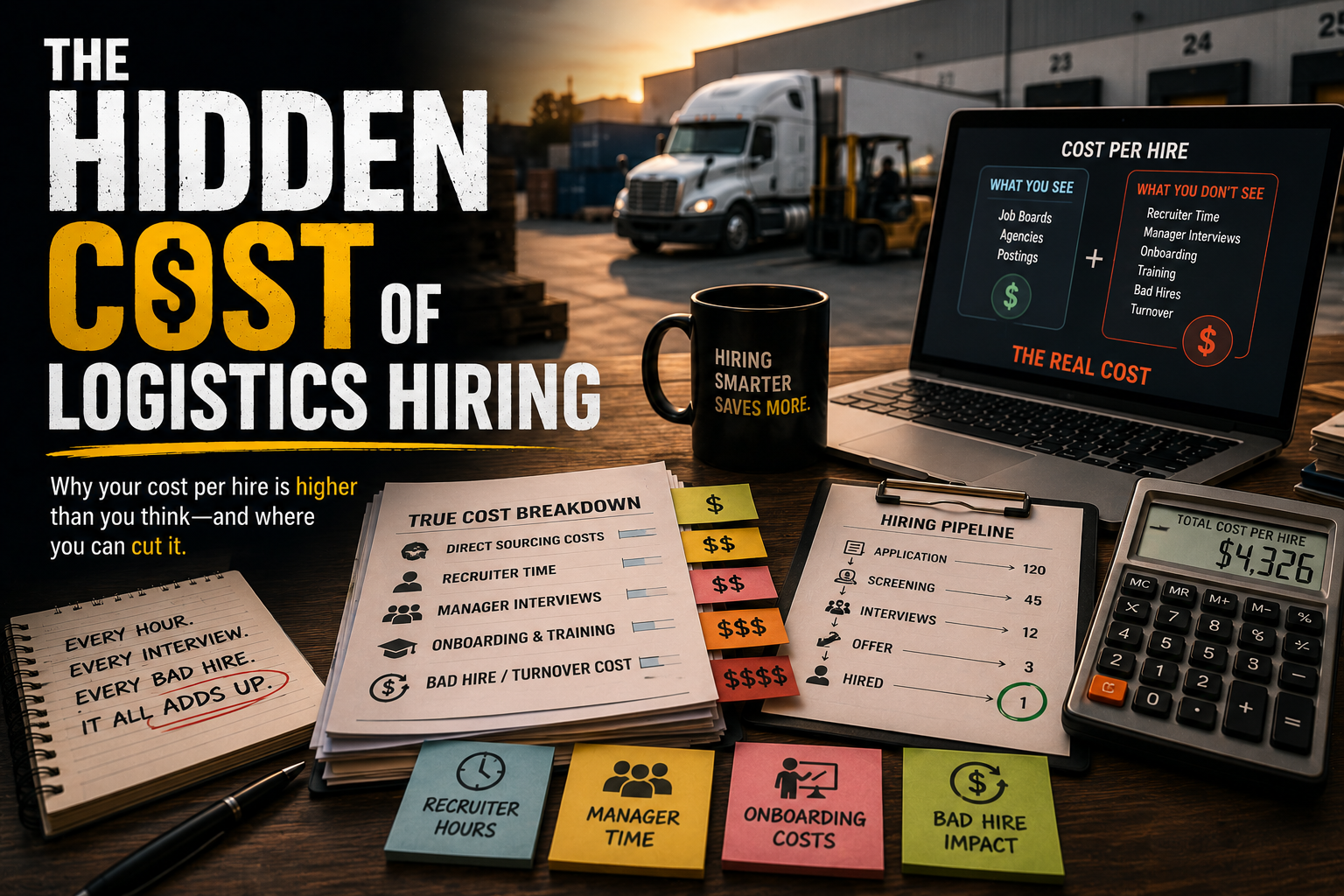
Cost per hire in logistics ranges from $1,200 for a warehouse associate to $4,800 or more for a supervisor role. Most companies believe their number is lower than it actually is. The gap comes from one place: internal time is almost never counted.
Key Takeaways
- Logistics cost per hire varies significantly by role, from $1,200 (warehouse associate) to $4,800 and above (supervisor).
- The largest cost category is usually internal time: recruiter hours, manager interviews, and onboarding labor.
- Companies that only track job board and agency fees are typically undercounting their true cost per hire by 40 to 60 percent.
- Reducing time-to-offer is the fastest lever available. Every extra week in the process adds manager and recruiter time to the total.
- Improving applicant source quality reduces the number of unqualified candidates screened, which cuts the internal time cost directly.
What Most Companies Leave Out of Their Cost Per Hire
Most logistics operators have a rough sense of what they spend on job boards and agencies. Those costs are visible. They appear on invoices.
What does not appear on an invoice is the three hours a warehouse manager spends interviewing two candidates who were never going to pass a background check. Or the hour a recruiter invests in a phone screen with someone who cannot meet the schedule requirements. Or the two weeks of onboarding labor before a new hire does not work out.
Why the Gap Persists
These costs are real. They come out of payroll and consume management capacity that would otherwise go to running operations. Because they are not billed by a vendor, most operators never add them up.
According to GoodTime's 2026 Hiring Insights Report, recruiters spend 38 percent of their time on interview scheduling alone, making it the single largest operational burden measured across more than 500 talent acquisition teams. That figure does not include the hours managers spend in interviews, debrief calls, or onboarding support. All of it converts to payroll cost, but none of it appears on a vendor invoice.
The result is a cost per hire figure that looks manageable, used to justify the current process, and compared favorably to agency alternatives. The full number tells a different story.
Industry Benchmarks by Role
- Warehouse associates ($1,200 to $1,800): Volume is high, roles are similar, and the screening process is often standardized. The cost is kept down by repetition, though it scales quickly when turnover is high.
- Delivery drivers ($2,000 to $2,800): Licensing requirements, background checks, and driving record verifications add direct costs. The pool of qualified applicants is also smaller, which means more time spent screening to find a suitable candidate.
- Dispatchers ($2,400 to $3,200): The role requires specific technical knowledge and communication skills. Hiring managers often spend more time evaluating fit, which drives up the internal time cost.
- Warehouse supervisors and team leads ($3,200 to $4,800): The most expensive category. Behavioral interviews, multiple decision-makers, and longer notice periods from departing employees all push the number up. A poor hire at this level also carries a high replacement cost. For more on what this role requires, see how to hire warehouse supervisors and team leads.
These figures are estimates based on industry benchmarks. Your actual number will depend on your sourcing channel mix, the time your managers spend in the process, and how often hires do not work out in the first 90 days.
Where the Money Actually Goes
Direct sourcing costs (job boards, agencies)
Job board fees for logistics roles typically run $200 to $500 per posting, depending on the platform and level of promotion. Agency fees are substantially higher: most charge 15 to 25 percent of first-year salary for permanent placements. For a driver earning $55,000 per year, a placement fee can reach $8,000 to $14,000. Even for warehouse associates, placement fees of $1,500 to $3,000 are common when demand is high and available candidates are scarce.
These costs are real, but they are not always the largest item on the list.
Internal recruiter time
A recruiter spending one hour per applicant across 20 applicants to fill one role invests 20 hours of labor before a single offer is made. At a fully loaded cost of $30 to $45 per hour, that is $600 to $900 in recruiter time alone.
Roles that generate a high volume of unqualified applicants amplify this cost. If 60 percent of applicants are screened out in the first pass, the recruiter is spending more than half their time on candidates who were never going to proceed. Reducing time to hire in logistics starts with fixing this step.
Manager interview time
A hiring manager earning $70,000 per year who conducts four one-hour interviews and two 30-minute debrief calls per hire is spending $175 in management labor on that single position. Multiply that by 40 hires per year, and it becomes $7,000 in manager time, just for interviews.
When multiple managers are involved in the decision, or when the process runs to three or four rounds, this figure grows quickly. It also does not account for the operational disruption of pulling a floor manager off the floor for an interview.
Onboarding and training costs
The first two to four weeks of a new hire's employment are a cost center, not a contribution. Training materials, trainer time, reduced productivity from new staff, and administrative setup all carry real costs.
For warehouse associates, onboarding often runs $500 to $1,200 per person. For drivers who require route familiarization, vehicle orientation, and safety briefings, the figure is higher. For supervisors who need to learn systems, processes, and team dynamics, it can exceed $2,000.
These costs are sunk if the hire does not work out. A 90-day turnover event means the full onboarding investment is lost, plus the cost of restarting the hiring process.
Cost of bad hires
A hire who leaves in the first 90 days or is let go during probation creates a multiplied cost. Every cost category above is incurred again: sourcing, screening, interviewing, and onboarding. Meanwhile, the role is understaffed, which creates overtime costs and productivity losses in the interim.
Warehouse staffing challenges are often downstream of repeated bad hires rather than genuine labor shortages. Addressing the quality of the hiring process is frequently more effective than increasing the sourcing budget. The cost of a bad hire is typically one to three times the annual salary. For a warehouse associate earning $40,000, that is $40,000 to $120,000 in fully loaded costs when replacement, lost productivity, and overtime are included.
Three Levers That Move the Number
Measure internal time cost first. Most cost reduction efforts target the visible line items: job board spend, agency fees, and advertising budgets. These are the wrong targets if you have not measured internal time first. You may cut $300 in job board fees while spending $800 in additional manager time to compensate. Track recruiter hours per hire and manager interview hours per hire for one quarter. The number you find will tell you where the real opportunity is.
Reduce time-to-offer. Every additional week a role remains open adds recruiter and manager time to the total. For roles that take four weeks to fill instead of two, the internal time cost may double. Screening candidates for driver hiring is one area where process speed directly affects the total cost. Faster decisions also reduce candidate dropout, which means fewer restarts partway through a search.
Improve source quality. A sourcing channel that delivers 40 percent qualified applicants costs roughly half as much in screening time as one that delivers 20 percent qualified applicants, even if channel fees are identical. Track qualified applicant rate by source (job board, employee referral, agency, organic) for two to three months. Shift budget toward sources that deliver higher-quality candidates and reduce spend on channels where you are screening out the majority.
Frequently Asked Questions
What is the average cost per hire in logistics?
The average cost per hire in logistics ranges from $1,200 for entry-level warehouse roles to $4,800 or more for supervisor and specialist positions. The figure varies based on sourcing method (agency versus direct), role complexity, time-to-fill, and how much internal recruiter and manager time is counted in the calculation.
Why is the cost per hire usually higher than operators expect?
Most logistics operators only count external vendor costs: job board fees, agency placement fees, and background check charges. The largest cost category in most hiring processes is internal time: recruiter screening hours, manager interview time, and the labor cost of onboarding. When these are included, the actual cost per hire is typically 40 to 60 percent higher than the figure most operators use. This gap is especially large in high-volume roles where unqualified applicants consume significant recruiter time before reaching the interview stage.
How does turnover affect cost per hire?
High turnover multiplies the cost per hire directly. Each departure means a full recruitment cycle restarts, with all associated sourcing, screening, interviewing, and onboarding costs incurred again. A position that turns over three times in a single year may generate $6,000 to $15,000 in total hiring costs for a single role, depending on the level.