
High-Volume Logistics Hiring: Methods That Hold Up at Scale
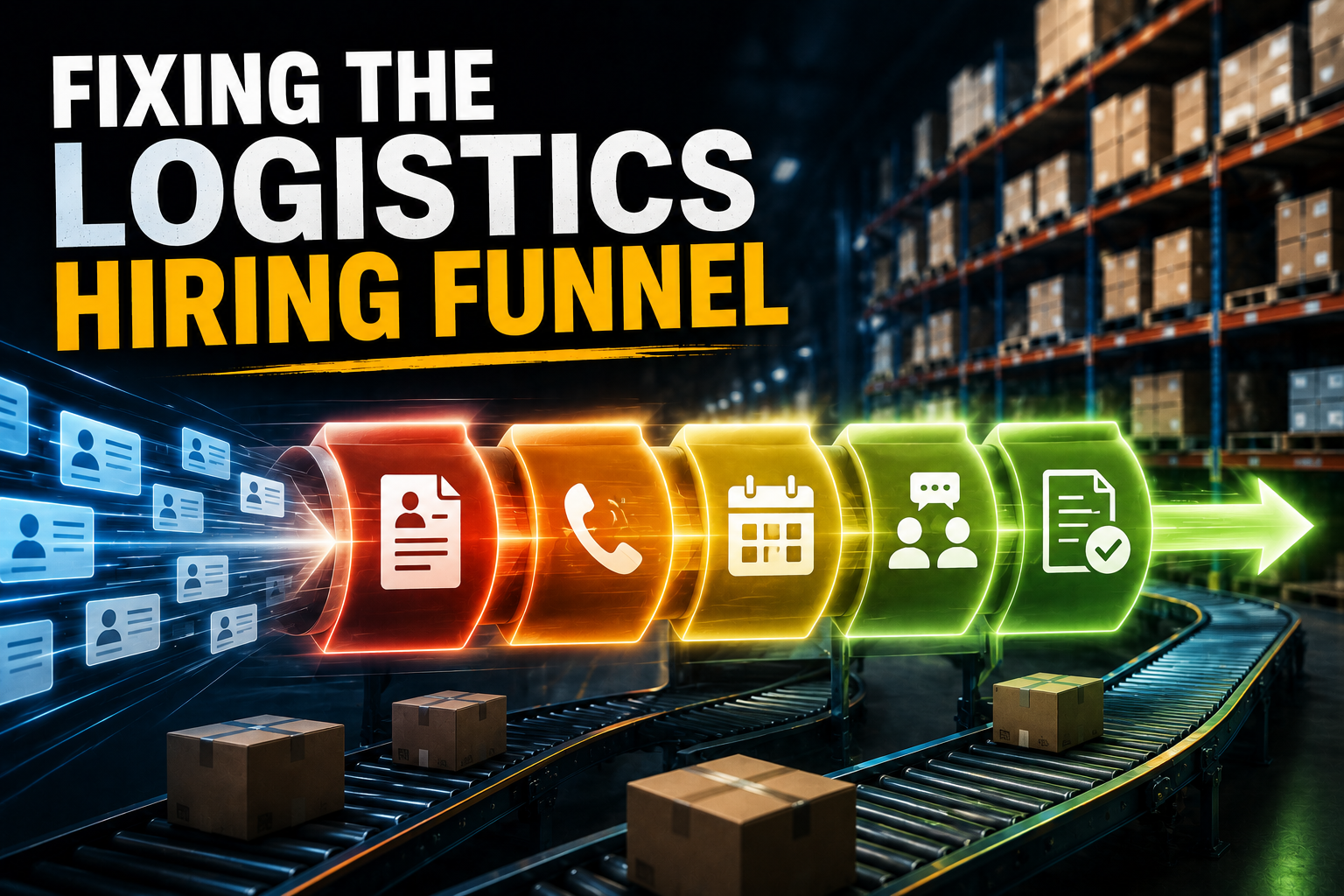
High-volume logistics hiring rarely fails because of a lack of applicants. It fails because the process between application and offer takes too long, and candidates accept elsewhere before you get to them. The companies that hire reliably at scale have fixed the middle of the funnel, not just the top.
Key Takeaways
- Most high-volume logistics hiring failures happen between application and scheduled interview, not at the sourcing stage.
- Slow application review, unstructured phone screening, and manual scheduling each add days to the funnel independently.
- Batch interviewing reduces time-to-hire without reducing quality when paired with a structured scorecard.
- Same-day offer capability is the single biggest competitive differentiator in hourly logistics hiring.
- Standardizing the screening and scheduling steps produces more consistent hires than optimizing the job posting alone.
Why Sourcing Is Not the Problem
Most logistics operations post a job and receive applications within hours. Driver roles, warehouse associate positions, and last-mile delivery jobs attract a large pool quickly, especially in markets with high labor demand.
The sourcing funnel works. The processing funnel does not.
What typically happens after the application arrives follows a predictable sequence:
- A hiring manager reviews it when time allows.
- A message is sent, or a voicemail is left.
- The manager waits for a response.
- A phone screen is attempted and scheduled.
That sequence can take three to five days on its own. By the time an interview is booked, a meaningful share of applicants have already started somewhere else.
Why Volume Makes It Worse
Warehouse staffing challenges at scale follow this same pattern across company sizes. The volume of applications creates an illusion of pipeline health, while the actual conversion rate from application to hire deteriorates.
The fix is not more job postings. The fix is a faster, more structured path from application to offer.
The Three Points Where Volume Kills the Funnel
Every high-volume logistics funnel has three points where time bleeds out. Each one compounds the others.
Slow application review
When applications sit unreviewed for more than 24 hours, candidate interest drops. Hourly logistics candidates are typically applying to multiple employers at the same time. They take the first interview they can get, not the most appealing job.
Manual review creates a queue that grows faster than reviewers can process it. Managers prioritize operational tasks over inbox management. Applications age, and strong candidates disappear before anyone contacts them.
Structured pre-screening questions or automated screening tools solve this without adding headcount. A candidate who answers five role-relevant questions during the application step has already filtered themselves. The reviewer sees a qualified shortlist rather than an undifferentiated pile. Example questions that work well for logistics roles:
- Can you work a consistent early morning shift starting at 5 AM?
- Do you have a current, valid driver's licence for the vehicle class required?
- Have you worked in a warehouse or distribution centre before? If yes, for how long?
- Are you available to start within the next two weeks?
Unstructured phone screening
Even when companies move quickly on review, the phone screen stage adds unpredictable time. Screens run long when there is no structure, interviewers ask different questions to different candidates, and schedulers play phone tag across multiple time zones or shift patterns.
An unstructured screen produces two bad outcomes: it takes longer than it needs to, and the information it produces is inconsistent, which makes the hiring decision harder. Managers compensate by adding another round, which adds more time.
What a Structured Screen Includes
A structured screen with five to seven fixed questions, scored on a simple rubric, runs in 10 to 12 minutes and produces comparable data across every candidate. The interviewer asks the same questions in the same order.
Manual interview scheduling
Scheduling is where most high-volume funnels stall. A recruiter or coordinator sends available slots, waits for a response, confirms, and then handles rescheduling when candidates do not show. For 20 open roles with three candidates per role, that is a significant coordination load with no strategic value.
How Self-Scheduling Changes the Equation
Self-scheduling links eliminate the back-and-forth. The candidate picks a slot from available times, receives an automated confirmation, and gets a reminder before the interview. No-show rates drop, coordinator time is redirected, and the calendar fills without manual effort.
Reducing time to hire in logistics consistently identifies scheduling bottlenecks as the highest-leverage point for operations with more than five open roles at a time.
How to Build a Funnel That Handles Volume
A volume-ready funnel has four components working in sequence. Each one removes a decision or a delay from the human coordinator's plate.
- Application with built-in screening. Role-specific questions asked during the application step separate qualified candidates from those who do not meet basic requirements, before any human reviews the application.
- Automated scoring or triage. Candidates who meet the minimum criteria move forward automatically. Those who do not are held or declined. The hiring team sees only the candidates who cleared the threshold.
- Self-scheduling. Qualified candidates receive a link and choose their interview slot. No coordinator involvement is required until the interview itself.
- Structured interview with same-day decision capability. Interviewers use a fixed question set and a scorecard, the debrief happens the same day, and offers go out before candidates leave or within hours.
This structure works for hiring warehouse workers fast and scales to driver and last-mile roles with minimal modification. The questions change. The structure does not.
Batch Interviewing: What Works and What Does Not
Batch interviewing means grouping multiple candidates into a single interview block rather than scheduling individual slots across multiple days. Done well, it cuts time-to-hire significantly. Done poorly, it becomes a logistical problem in its own right.
What Works
- Schedule four to six candidates in two-hour blocks with a structured format.
- Give each candidate a defined slot with no overlap
- Have interviewers rotate through candidates using the same question set
- Complete scorecards during each interview and make decisions at the end of the block
What to Avoid
- Running batch interviews without a scorecard
- Relying on memory or notes after multiple back-to-back conversations
- Allowing fatigue to affect later-round evaluations
The scorecard is not optional. It is what makes batch interviewing a reliable process rather than an efficient-looking one.
For roles like last-mile delivery drivers, batch interviewing with a structured scorecard reduces time-to-hire from 8 to 12 days down to 2 to 3 days in operations that have implemented it consistently.
Same-Day Offer Capability (and Why It Matters)
Same-day offers are not a gimmick. They are a structural response to the reality that hourly logistics candidates make decisions quickly. A candidate who completes a batch interview at 10 AM and receives a verbal offer at 2 PM is far more likely to accept than one who is told, "We will be in touch."
The Three Steps That Make It Possible
- A hiring decision was made the same afternoon using completed scorecards.
- A verbal offer is extended before the candidate leaves the building or ends the call.
- A written offer is sent the same evening, with a start date confirmation expected within 24 hours.
Operations that build same-day offer capability do not just hire faster. They hire candidates that slower competitors lose. In markets where two or three employers are competing for the same pool, the one with a same-day process wins a disproportionate share of strong candidates.
This is not about lowering standards. A candidate who clears a structured screen and scores well on a structured interview is a legitimate hire. The speed comes from removing administrative delays, not from skipping evaluation steps.
FAQ
How many open roles does a structured funnel require to be worth building?
The structure pays off at three or more open roles at a time. Below that, the coordination overhead is low enough that informal processes work. Above three, the compounding delays from manual scheduling and unstructured screens create enough drag that a structured funnel recovers its setup time within the first hiring cycle.
Does batch interviewing work for driver roles or only for warehouse positions?
Batch interviewing works for any role where the core qualifications can be evaluated in a structured 15 to 20-minute conversation. Driver roles are a good fit when the batch is followed by a license and record check rather than used as a replacement for it. The interview assesses reliability, judgment, and communication. Verification handles the credential side.
What is a realistic time-to-hire target for high-volume logistics roles with a structured funnel?
Two to three days from application to offer is achievable with automated pre-screening, self-scheduling, batch interviews, and same-day offer capability. Without any of those elements, the median sits closer to 8 to 14 days. The biggest single lever is self-scheduling: it typically removes two to three days on its own.