
Dockworker Hiring: Screen for Reliability First
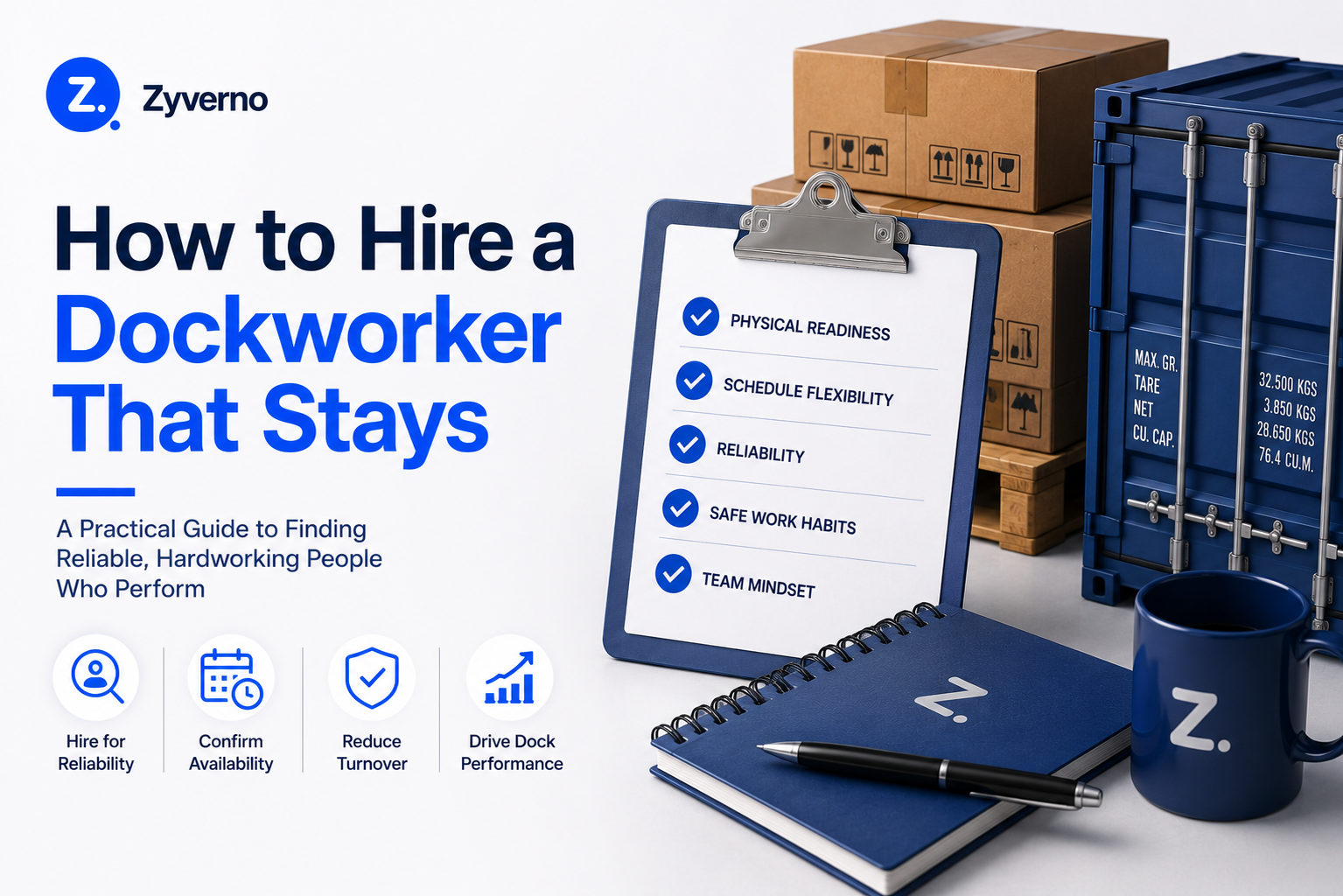
To hire dockworkers who stay and perform, screen for physical reliability and schedule flexibility before anything else. Most hiring managers focus on experience. They skip the two checks that actually predict early attrition: physical readiness and schedule compatibility. This guide covers what to post, how to screen, which questions reveal real candidates, and the red flags that predict a bad hire.
Key Takeaways
- Transportation and material moving occupations account for 26% of all nonfatal workplace injury cases involving days away from work in the United States, making safety screening a non-negotiable step in dock hiring.
- Physical screening and schedule confirmation are the two most commonly skipped steps, and the two most predictive of early attrition.
- Reliability signals in the application and phone screen are stronger predictors than claimed experience alone.
- A practical trial shift or loading observation is the most reliable final-stage check available to hiring managers.
- Port and marine dock roles may require a Transportation Worker Identification Credential. Warehouse dock roles typically do not.
- Forklift certification requirements apply to dock roles that involve powered equipment, the same as any warehouse role.
What Dockworkers Actually Do
Dockworkers load and unload freight, sort and stage shipments, and keep the flow of goods moving at the transfer point between inbound and outbound transport. The role goes by several titles depending on the employer: dock loader, material handler, freight handler, or warehouse associate with dock duties.
The physical demands are real and consistent across operations. Candidates will handle boxes and freight weighing 50 to 70 pounds repeatedly across a shift. They will stand, bend, and lift in cold storage facilities and in open-door summer heat. Conditions vary by operation, but the physical load is consistent. They will do this at 5 AM, at 10 PM, and on weekends.
According to the U.S. Bureau of Labor Statistics Employer-Reported Workplace Injuries and Illnesses report for 2024, transportation and material moving occupations account for 26% of all nonfatal injury cases involving days away from work across private industry in the United States. That figure reflects how physically demanding these roles are and why screening candidates for physical readiness is not optional.
Direct Answer: How Do You Hire a Dockworker?
Write a job posting that is honest about the physical demands and shift times. Screen applicants by phone for schedule availability and physical capability. Interview for reliability signals, not just experience. Conduct a reference check that asks specifically about attendance. Offer a practical trial shift before making a final decision.
The candidates who accept honest job descriptions and still apply are the ones most likely to stay past 90 days. For context on the broader factors that extend time to hire in logistics operations, reducing time to hire in logistics covers where delays typically occur and how to tighten each stage.
Port Docks vs. Warehouse Docks: A Key Distinction
The hiring process described in this guide applies to warehouse and distribution center dock roles. Port and marine terminal operations have a different set of requirements.
Port and Marine Terminal Roles
At ports, most dockworkers are hired through union halls. The International Longshoremen's Association covers East and Gulf Coast ports. The International Longshore and Warehouse Union covers the West Coast. New workers typically enter as casual labor and advance to full membership through a registration process managed by the union. Employers at these facilities hire through the union, not directly.
Port roles also require a Transportation Worker Identification Credential, issued by the Transportation Security Administration. This is a federal biometric card required for unescorted access to secure maritime facilities. It involves a background check and takes several weeks to obtain. Candidates who do not yet hold one cannot start work at a secured port until it is issued.
Warehouse and Distribution Dock Roles
For warehouse, distribution center, and inland freight dock roles, the union and credential requirements above do not apply. The rest of this guide covers that type of hiring.
Where to Source Dock Candidates
The most productive sourcing channels for warehouse and distribution dock roles are general job boards, local staffing agencies, and referrals from existing dock staff.
Job Boards
Indeed consistently produces the highest volume of applications for dock and material handler roles. Posting there first, with an honest job description, will cover most active job seekers. LinkedIn is less productive for dock roles than for office or technical positions. Local Facebook groups and community job boards produce strong results in markets where warehouse employment is concentrated.
Staffing Agencies
Staffing agencies that specialize in light industrial and warehouse placements are a reliable channel for volume hiring and short-notice gaps. They pre-screen for availability and basic physical readiness, which shortens your own screening time. The tradeoff is cost and the additional step of converting strong temps to permanent hires.
Employee Referrals
Referrals from current dock employees produce the most reliable candidates. Workers in physical roles tend to refer people whose work ethic and reliability they know personally. A simple referral incentive, paid after the new hire completes 90 days, is worth building into any dock hiring program.
For operations that need to fill multiple dock positions quickly, the guide on how to hire warehouse workers fast covers high-volume sourcing tactics and application flow that adapt directly to dock roles.
Writing a Job Posting That Attracts the Right Candidates
The most common dock job posting mistake is downplaying the physical demands and overwriting the benefits. This filters in the wrong candidates and filters out the ones who are genuinely suited to the role.
Physical Demands and Shift Times
State the weight requirements in the posting: "Regularly lifting 50 to 70 lbs." Write the shift times explicitly: "5 AM to 1 PM Monday through Friday, with Saturday rotation."
If the work environment includes cold storage, outdoor conditions, or temperature variation, say so.
Candidates who read an honest posting and still apply have already self-selected for the role. Candidates who discover the physical demands or schedule at orientation are more likely to leave in the first two weeks. Some do not come back after the first shift.
Equipment and Certification Requirements
List the actual certifications required if any dock equipment is involved. If the role includes operating a powered pallet jack, say that. If it requires forklift operation, say which class of equipment. Vague language like "may operate powered equipment" produces two problems: candidates who cannot meet the requirement, and candidates who overestimate their qualification level.
For a broader approach to logistics job postings, the complete guide to hiring for logistics covers sourcing, job board strategy, and application flow for high-volume roles.
Phone Screen: The Two Questions That Matter Most
Most dock role phone screens run five to ten minutes. That is enough time to confirm two things that predict whether a hire will stick.
Schedule availability. State the shift hours directly and ask if the candidate can commit to them. Do not ask "Are you available mornings?" Ask "this role runs 5 AM to 1 PM with a Saturday rotation every three weeks. Does that work for you?"
A vague yes is not a yes. A specific yes, where the candidate explains their current schedule and confirms they can manage it, is a yes.
Physical readiness. Describe the lifting requirements. Ask directly whether the candidate has a current limitation that would affect their ability to perform them. This is not a medical inquiry. It is a practical question. A candidate who discloses a recovering back injury is giving you the information you need before you invest further.
Experienced dock supervisors consistently note that attendance issues in the first 30 days almost always trace back to a schedule conflict the hire knew about but did not disclose. The fix is asking directly rather than assuming the posting was clear.
Screening for Reliability Before the Interview
Reliability in dock roles means showing up on time, every shift, without constant follow-up. It is the single most operationally important quality and the hardest to assess from a resume.
Three signals in the application and phone screen predict reliability before the first interview.
Stable work history. A candidate who held two or three dock or warehouse positions over four to five years has demonstrated they can sustain physical work over time. Multiple employers are fine. Five or six positions in 18 months is a pattern worth investigating.
Consistency of role type. Candidates who have worked in loading dock, warehouse, or freight roles throughout their history know what they are applying for. They have done this work before and chose to apply again. That is a meaningful signal.
A candidate with no prior physical work history is not automatically a bad hire. They require more pre-hire confirmation of physical readiness before the trial shift.
Response quality on the application. A candidate who fills out every field and responds to follow-up promptly is showing the same attentiveness they will need on the job. This is a rough signal, not a definitive screen. Application quality consistently correlates with early retention in high-volume dock hiring.
For roles that involve forklift or powered equipment operation, the same certification screening approach used in warehouse and freight roles applies. The article on how to hire forklift operators covers what valid certification documents look like and which questions confirm real equipment experience versus paper credentials.
Interview Questions That Reveal Real Candidates
Generic questions produce generic answers. These questions are designed to surface specific, verifiable information.
"Describe the heaviest or most physically demanding part of your last dock role." A candidate with real experience answers in detail: freight type, volume per shift, equipment used, and how they managed fatigue. A candidate without genuine experience gives a general answer about lifting.
"What did your shift schedule look like, and how did you handle it when it changed?" Schedule adherence is the core operational requirement. This question surfaces whether the candidate has managed shift work before and how they handle schedule variability.
"Walk me through what you do when a shipment arrives, and the count is off from the paperwork." Discrepancy handling is a core skill. The right answer: stop, document, notify a supervisor before accepting or releasing the shipment. A candidate who describes accepting the shipment and noting it informally is showing a process knowledge gap.
"Tell me about a time you raised a safety concern about how something was being loaded or moved." This question reveals whether the candidate treats safety as a rule to follow or an active responsibility. Candidates with genuine dock experience will have a specific example.
"What does a good dock shift look like at the end of the day?" Strong candidates describe a clean staging area, accurate counts, completed paperwork, and equipment returned to its place. Weaker candidates describe finishing the physical work and omit the administrative and organizational components.
Reference Checks That Ask the Right Questions
A reference check on a dock candidate is most valuable when it focuses on attendance and reliability, not just job performance.
Ask previous supervisors directly: "How was their attendance?" Ask: "Were there patterns of lateness or unplanned absence?" Ask: "Would you rehire them for the same role, and if not, why?" Ask: "How did they perform on early shifts or rotating schedules?"
Many reference providers will answer open questions about attendance when the question is asked plainly and specifically. Vague references that confirm only employment dates are a signal worth noting. A manager who genuinely valued a former employee will say so with some detail.
The Trial Shift
A two-to-four-hour observation during an actual dock shift is the most reliable final-stage screen for dock roles. It is not a test. It is an opportunity for the candidate to show how they work and for the hiring team to observe physical capability, pace, and team interaction.
Pay candidates for trial shifts. Paid trial shifts are standard practice in the industry and required in many jurisdictions. They signal to the candidate that you are a legitimate employer. Unpaid trials produce resentment and attrition regardless of whether an offer follows.
During the trial, observe whether the candidate asks clarifying questions, whether they maintain pace, and whether they follow safety conventions like keeping aisles clear and setting loads down correctly. These are habits from prior experience. They are not things a good candidate needs to be reminded of on day one. For dock roles that feed into a larger warehouse team, the article on hiring warehouse supervisors and team leads covers how to evaluate candidates for the layer of oversight that sits above dock staff.
If you are running multiple dock hires simultaneously, the screening steps above become a manual bottleneck at scale. Frontline hiring tools like Zyverno handle the phone screen via voice or chat. They collect schedule confirmation, physical capability acknowledgment, and reliability signals from every applicant before a supervisor is involved. The team then only runs trial shifts with pre-qualified candidates.
Red Flags That Predict Early Attrition
These signals do not automatically disqualify a candidate, but each one warrants direct follow-up before an offer is made.
Multiple dock roles shorter than 60 days. One short tenure is normal. A consistent pattern of very short stints at freight or warehouse employers suggests repeated early exits, whether voluntary or not.
Uncertainty about the shift times on the day of the interview. If a candidate confirmed availability at the phone screen but is uncertain about the shift times in person, something was not heard or not retained. Reconfirm explicitly before proceeding.
No specific memory of prior freight volumes or equipment. Experienced dock workers remember the operation they worked in. If a candidate cannot describe the volume, equipment, or layout of a role they held for over a year, their account of that experience may not be accurate.
Reluctance to discuss previous separations. Most dock workers have left at least one role for a legitimate reason: better pay, facility closure, or schedule conflict. Candidates who give inconsistent accounts of how previous roles ended are worth probing further.
No questions about the role during the interview. Dock candidates who ask nothing about the operation, the team, or the schedule are often applying broadly. They are not particularly motivated by this specific role. That is not always disqualifying, but it correlates with lower commitment in the first 90 days.
High early attrition in dock roles is part of a wider pattern in warehouse and distribution operations. The article on warehouse staffing challenges covers the structural causes of turnover in physical logistics roles and the hiring-stage fixes that have the most impact.
Frequently Asked Questions
What qualifications should a dockworker have?
No formal credentials are required for most dock loader positions. The core requirements are physical fitness, availability for the required shift schedule, and prior experience handling freight or operating in a warehouse environment. If the role involves powered equipment like a powered pallet jack or forklift, relevant equipment certification is required. Port roles at secured marine facilities require a Transportation Worker Identification Credential, issued by the Transportation Security Administration.
How long does it take to hire a dockworker?
A full dock hiring cycle, from posting to start date, typically runs 7 to 14 days for an active search. The phone screen, one in-person interview, reference check, and trial shift can all be completed within a week if scheduling is managed tightly. Roles with a longer cycle usually have a gap in the phone screen or reference stage.
What is the difference between a dockworker and a material handler?
In most operations, the terms are used interchangeably. A dockworker typically refers to roles on the loading dock: loading and unloading trucks, staging freight, and managing inbound and outbound shipments. Material handler is a broader term that may include dock duties alongside internal warehouse movement, picking, and staging. The physical demands and hiring criteria for both roles are largely the same.
How do you reduce turnover in dock roles?
Early attrition in dock roles almost always traces back to the hiring stage. The most common root cause: candidates who did not fully understand the schedule, physical demands, or work environment. The fix is upstream. Be explicit about shift times in the job posting. Confirm schedule compatibility at the phone screen. Use a trial shift to let candidates experience the role before committing. Candidates who accept an offer knowing exactly what the role involves are substantially more likely to stay past 90 days.
Do I need to run background checks for dock workers?
This depends on your operation and jurisdiction. Many freight and logistics employers run a standard background check covering criminal history and motor vehicle records. The motor vehicle check applies to roles involving vehicle operation. Drug screening is common for safety-sensitive roles in regulated environments. Confirm requirements with your legal or compliance team before setting a screening policy.
Do dockworkers need to be union members?
For warehouse, distribution center, and inland freight dock roles, union membership is not required. For port and marine terminal operations, most workers are hired through union halls. Union membership is typically required to hold a regular position. The two main unions are the International Longshoremen's Association and the International Longshore and Warehouse Union.