
Logistics Turnover: The Hiring Mistakes Driving Workers Away
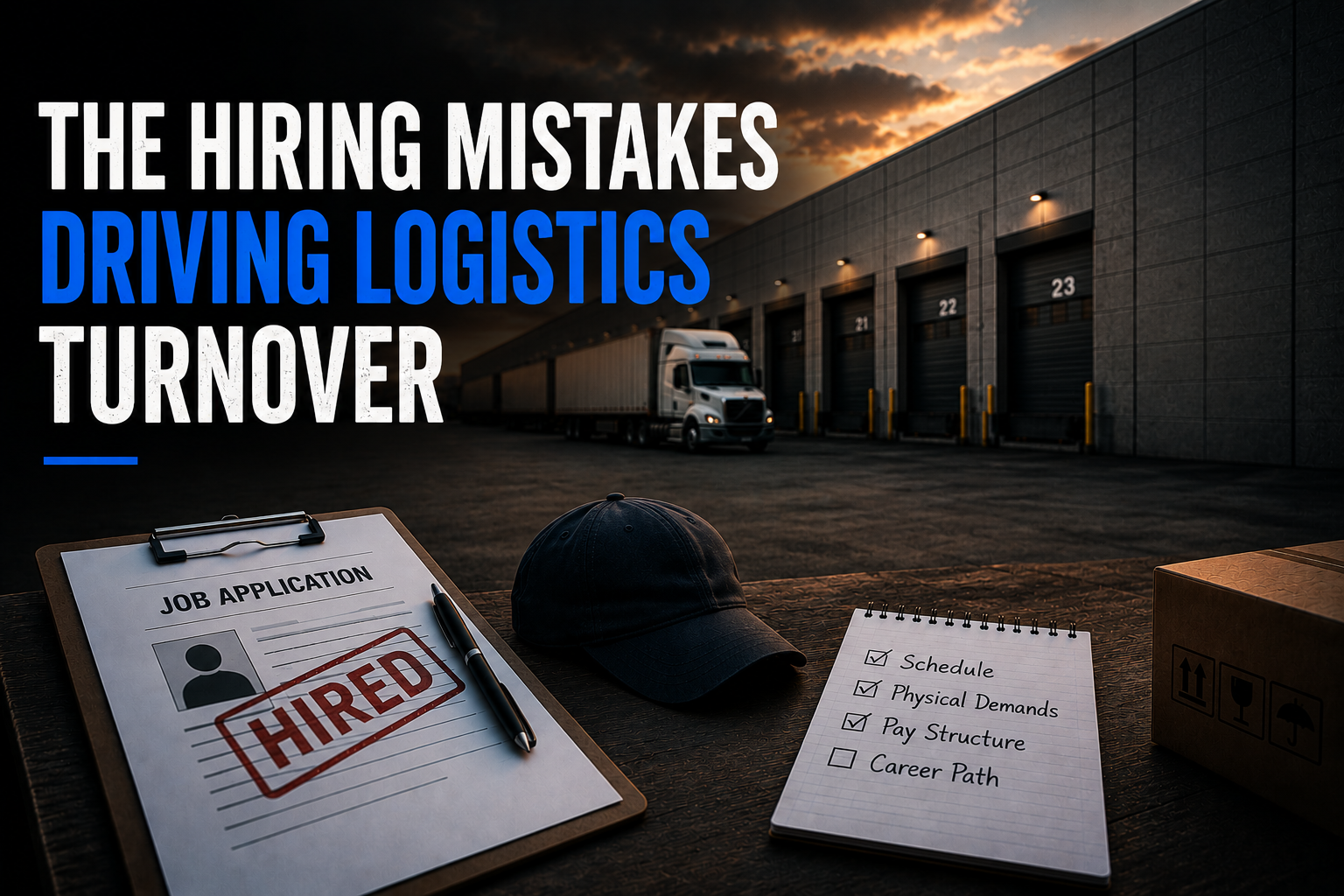
Most logistics turnover is a hiring problem, not a retention problem. The worker who leaves in week six made the decision to leave in week two, when the role turned out to be nothing like what they were told during screening.
Retention programs help, but they arrive too late to fix early attrition. The conversation that determines whether a worker stays past 90 days happens before their first shift.
Key Takeaways
- Early attrition in logistics is driven by expectation mismatches set up during hiring, not by conditions that develop after the worker starts.
- The three most common hiring mistakes are: failing to disclose the real schedule, understating physical demands, and misrepresenting how pay is structured.
- Workers who leave before 90 days rarely cite pay as the top reason. They cite feeling misled about what the job actually involved.
- Fixing the job posting and the screening conversation is cheaper and faster than any bonus or recognition program.
- Confirming transportation access at offer stage eliminates one of the most common week-one no-shows.
Why Retention Programs Miss the Root Cause
Most operations managers respond to high turnover by adding something: a referral bonus, a 90-day retention bonus, a recognition wall, an engagement survey. These tools address workers who are already feeling disengaged. They do nothing for a worker who walked in on day one expecting a morning shift and discovered they were on nights.
Early attrition (workers leaving in the first 90 days) has a different cause profile than mid-tenure attrition. Mid-tenure attrition is driven by management quality, career growth, and compensation. Early attrition is driven almost entirely by expectation mismatches between what was communicated during hiring and what the worker actually encountered.
Where to Intervene
Retention programs are designed for mid-tenure problems. The place to intervene is the hiring process itself.
The Three Hiring Mistakes That Cause 90-Day Attrition
When Turnover Happens in Logistics
Primary cause at each stage of early attrition
Bar width reflects relative frequency, not a measured percentage. Early exits (weeks 1 to 8) are primarily hiring process failures, not workplace culture failures.
Three specific gaps in the hiring process account for the majority of early attrition in logistics roles. Each one is preventable without a new program or additional budget. They require a change to what gets said and written before the worker accepts an offer.
Not disclosing the real schedule at screening
The following schedule types are standard in warehousing, distribution, and last-mile delivery, and each is a common source of early attrition when not disclosed upfront:
- Rotating shifts
- Split shifts
- Overnight coverage
- Weekend requirements
- Mandatory overtime during peak periods
The problem is not that candidates cannot handle these schedules. The problem is that the schedule is disclosed too late, often after the candidate has already mentally accepted the job on different terms.
A job posting that says "full-time, competitive pay" without specifying shift times guarantees that a portion of candidates will arrive on day one expecting something different from what they find. The fix is simple: state the actual shift times in the posting and confirm them again during screening. "This role runs Monday through Saturday, 4 AM to noon" is the full disclosure. A candidate who self-selects out because of the schedule saves both parties two weeks of payroll and administrative costs.
The warehouse staffing challenges that compound turnover most often trace back to this gap. Workers who were not clearly told the schedule are statistically more likely to ghost in the first two weeks than workers who were.
Understating physical demands
The Expectation Gap
What candidates hear in hiring vs. what they experience on day 30
Physical demand descriptions in logistics job postings tend toward the generic. "Must be able to lift 50 pounds" appears in approximately every logistics posting on every job board and tells a candidate almost nothing about what the role actually involves.
A dock worker's role may require lifting 50 pounds, but it may also require standing for 10 hours on a concrete floor, working in a facility that reaches 95 degrees Fahrenheit in summer, and handling repetitive overhead reach for the last three hours of the shift. A candidate who can lift 50 pounds but has a heat sensitivity will leave that role in the first month. That is not a failure of will. It is a failure of the job description.
How to Describe Physical Demands Accurately
The screening conversation is the point to correct this. Describe conditions in measurable terms: temperature range, hours on feet, weight handled over the course of the shift (not the maximum single lift), and any environmental factors that differ from a standard office or retail environment. Ask what the candidate knows about the physical environment and confirm they have no relevant physical restrictions. You are not looking to screen out protected characteristics. You are giving the candidate accurate information so they can make an informed decision.
Misrepresenting pay structure (base vs. shift differentials vs. overtime-dependent)
This mistake happens when pay is described accurately, but in a way that creates an expectation that the worker's first paycheck will not match.
A recruiter tells a candidate, "You can earn up to $24 an hour in this role." That is true. But the base rate is $18, and the extra $6 comes from a night shift differential that applies only to the 10 PM to 6 AM shift. If the candidate is hired onto a day shift, they will never see $24. A worker who feels misled about pay will leave faster than a worker who genuinely does not like the pay. Being misled signals that the employer cannot be trusted, and that mistrust generalizes quickly.
The fix is to walk through the full pay structure before the offer is made: base rate, applicable differentials and which shifts they apply to, overtime eligibility, and whether the role realistically earns the higher end of any advertised range. This conversation belongs in the screening stage, not after the offer is accepted.
For how to hire forklift operators and similar roles where certification pay or shift differentials are common, disclosing this structure upfront meaningfully reduces the first-month churn rate.
Frontline hiring tools like Zyverno can be configured to surface these disclosures consistently at the candidate assessment stage, ensuring every applicant receives the same pay structure explanation before a hiring manager is involved.
How to Reset Candidate Expectations Before Day One
The goal is not to make the job sound better than it is. The goal is to make what candidates expect match what they will actually experience. Three moments in the hiring process are where expectation setting happens.
At the Job Posting
The job posting is where candidates form their initial mental model. Specific language about schedule, physical demands, and pay structure replaces optimistic assumptions before the first conversation.
At the Phone Screen
Use the screening conversation to confirm the candidate has absorbed the specifics in the posting, not just the title and pay range. Ask what they know about the shift structure. Confirm the pay structure makes sense to them.
At the Offer
State the exact shift, the base pay and any applicable differentials, and the transportation requirement. Ask if anything has changed that would prevent them from starting on the agreed date.
For high-volume roles like how to hire last-mile delivery drivers, running this expectation-setting process consistently across hundreds of applicants requires a structured screening layer, not individual recruiter judgment.
What to Verify at Offer Stage
Pre-Hire Retention Checklist
4 confirmations before every offer that reduce first-30-day attrition
State the actual shift in the job posting
Include specific start and end times, days of the week, and any rotation pattern. Replace vague phrasing with exact hours.
Describe physical demands in measurable terms
Weight handled over a shift (not just the single-lift maximum), hours on feet, temperature range, and any environmental conditions outside the norm.
Explain the full pay structure before the offer
Walk through base rate, which differentials apply to the candidate's specific shift, overtime eligibility, and the realistic earnings range for their role and hours.
Confirm transportation for the actual shift time
Ask directly before the offer is accepted. Early morning and late night shifts often fall outside public transit hours. Surface this now, not on day one.
The offer stage is the last opportunity to close expectation gaps before the cost of a mismatch becomes your cost. Four confirmations before every offer reduces first-30-day attrition significantly.
First, confirm the exact shift the candidate is being hired into, including start time, end time, and days of the week. Do not assume the candidate retained this from the job posting.
Second, confirm the physical environment. If the role involves temperatures outside the normal range, significant time on foot, or repetitive physical tasks, state this one more time.
Third, walk through the total pay structure. Base rate, any differentials that apply to their specific shift, overtime eligibility, and pay frequency. If the candidate has questions, answer them before the offer is signed, not on the first payday.
Fourth, confirm transportation. Ask directly: "Your shift starts at 4 AM. Do you have a reliable way to get to the facility at that time?" This question prevents a significant share of week-one no-shows. Candidates who do not have a viable answer may reveal it here rather than ghosting on day one.
These four confirmations take five minutes in a phone call or can be structured into a short pre-hire form. The cost of skipping them is a replacement hire, re-advertising the role, and a gap on the floor.
FAQ
Why do most logistics workers leave in the first 90 days?
The most common cause is an expectation mismatch between what was communicated during hiring and what the worker experienced on the job. Schedule conflicts, physical demands that were understated, and pay structure confusion account for the majority of exits in the first 90 days. Management and culture issues become more significant causes after the 90-day mark.
How do I write a logistics job posting that reduces early attrition?
Include the actual shift start and end times, not just "full-time." Describe physical demands in measurable terms: weight handled over a shift, hours standing, temperature range if applicable. State the base pay rate clearly and explain any differentials or overtime structure that affects total earnings. Candidates who apply to a specific, honest posting self-select more accurately than candidates who apply to a vague one.
Do retention bonuses reduce logistics turnover?
Retention bonuses reduce attrition for workers who are already engaged but considering leaving for a financial reason. They do very little for early attrition, which is driven by expectation mismatch rather than compensation dissatisfaction. A worker who discovered the job was different from what they expected will not stay for a 90-day bonus they did not know about when they were deciding whether to come back after week two.