
Distribution Center Staffing: Hire in the Right Order
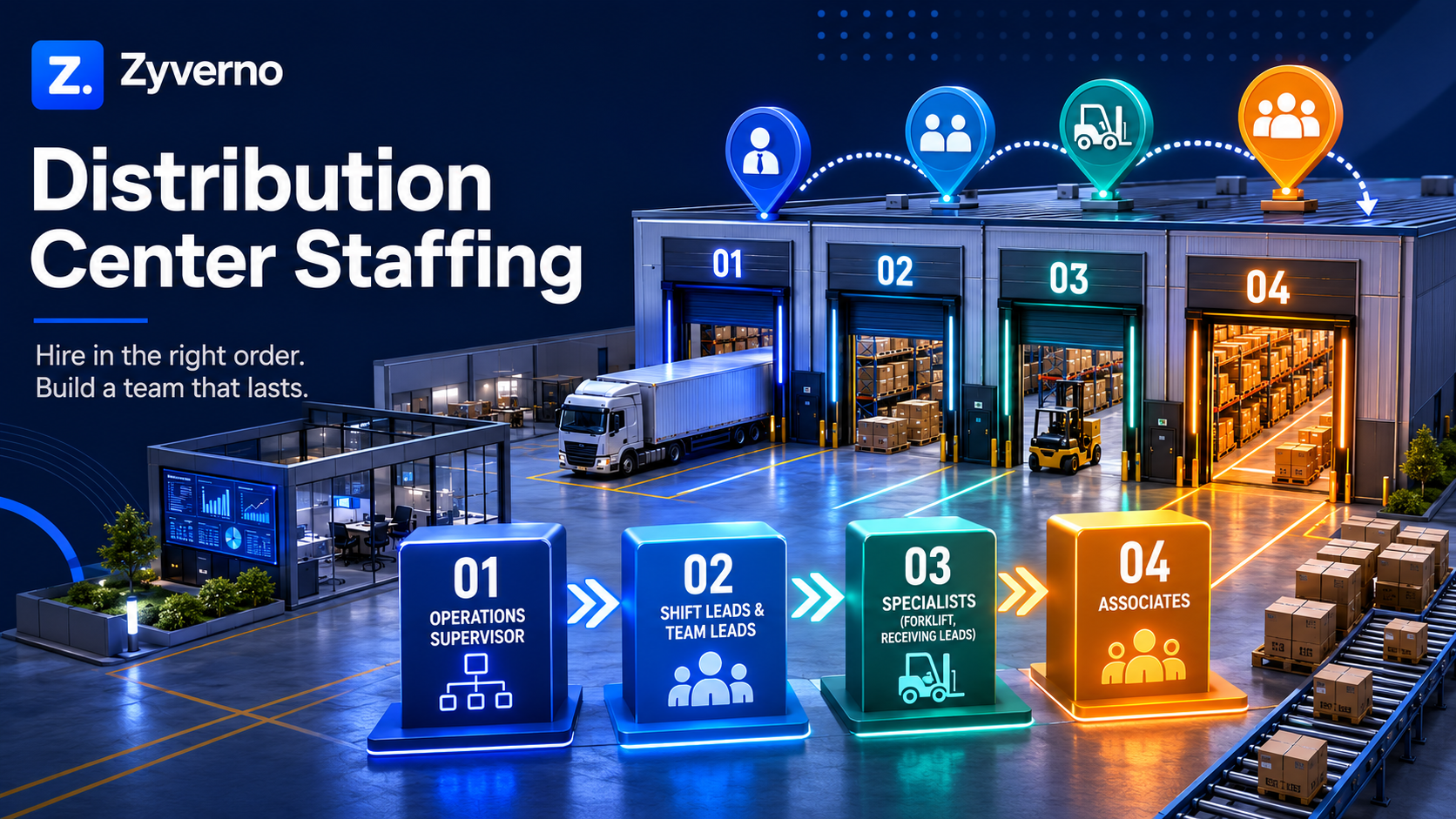
Staffing a distribution center correctly starts with the order in which you hire, not the speed. When all roles open at once, associates arrive before supervisors, and the entire operation fails before it begins.
Key Takeaways
- The sequence matters as much as the speed: supervisors and leads must be in their seats before associates arrive.
- Operations supervisors require the longest lead time, at approximately 8 weeks.
- Associates can be sourced in 2 to 3 weeks, but opening those roles before leadership is in place causes first-month attrition spikes.
- Forklift operators and receiving leads sit in the middle of the sequence and are often the most overlooked step.
- Treating all headcounts as equal in the hiring timeline is the single most common distribution center staffing mistake.
Why Hiring Order Matters More Than Hiring Speed
Most distribution center buildouts run into the same problem. The headcount plan gets approved, all requisitions open at the same time, and recruiting fills the easiest roles first. Associates come in fast. Supervisors lag.
Then associates show up on day one with no one to run orientation, no one to answer questions, and no one to enforce the process. Confusion sets in by the end of the first shift. By week two, attrition spikes.
Why does early attrition follow this pattern
According to Speed Commerce, the average annual employee turnover rate in warehousing sits around 43%, and 59% of warehouses report struggling to find and retain qualified workers. Most of that early churn is avoidable. It traces back to poor onboarding, and poor onboarding traces back to leadership not being ready when associates arrive.
Hiring speed matters. Hiring in the wrong order makes speed irrelevant. The fix is to treat the hiring sequence as a planning document, not just a headcount list. Every role has a lead time. Every role depends on a previous one being filled first.
The Right Sequence: Supervisors and Leads Before Associates
If skipped: no one to define process, run training, or make floor decisions. Every step below fails.
If skipped: supervisor cannot cover multiple shifts or zones. Associates have no immediate point of contact on the floor.
If skipped: equipment cannot be operated safely, inbound inventory cannot be received correctly. Operations cannot start at full capacity.
Open only after steps 1 to 3 are confirmed. Arriving before leadership is in place causes attrition spikes in week 1 and 2.
The correct order for building out a distribution center workforce follows a simple logic: the people responsible for training and managing each group must be hired before the group they manage. Here is how that plays out across four steps.
Step 1: Hire the Operations Supervisor (8 Weeks Lead Time)
The operations supervisor is the single most important hire in the buildout. This person owns the floor process, sets the standard, and runs orientation for every other hire that follows.
Start this search first. The lead time is approximately 8 weeks from posting to start date, accounting for sourcing, interviews, reference checks, and a two-week notice period with their current employer.
If this role is not filled before any other onboarding begins, nothing works. There is no one to train the leads. There is no one to define the process. There is no one to make decisions when things go wrong on the floor.
Hiring warehouse supervisors and team leads requires a different process than hiring hourly floor staff. Sourcing must start weeks earlier, and the interview process needs to assess both operational knowledge and people management ability.
Step 2: Hire Shift Leads and Team Leads (6 Weeks Lead Time)
Shift leads and team leads are the supervisors' multipliers. In a distribution center with multiple shifts or zones, these roles extend the supervisor's reach across the floor.
Start this search as soon as the operations supervisor is confirmed, not when they start. The lead time is approximately 6 weeks. By the time leads are hired and onboarded, the supervisor should already be in the seat and can participate in their orientation.
If leads are not hired before associates, the supervisor cannot effectively manage orientation for a large group. The floor breaks down into clusters of confused new hires with no immediate point of contact.
Step 3: Hire Specialists (4 to 5 Weeks Lead Time)
Specialist roles include forklift operators and receiving leads. These are the most commonly skipped steps in the sequence.
Operations managers often treat specialist roles as interchangeable with general associates, but they are not. Forklift operators require verification of certification before they can operate equipment. Receiving leads need to understand the warehouse management system before inbound inventory starts flowing. Hiring forklift operators requires credential verification that adds time to the process.
The lead time for these roles is 4 to 5 weeks. Skipping this step means either delaying facility operations or putting uncertified or untrained staff in specialist positions on day one.
Step 4: Open Associate Roles (2 to 3 Weeks Lead Time)
General warehouse associates can be sourced in 2 to 3 weeks, which is why they are almost always the first roles filled when all requisitions open simultaneously. The sourcing is fast, and applicant volume is high.
But associates arriving before steps 1 through 3 are complete is the single most common cause of first-month failure. Open associate roles only after leadership and specialists are confirmed. The shorter sourcing window means you can time this step to land exactly when you need it.
Lead Times by Role: When to Start Each Search
How to use this: Count backward from your go-live date. The operations supervisor search must start 8 weeks out. Associate sourcing opens only after leadership roles are confirmed.
Working backward from your target go-live date determines when each search must start:
- Operations Supervisor: Start 8 weeks before go-live. This is the anchor of the entire timeline.
- Shift Lead and Team Lead: Start 6 weeks before go-live. Parallel to supervisor onboarding, not after.
- Forklift Operator: Start 5 weeks before go-live. Certification verification takes extra time.
- Receiving Lead: Start 4 weeks before go-live. Needs system training time before associates arrive.
- Warehouse Associate: Start 2 to 3 weeks before go-live. Open only after leadership and specialists are confirmed.
Most operations managers look at that list and realise the supervisor search should have started before the headcount plan was even approved. That is the right instinct. If you are waiting for a signed headcount plan before posting the supervisor role, you are already behind.
For the full picture on how to hire warehouse workers fast without cutting corners on quality, the approach changes significantly at the associate level compared to lead and supervisor searches.
Sourcing Volume for Floor Associates
Associates are a volume hire. The sourcing approach reflects that.
Effective sourcing for floor associates in a distribution center buildout uses three channels:
- Job boards with geo-targeting. Set tight radius filters (5 to 10 miles from the facility) and post for specific shifts rather than general availability. Split-shift facilities should post each shift separately.
- Staffing agencies with a distribution specialisation. Use agencies that focus on warehousing and light industrial, not generalist agencies. They move faster and screen for relevant experience before submitting candidates.
- Referral networks from your leads. Once team leads are hired, ask them immediately for referrals. Leads from similar facilities often know other reliable floor staff who are open to a new role. This is one of the fastest and lowest-cost sourcing channels available.
Expect attrition in the first two weeks, even in a well-run buildout. Build a 15 to 20 percent buffer into your associate headcount to account for no-shows and early quits. Do not treat your target headcount as your hiring target.
Managing the Day-One Readiness Gap
Associates arrive on day one. No supervisor is in seat yet to run orientation.
No one can answer process questions. New hires figure things out on their own or wait.
Confusion on the floor by the end of the first shift. Standards are set informally or not at all.
Attrition spikes in week two. The facility starts below capacity and rebuilds from a weaker base.
Supervisor is in the building two weeks before the first associate arrives. Process is defined and documented.
Leads are trained before associates start. Each shift has a named point of contact from day one.
Structured orientation runs consistently across all new associate cohorts. Questions get answered immediately.
First-month attrition stays lower. Associates know what to do, who to ask, and what good looks like.
Even when the sequence is followed correctly, a gap often opens between the time associates are hired and the time the facility is fully ready to process volume. Managing this gap is as important as the hiring sequence itself.
Three things that cause day-one readiness gaps:
- System access not provisioned before start date. Associates arrive with no logins, no equipment assigned, and no way to perform their job. This is an IT coordination failure, not a hiring failure, but it presents as a hiring failure to the new employee.
- Supervisors are not completing their own onboarding before associates arrive. If the supervisor is still learning the warehouse management system when associates start, they cannot answer basic questions. Give supervisors at least two full weeks in the facility before the first associate cohort arrives.
- Training materials not ready. Processes that exist in the supervisor's head but have not been documented cannot be consistently delivered across multiple orientation groups. Before associates start, the supervisor must complete a written orientation guide for each role.
Screening and scheduling associates for the right shift at the right volume at the right time is one of the highest-friction parts of a distribution center buildout. Tools that automate logistics hiring screening and scheduling can significantly reduce the coordination load during high-volume associate intake.
Frequently Asked Questions
What happens if we skip the supervisor hire and start with associates?
Associates arrive with no one to run orientation, no one to set process expectations, and no one to answer questions when problems come up on the floor. Confusion on day one leads to frustration by the end of week one and quits by week two. Attrition in the first 30 days typically runs two to three times higher in facilities that onboard associates before supervisors are in place.
How do we handle urgent timelines that don't allow 8 weeks for a supervisor search?
The most common solution is to promote an internal candidate or bring in an interim supervisor from a staffing agency that specialises in logistics management. An interim supervisor who has run a similar facility can step in within one to two weeks and hold the floor process together while a permanent search runs in parallel. This is significantly less disruptive than opening with no supervisor at all.
Can we hire supervisors and associates at the same time if we stagger their start dates?
Yes, this is the correct approach. The key is sequencing start dates, not search start dates. Post all roles as early as possible, but set start dates in order: supervisor first, then leads, then specialists, then associates. If a supervisor candidate accepts quickly and wants to start sooner than planned, let them start early. The more time leadership has in the facility before associates arrive, the smoother day one will be.