
How to Build a Sales Hiring Scorecard
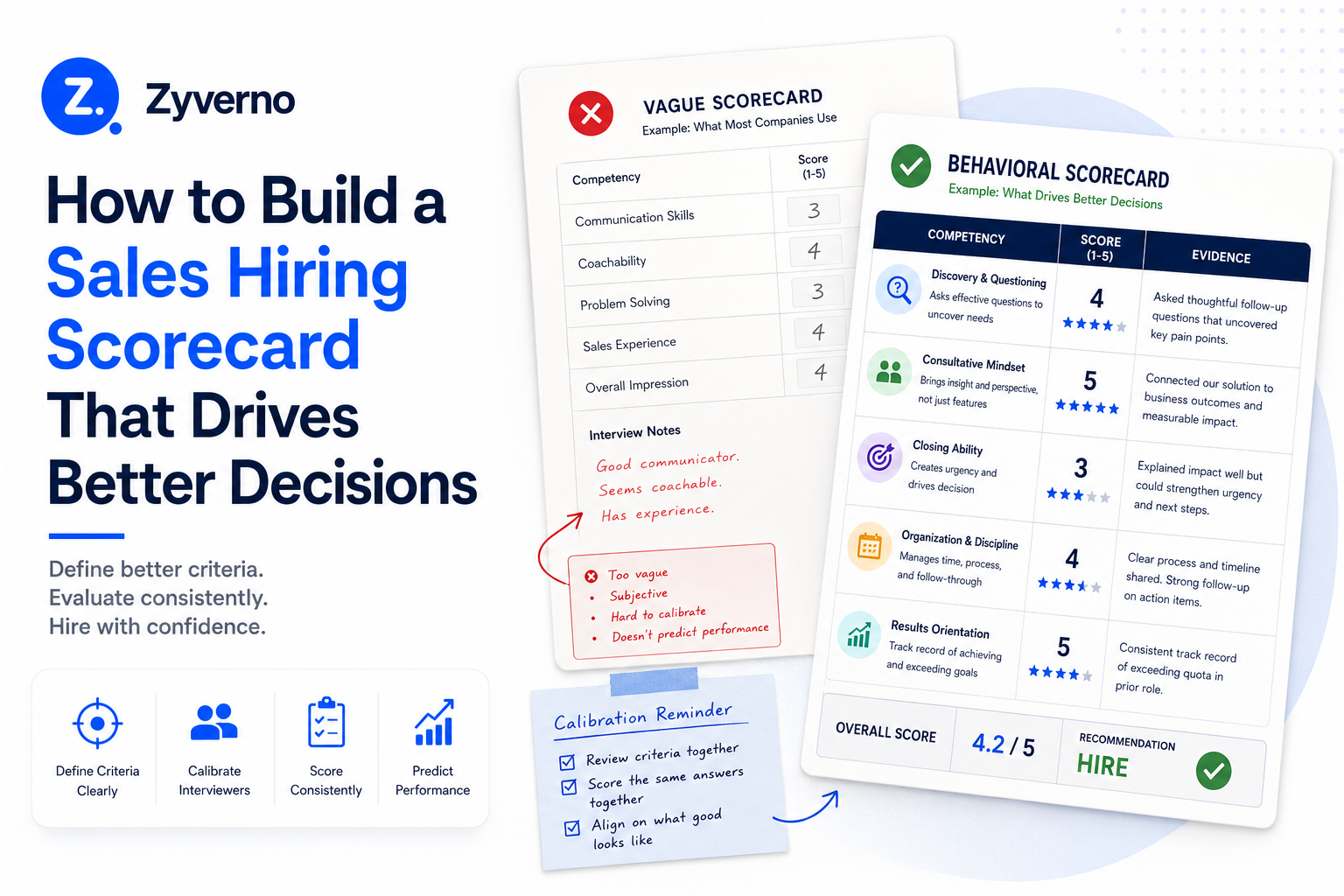
Most sales hiring scorecards are filled out after the decision is already made. To build one that functions as an actual decision tool: define competencies specifically, calibrate interviewers on what strong versus weak looks like before the process starts, and tie scorecard outputs to an explicit decision framework. Here is how.
Key Takeaways
- A scorecard only works if criteria are defined before the interview, not after.
- Vague criteria ("communication skills," "coachability") produce vague, useless scores. Behavioral criteria with defined anchors produce usable data.
- Calibration is required. If two interviewers score the same answer differently, the criteria are not specific enough.
- The scorecard should include a hiring recommendation field with a decision threshold: hire if X, do not hire if Y, escalate if Z.
- Track scorecard scores against 6-month and 12-month performance. If scores do not correlate with outcomes, the criteria are wrong.
Why Most Scorecards Fail
Before building a better one, it helps to understand what breaks the typical approach.
Vague criteria. "Communication skills" on a 1 to 5 scale tells an interviewer nothing about what to listen for. Two interviewers will score the same candidate 4 and 2, respectively, and both will believe they evaluated the same thing. Criteria that are observable and specific ("asked follow-up questions in response to a vague answer" versus "accepted the first answer and moved on") create consistent scores.
Vague Criteria vs. Behavioral Criteria
The difference between a score that means something and one that does not.
No anchor descriptions. A score of 3 means nothing without a description of what a 3 looks like versus a 4 versus a 2. Without behavioral anchors, every interviewer calibrates to their own internal scale.
No decision trigger. Most scorecards produce a score and then leave the decision to "consensus in the debrief." The debrief then becomes a debate where the person with the strongest conviction wins, not where the best evidence wins. A scorecard that does not tell you what to do with the score is not a decision tool.
Post-interview completion. When interviewers complete the scorecard after the debrief rather than immediately after the interview, the discussion contaminates individual evaluation. Each interviewer's scores shift toward the group consensus, which eliminates the benefit of multiple independent assessments.
According to Sackett et al. (2022) in the Journal of Applied Psychology, structured interviews show a mean validity of .42 for predicting job performance, compared to .16 for unstructured interviews. The structure is not just an administrative preference. It is what makes the score mean something.
The Structure of an Effective Sales Hiring Scorecard
Section 1: Candidate and role information
Basic context that makes the scorecard useful when reviewed months later:
- Candidate name, date, interviewer
- Role being evaluated
- Interview stage (recruiter screen, hiring manager screen, technical assessment, final loop)
- Which competencies is this interviewer responsible for evaluating
If your recruiter screen stage uses automated pre-screening, tools like Zyverno deliver structured candidate data before any human screen takes place. Those outputs can populate the scorecard's evidence fields at Stage 1, so the hiring manager reviews scored responses alongside the resume rather than a blank form.
In a multi-stage interview loop, each interviewer should own specific competencies, not all of them. Evaluating a candidate on five dimensions in a 45-minute interview produces shallow scores on all five. Two interviewers evaluating two or three dimensions each produce deeper, more reliable assessments.
Section 2: Competency scores
For each competency in scope for this interviewer:
- Competency name: Specific (for example, "Pipeline management discipline"), not generic ("process orientation").
- Behavioral indicators: 2 to 3 observable behaviors that demonstrate this competency at a high level.
- Scoring anchors: A description of what a 1, 3, and 5 look like for this specific competency.
- Evidence field: The interviewer records the specific thing the candidate said or did that informed the score, not a justification, but the actual data.
Example competency entry:
Commercial Acumen (Priority: High for account executive roles)
Behavioral indicators:
- Frames customer problems in financial or business impact terms, not feature terms.
- Asks questions about business outcomes during role-play or deal walkthrough.
- Can articulate return on investment or business case for past deals with specific numbers.
Scoring anchors:
- 5: Consistently asked about business impact, quantified outcomes in customer terms, and connected their solution explicitly to measurable results.
- 3: Asked some business questions but defaulted to product language when describing value. Gave outcomes without quantification.
- 1: Described all deals and responses in product and feature terms. Did not ask about business impact. Answered "what does your product do?" in spec-sheet language.
Evidence (interviewer fills in): _______________
Score: ___/5
Section 3: Specific deal walk-through assessment
For sales roles, the deal walk-through is the most informative part of any interview. It gets its own section:
- Deal described (company type, deal size, cycle length): _______________
- Stakeholders named and their roles: _______________
- Obstacles encountered and how handled: _______________
- Specificity score (1 to 5): How concrete and detailed were the answers?
- 5: Named stakeholders, recalled specific objections and responses, recalled timeline milestones, and what moved the deal.
- 3: Described the deal type and general process, but was vague on individual moments and stakeholders.
- 1: Described a deal archetype rather than a specific deal. Could not recall specifics when probed.
- Consistency score (1 to 5): Did the story hold together across follow-up questions?
Section 4: Communication quality
One section that every interviewer in the loop scores independently, because it is evaluated differently by a peer versus a hiring manager:
- Listening: Did they pause before answering, or jump in? Did they ask clarifying questions?
- Brevity: Did they answer the question asked, or did they over-explain?
- Specificity: Were their examples concrete or vague?
- Handling uncertainty: When they did not know something, did they say so or talk around it?
Score each on 1 to 5 with a brief evidence note.
Section 5: Hiring recommendation
This is the field most scorecards omit, and the omission is why scorecards become post-rationalization tools.
The interviewer should make a recommendation, not as a vote, but as an evaluation:
- Strong hire: The candidate demonstrated the competencies at the required level. No significant gaps.
- Hire with noted risks: Demonstrated most competencies at the required level. Specific gap (name it) that should be probed in the next stage or monitored in onboarding.
- Needs more information: Could not evaluate (specific competency) due to time or conversation direction. Should be covered in (next stage).
- Do not hire: Specific competency gaps make this candidate a poor fit for this role.
The critical rule: the hiring recommendation must be completed before the debrief, not after. Once the debrief begins, the recommendation is locked. Post-debrief score changes are permitted only to add evidence, not to change the recommendation.
Adapting the Scorecard for Different Sales Roles
The four core competencies (commercial acumen, process discipline, communication, resilience) apply across sales roles, but the weight and behavioral indicators shift by role.
For sales development representatives: Weight communication and resilience are higher. The role requires sustained outbound activity and handling rejection at volume. Pipeline discipline and early prospecting judgment are the relevant process indicators, not dealing with complexity. The deal walk-through section becomes a "cold outreach walk-through" instead.
For account executives: Weigh commercial acumen and process discipline most heavily. The deal walk-through should probe a specific complex deal. Resilience matters, but the differentiating signal is whether the candidate thinks in business impact terms and manages a long pipeline process systematically.
For sales managers: Replace "commercial acumen" with "coaching and development approach." The deal walk-through becomes a "team development walk-through": describe a rep who was struggling and what you did. Managers who talk about their own selling instead of their team's development are a predictable failure mode. Add a specific section for how they describe their pipeline review process.
One scorecard for all three roles produces misleading scores. Build role-specific versions, even if the structure is the same.
Bias Safeguards in Scorecard Design
A scorecard reduces bias when the criteria are behavioral and specific. It amplifies bias when the criteria are vague, and the interviewer fills them in with subjective impressions.
Specific safeguards:
Name the behaviors, not the traits. "Asked clarifying questions before answering" is a behavior. "Seems curious" is an impression. Behavioral criteria can be observed consistently across candidates. Trait-based criteria are filtered through the interviewer's existing assumptions.
Require evidence fields. An interviewer who must write down what the candidate specifically said or did has to confront whether their score is based on evidence or feeling. Evidence requirements reduce the distance between score and justification.
Separate scoring from discussion. Interviewers complete their scores and recommendations independently before the debrief. Once the group talks, individual assessments drift toward consensus. Keeping them separate preserves the independent signal each interviewer provides.
Run adverse impact checks over time. If candidates from a particular demographic are consistently scored lower on specific competencies without performance data to support the pattern, the criteria or the calibration may be introducing systematic bias. Review aggregate data across candidate pools every 6 to 12 months.
Calibration: The Missing Step
A scorecard with good criteria and no calibration produces inconsistent results. Calibration means all interviewers in a loop agree on what each score level looks like before they evaluate candidates.
How to calibrate:
-
Before the first candidate in a new search, run a calibration session (30 minutes) where the hiring manager describes:
- What a "5" looks like on each competency, using examples from past strong hires or hypothetical scenarios.
- What a "3" looks like, the good-but-not-great version.
- What a "1" looks like, the clear disqualifier.
-
After the first 2 to 3 interviews, compare scores across interviewers. If two interviewers scored the same competency 5 and 2, there is a calibration gap. Address it in a brief sync before the next interview.
-
For recurring roles (ongoing sales development representative or account executive hiring), calibrate quarterly. As you see real candidates, your mental model of the range becomes more precise. Update the anchors to reflect what you have learned.
Using Scorecard Data Over Time
The scorecard's second function, often ignored, is generating data that lets you improve hiring criteria over time. For the broader framework on using data to evaluate sales candidates, including which pre-hire assessments correlate most strongly with performance, see that guide.
Track the 6-month and 12-month performance of every hire against their pre-hire scorecard scores. The correlations tell you which criteria are predictive:
- If "specificity of deal walk-through" scores correlate strongly with 12-month quota attainment, that criterion is predictive. Weight it higher.
- If "communication quality" scores show no correlation with performance, either it is not predictive for your role, or you are not measuring it accurately. Revise or deprioritize.
- If hires with a "hire with noted risk on pipeline discipline" flag underperform consistently, that risk flag is real. Treat it as a harder filter.
This is how a scorecard gets better over 12 to 18 months of use. The first version is a hypothesis about what matters. The calibrated version is evidence-based.
For connecting scorecard data to broader hiring metrics, refer to sales hiring metrics. For the full competency model, the scorecard should be built from the sales competency framework.
Template: One-Page Sales Hiring Scorecard
Sales Hiring Scorecard: Visual Template
Rendered version of the one-page scorecard format with behavioral anchors and decision fields
| Competency | Priority | Score (1–5) | Evidence (what they said / did) |
|---|---|---|---|
| Commercial Acumen | High |
|
Interviewer notes here |
| Process Discipline | High |
|
Interviewer notes here |
| Communication & Influence | High |
|
Interviewer notes here |
| Resilience & Self-Management | Medium |
|
Interviewer notes here |
Frequently Asked Questions
How many competencies should a sales hiring scorecard include?
Three to five per interview stage. More than five creates scoring fatigue and shallow assessments. If you have eight important criteria, split them across two interviewers (four each) rather than asking one person to evaluate all eight in 45 minutes.
Should candidates see the scorecard?
The criteria, yes. The scores and recommendations, no. Sharing what you are evaluating helps candidates prepare relevant examples, which produces better information. It does not give candidates an advantage if the criteria are about actual competency rather than the ability to perform in an interview.
What if interviewers disagree significantly in debrief?
Treat it as data. A significant score divergence (2 or more points on the same competency) usually means either that the criterion is not calibrated or that the interviewers saw genuinely different things because the candidate performed differently in each conversation. The second case is informative: a candidate who performs well with a recruiter and poorly with a hiring manager may have good surface-level communication and weak domain depth.
How do you build a scorecard for a role you are hiring for the first time?
Start with the four core competency categories (commercial acumen, process discipline, communication, resilience) and weight them based on your role's requirements. After 5 to 8 hires, review which criteria correlated with performance and which did not. The first scorecard is always a hypothesis. Refine it with each cohort.
Are scorecards legally required?
No. But they reduce legal exposure by making hiring decisions documentable and criteria-based. If a candidate alleges discrimination, a documented scorecard showing what criteria were applied and how the candidate was scored relative to those criteria is a stronger defense than an undocumented judgment call. The key requirement: the criteria must be job-related and consistently applied across all candidates for the same role.
Frequently asked questions
Related articles
The CV Graveyard
Stop starting from zero. Use Zyverno to match past applicants to new roles based on skills and experience. Reengage your existing talent pool effectively today.
salesThe Holiday Hiring Horror Story
Discover how Zyverno can streamline your holiday hiring process, ensuring you don't lose top candidates during peak times.
salesAI recruitment is only for tech roles?
Discover how AI recruitment helps streamline hiring for all roles, not just tech. Improve efficiency and decision-making with Zyverno.