
Sales Competency Framework: How to Define What Good Looks Like
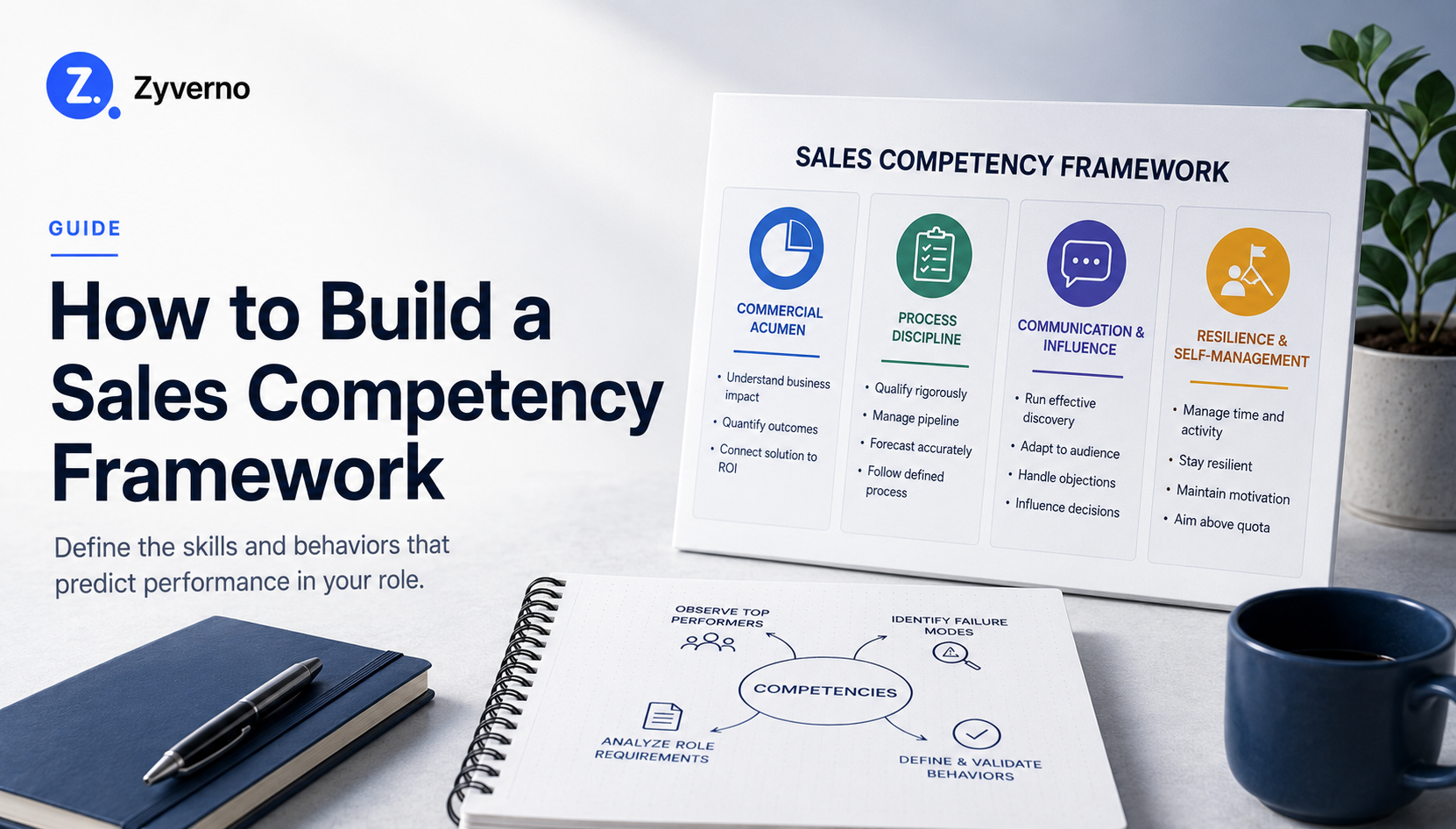
A sales competency framework defines the observable skills and behaviors that predict performance in your specific role. Not personality traits, not pedigree, and not a recycled list from a job description template. Without one, every hiring decision defaults to gut feel.
Why Generic Sales Competencies Don't Work
Industry benchmarks consistently show the majority of sellers miss quota in a given year. A generic hiring checklist does not explain that number. A calibrated competency framework that defines what good performance actually looks like in your specific role is the starting point for changing it.
A search for "sales competency framework" produces lists that look roughly the same: communication skills, persistence, product knowledge, active listening, closing ability, time management, and coachability.
These are not useless, but they're not specific enough to make decisions from. "Communication skills" describes everyone you'd interview. "Closing ability" is the outcome you're trying to predict, not the behavior you can evaluate.
The second problem is that generic frameworks apply the same criteria to every sales role. The competencies that matter for a sales development representative booking 30 discovery calls a week are different from those that matter for an enterprise account executive managing a $500K deal with six stakeholders over nine months.
A useful competency framework is built from three inputs:
- The specific nature of your sales motion (deal size, cycle length, buyer type, complexity)
- The behaviors of your top performers (what they actually do, not what sounds like good sales advice)
- The failure modes of past underperformers: the patterns that showed up early and should have been caught
The Four Competency Categories
Most sales competency frameworks map to four categories. The weighting of each should vary by role.
1. Commercial acumen
The ability to understand a business's problem in financial terms and connect your solution to measurable outcomes.
Observable behaviors:
- Asks questions about business impact, not just pain points ("What does this cost you today?" not just "What's the challenge?")
- Quantifies outcomes in the customer's terms during demo and proposal
- Adjusts their pitch based on what the buyer's business cares about, not a fixed script
- Can build a simple return on investment case when asked
Highly weighted for: enterprise account executives, complex business-to-business sales, deals over $50K.
Less critical for: transactional small business sales, inside sales with short cycles.
2. Process discipline
The ability to execute a consistent sales process, qualify rigorously, and manage the pipeline accurately.
Observable behaviors:
- Can describe their qualification criteria and apply them consistently
- Accurately forecasts based on deal signals, not optimism
- Advances are made through defined stages rather than running every opportunity indefinitely
- Updates the customer relationship management system as part of the workflow, not as a separate administrative task
Highly weighted for: mid-market and enterprise account executives, any role where pipeline accuracy matters for forecasting.
Less critical for: roles where the cycle is short and deals either close or are not completed within two weeks.
3. Communication and influence
The ability to run a discovery that surfaces real buying motivation, adjust communication style to different stakeholders, and guide a buyer toward a decision.
Observable behaviors:
- Listens more than they talk in discovery calls
- Asks follow-up questions rather than jumping to pitch
- Adjusts their language, pace, and depth based on the audience (technical vs. economic buyer)
- Can explain the same concept at three different levels of detail
- Handles objections by understanding the concern before responding to it
Weighted for: all sales roles, but the specific manifestation varies. Enterprise account executives need multi-stakeholder communication. Sales development representatives need call-opening and curiosity-building.
4. Resilience and self-management
The ability to sustain high activity levels through rejection, manage time without micromanagement, and maintain performance across a variable income model.
Observable behaviors:
- Has a personal system for managing their day and follow-up (not relying entirely on system reminders)
- Recovers quickly after a bad week, doesn't let a rough stretch compound
- Can describe a time they were in a sustained slump and what they did about it
- Sets personal performance goals above quota, not equal to it
Weighted for: outbound-heavy roles, sales development representatives, any role with significant rejection volume.
How to Build Your Framework
The Five-Step Build Process: What You Do, What You Get
Each step has a concrete activity and a concrete output. The framework is not done until all five outputs exist.
Analyze top performers
Sit in on calls. Review recordings. Interview your best reps. Ask what they do that their peers do not.
Output
A list of 8 to 12 observable behaviors your top performers share, written in plain language.
Identify failure patterns
Pull exit data and manager notes on reps who did not work out. What was visible in month one or two?
Output
A list of early warning signals that appeared before a rep hit full underperformance. These become your screening filters.
Define behaviors, not traits
Rewrite each pattern from steps 1 and 2 as an observable action. Replace adjectives with verbs.
Output
Behavior statements an interviewer can listen for and score, not traits an interviewer must interpret.
Assign weights by role
Score each competency for your specific role type. A sales development representative role and an enterprise account executive role need different weightings.
Output
A scored competency list where the four categories are ranked by importance for this specific hire.
Define proficiency levels
For each competency, write what developing, proficient, and advanced performance looks like in an interview answer.
Output
A scoring rubric interviewers can use independently. Calibration meetings become comparison of scores, not debate of impressions.
The framework is only as reliable as the behavioral evidence behind it. Steps 1 and 2 are the work most teams skip. They are also the steps that determine whether the framework reflects your actual sales motion or someone else's.
Step 1: Analyze your top performers
The most reliable input to a competency framework is observational data on your best reps. What do they do differently in the ways you can see?
Questions to ask:
- When they run a discovery call, what questions do they ask that their peers don't?
- How do they handle the three most common objections? What's the pattern?
- When they lose deals, what's the reason? When peers lose deals, is it the same reason or different?
- What does their pipeline look like: how many opportunities, at what stages, with what accuracy?
- How do they manage their week? What do their Mondays look like?
Sit in on calls. Listen to recordings. Interview the reps themselves. The best ones can often articulate what they do differently if you ask the right questions.
Step 2: Identify the failure patterns
Look at your underperformers and the reps who didn't work out. Not what they failed at eventually, but what was visible early:
- What did their first 30-day pipeline look like?
- Where did deals stall consistently?
- What were the early warning signs in call reviews?
- What did their manager notice first?
The failure patterns tell you what to screen for just as much as the success patterns do. If every underperformer had a thin pipeline in month two despite activity metrics looking fine, you're looking at a qualification problem. That's a competency you can evaluate at an interview.
Step 3: Define the behaviors, not the traits
Translate each pattern into an observable behavior, not a personality description.
Don't write: "Strong communicator."
Write: "Adjusts explanation depth based on audience. Uses customer's language, not product language, in objection handling."
Don't write: "Driven."
Write: "Sets personal weekly goals for pipeline adds and call volume. Tracks their own performance without manager prompting."
The behavior description tells an interviewer what to listen for and what to probe. The trait description does not.
Step 4: Assign weights by role
Not all competencies matter equally for every role. A reasonable starting weight guide:
Commercial acumen matters most for enterprise account executives (very high weight) and mid-market account executives (high weight). For small business account executives, the weight is medium. For sales development representatives, it is low, since their job is to qualify and book, not to build a return on investment case.
Process discipline carries high weight across all four role types: sales development representative, small business account executive, mid-market account executive, and enterprise account executive. Pipeline accuracy and qualification rigor are non-negotiable at every level.
Communication and influence are high across sales development representative, small business account executive, and mid-market account executive roles, and very high for enterprise account executives who must navigate multiple stakeholders and buying committees.
Resilience and self-management are very high for sales development representatives (high rejection volume, outbound activity) and high for small business account executives. It drops to medium for mid-market and enterprise account executives, where deal cycles are longer, and the pace of rejection is lower.
Adjust these based on your actual observations. If your data shows that mid-market deals at your company fail primarily because of poor qualification rather than poor communication, weigh process discipline higher.
Step 5: Define proficiency levels for each competency
A framework without proficiency levels creates scoring debates. For each competency, define what the three levels of performance look like.
A simple model:
Three Proficiency Levels for Every Competency
Use these to calibrate scores across interviewers and guide coaching conversations.
Level 1
Developing
Demonstrates the behavior inconsistently or only with prompting. Needs direct coaching and close observation to improve.
Level 2
Proficient
Demonstrates the behavior consistently and independently. Can explain their approach and adapt it to different situations.
Level 3
Advanced
Excels and can coach others. Their approach is visible in team outcomes, not just their own numbers.
- Developing: Demonstrates the behavior inconsistently or only with prompting. Needs direct coaching and close observation.
- Proficient: Demonstrates the behavior consistently and independently. Can explain their approach and adapt it.
- Advanced: Excels and can coach others. Their approach is visible in team outcomes, not just their own numbers.
This level structure makes calibration conversations between interviewers faster. Instead of arguing whether a candidate was "good or not good," you're comparing notes on whether they showed proficient or developing-level commercial acumen.
Using the Framework in Hiring
The framework becomes a hiring tool when you translate it into interview questions and evaluation criteria that every interviewer uses for the same role.
The process:
- For each competency, identify the 2 to 3 behavioral interview questions that surface evidence of it
- Define what a strong answer looks like vs. a weak one
- Brief all interviewers on the criteria before the interview loop
- After each interview, score the candidate on each competency, not on an overall impression
- Make the hire/no-hire decision based on the competency scores, not the post-interview conversation
The typical failure mode: the interview loop generates enthusiasm from some interviewers, and concern from others, and the hire/no-hire discussion becomes a negotiation of opinions. A competency-based evaluation makes disagreements productive. Instead of "I just felt like they weren't a fit," you can say "their commercial acumen answers were consistently vague. They couldn't give me a specific example of quantifying value for a buyer."
One useful diagnostic before the structured interview stage: ask candidates to self-assess against the key competencies, then compare their self-ratings to your interviewer's scores. A candidate who rates themselves highly on process discipline but can't describe their pipeline management in concrete terms has a perception gap. That gap is itself a signal.
For the question set to use when interviewing against these competencies, see the best sales interview questions. For the full evaluation methodology, see how to assess sales skills in an interview.
Competency Weight Matrix by Role Type
Starting weights. Adjust based on your top-performer analysis.
| Competency | Sales Development Rep | Small Business Account Executive | Mid-Market Account Executive | Enterprise Account Executive |
|---|---|---|---|---|
|
Commercial acumen Business impact, return on investment framing, quantifying value | Low | Medium | High | Very high |
|
Process discipline Qualification rigor, pipeline accuracy, data hygiene | High | High | High | High |
|
Communication & influence Discovery, multi-stakeholder, objection handling | High | High | High | Very high |
|
Resilience & self-management Rejection handling, personal systems, sustained activity | Very high | High | Medium | Medium |
These are starting weights only. Calibrate against your top-performer analysis. If your best enterprise reps win on relationship, weight communication higher than shown. If they win on qualification rigor, weight process discipline higher.
Using the Framework for Development
The framework's second use is identifying skill gaps in current reps and targeting them specifically.
A rep who is underperforming at quota but has strong commercial acumen scores has a different problem than one who struggles with process discipline. Coaching for the first rep should focus on call mechanics and pipeline management. Coaching for the second should focus on business-level questioning and return on investment framing.
Without a framework, managers tend to give generic coaching ("try to ask more discovery questions") that doesn't address the actual gap. With a framework, coaching becomes specific: "Your commercial acumen scores are lower than your peers. Your discovery questions focus on features, not business impact. Let's pull three calls and identify where you could have gone deeper."
The framework also supports succession planning. A rep who scores advanced on commercial acumen and communication, but is developing in self-management, may be a future manager candidate once the self-management gap closes. Without a framework, that identification relies entirely on how much a manager happens to like a rep.
Making Competencies Measurable Over Time
A framework only holds value if you track it consistently.
Options for measurement:
- Call review scoring: Score reps against competency behaviors on a sample of recorded calls each month
- Manager calibration sessions: Have managers score the same rep independently, then compare. Disagreements reveal where the framework definition is unclear.
- System data checks: Process discipline competencies (pipeline accuracy, stage progression, data hygiene) can be pulled from system data rather than relying on observation alone.
- Self-assessment plus manager calibration: Ask reps to rate themselves quarterly. Compare to manager scores. The gap between self-perception and observed performance is often where coaching should focus.
The goal is to move from annual subjective performance reviews to monthly observable-behavior feedback. A rep who knows their commercial acumen score has something specific to work toward.
Frequently Asked Questions
How often should you update a sales competency framework?
Review it annually and after any significant change to your ideal customer profile, product, or go-to-market motion. A competency framework built for a transactional small business motion stops being useful when the company moves upmarket to enterprise. The underlying behaviors change enough to require a rebuild, not just a revision.
Should you share the competency framework with candidates?
Sharing it isn't harmful and can improve the quality of answers in behavioral interviews. Candidates who know you'll ask about commercial acumen will prepare examples.
Some companies share it explicitly as a signal of how they hire. The risk is low. The benefit is that candidates who come to the interview with better-prepared examples.
What if your top performers don't agree on what makes them successful?
That's useful data. If your top performers have meaningfully different competency profiles, you may not have a single sales motion. One rep wins through process discipline, another through relationship building, and a third through technical depth. Your hiring criteria should reflect that by weighting competencies differently for different types of candidates rather than applying one model uniformly.
How is a competency framework different from a job description?
A job description describes the role and the requirements. A competency framework describes the specific skills and behaviors that determine whether someone will succeed in that role.
The job description is an external document for candidates. The competency framework is an internal tool for evaluators. Both are necessary and serve different purposes.
Frequently asked questions
Related articles
The CV Graveyard
Stop starting from zero. Use Zyverno to match past applicants to new roles based on skills and experience. Reengage your existing talent pool effectively today.
salesThe Holiday Hiring Horror Story
Discover how Zyverno can streamline your holiday hiring process, ensuring you don't lose top candidates during peak times.
salesAI recruitment is only for tech roles?
Discover how AI recruitment helps streamline hiring for all roles, not just tech. Improve efficiency and decision-making with Zyverno.