
How to Use Role-Play Scenarios in Sales Interviews
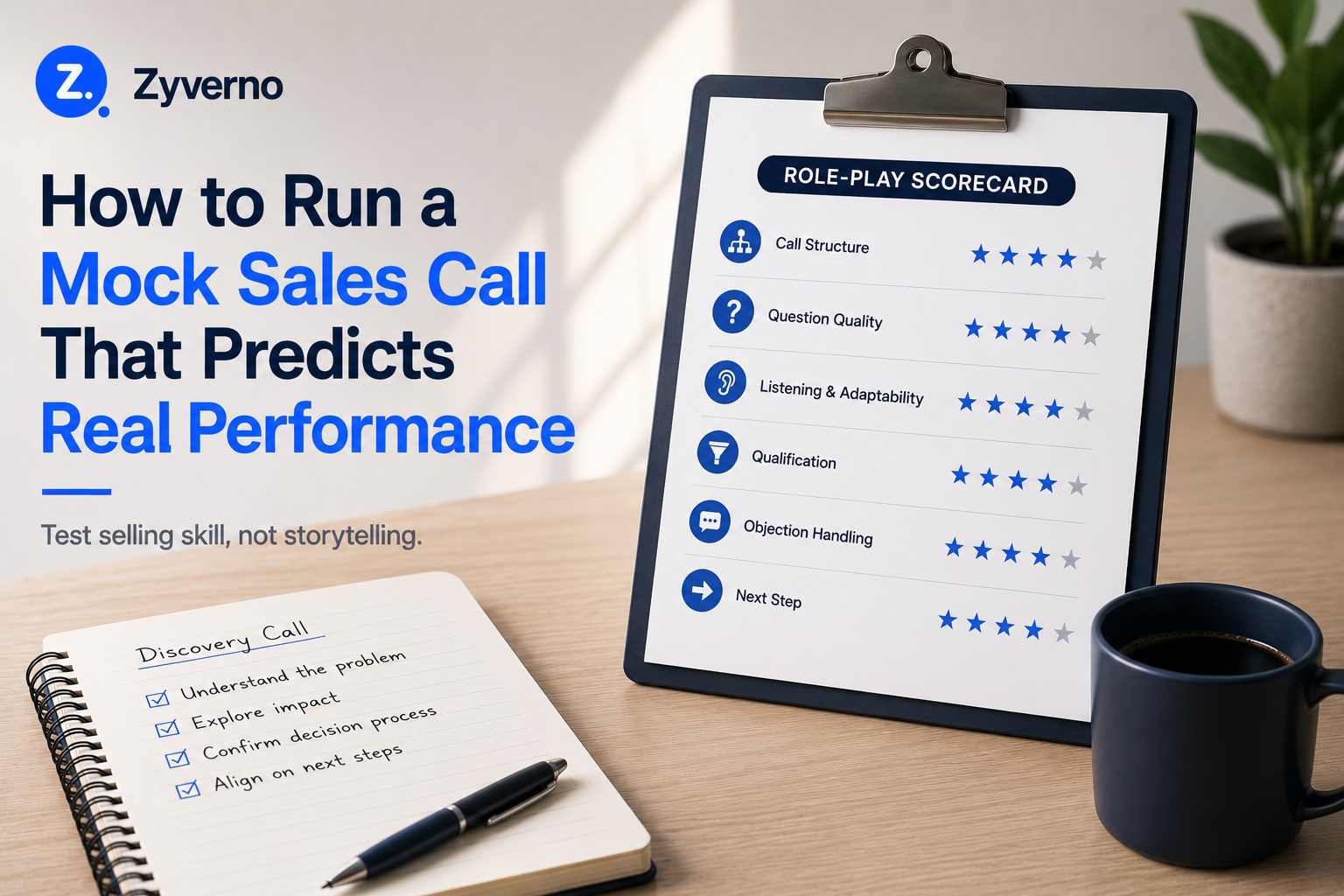
The highest-signal assessment in sales interviewing is a role-play: give the candidate a scenario and watch them sell. Standard behavioral interviews reveal storytelling ability, not selling ability. A mock call or discovery scenario is the closest available equivalent to a live work sample test.
This guide covers how to design and score one that surfaces real selling skills, not interview preparation.
Key Takeaways
- Work sample tests (including mock calls) consistently outperform unstructured interviews in predicting actual job performance.
- The role-play should simulate a real selling task: a discovery call, a follow-up conversation, or an objection-handling scenario, not an abstract exercise.
- What to evaluate: structuring the call, asking genuine discovery questions, listening and adapting, qualifying for business need and decision process, and setting a concrete next step
- What to avoid evaluating: likability, energy, and interview polish. These are interview skills, not selling skills.
- A candidate who can't run a coherent mock discovery call in a controlled setting won't run one in front of real prospects.
Why Standard Interviews Miss Selling Skill
A hiring process built around behavioral questions ("Tell me about a deal you closed against a strong competitor") produces answers that reveal storytelling competence. The candidate with the best deal story wins, regardless of whether they can actually replicate the skill being described.
Selling is a procedural skill. It requires a specific sequence of behaviors in a live conversation: establishing rapport and agenda, asking qualifying questions, listening to answers and building on them, identifying and quantifying business impact, navigating objections, and setting a next step. None of these can be evaluated from a story about how it went in the past.
For teams with significant applicant volume, the role-play stage is best preceded by a structured pre-screen. Zyverno screens candidates via voice or chat before any human interview time is invested, scoring responses against role criteria. By the time a candidate reaches the role-play stage, the recruiter already knows they meet the baseline requirements.
The role-play is the final skills assessment, not one step in an eight-step triage process.
Designing the Role-Play Scenario
Choose the right selling stage
The most informative role-play for most sales roles is the discovery call. It's the foundational selling motion; it reveals whether the candidate actually listens and adapts, and it exposes the qualification behaviors that separate good reps from great ones.
For complex enterprise roles, adding an objection-handling scenario or a multi-stakeholder follow-up scenario can reveal additional competency. For sales development representatives, a cold outreach call or an introductory call is more relevant than a full discovery.
Match the role-play to what the candidate will actually do on day one. If the role is cold-calling, the role-play should be a cold call. If the role is running discovery on inbound demos, the role-play should be a discovery call.
Role-Play Scenario Types by Sales Role
Match the scenario to what the candidate will actually do in the first 30 days
| Role | Scenario Type | Duration | Core Competencies Revealed |
|---|---|---|---|
| Sales development representative / Business development representative | Cold outreach call or introductory call opener Cold call | 10 min | Pattern interruption, early qualification, call control under rejection |
| Inside Sales Account Executive | Inbound discovery call with a warm prospect Discovery Recommended | 15-20 min | Question quality, listening, business impact identification, next step |
| Field / Small and mid-size business Account Executive | Discovery + one mid-call objection introduced by interviewer Discovery + objection | 20 min | All discovery skills plus objection handling and recovery |
| Mid-Market Account Executive | Discovery call + stakeholder mapping question set Multi-stakeholder | 25 min | Decision process qualification, champion building, enterprise buying dynamics |
| Enterprise Account Executive | Follow-up call: summarize prior meeting, address new stakeholder objection, build business case Complex follow-up | 25-30 min | Recall and synthesis, multi-stakeholder influence, return on investment framing under scrutiny |
| Sales Manager | Coaching call: rep has missed quota two quarters; manager must diagnose and motivate Coaching | 20 min | Diagnosis vs. advice-giving, accountability framing, coaching without demoralizing |
Provide materials in advance
Give the candidate the information they would have before a real call: your company's pitch deck, a one-page buyer persona, and a basic product overview. Send this 24 hours before the interview.
The advanced materials serve two purposes. First, they remove the excuse of not knowing the product. Second, how the candidate uses the materials (or doesn't) tells you something. A rep who shows up having read the materials and prepared a plan is demonstrating an instinct that predicts real-world behavior.
Define your role clearly
Play the buyer persona. Be realistic: have a genuine business problem, be a little skeptical, don't give away information the rep hasn't earned with a good question. But don't be a brick wall. The goal is to simulate a real prospect, not to sabotage the candidate.
Establish the scenario in one sentence at the start: "I'm the VP of Operations at a logistics company with 80 employees. We're currently using two different scheduling tools, and they don't talk to each other. You can start whenever you're ready."
Adapt for remote interviews
Remote role-plays require one additional design choice: decide whether video is on for both parties. In a real sales call, the rep would see the prospect. Turning the video off simulates a phone call. Leaving it on simulates a video call. Match the format to what the rep will actually do in the role.
Also, brief the candidate explicitly that this is a screen-based role-play, not an in-person one. Some candidates who are strong on the phone lose composure on Zoom. That's a signal too.
What to Evaluate
Use a structured scorecard. Assess the same competencies across every candidate so that comparisons are apples-to-apples. For a full framework on what to measure and how to score it, see how to assess sales skills in an interview. The following six dimensions apply to most business-to-business sales discovery scenarios:
Discovery Role-Play Scorecard
Score each dimension independently before debriefing with other interviewers
| Dimension | What to Look For | Score Guide |
|---|---|---|
| 1. Call structure | Agenda-setting, direction, professional opening |
1
2
3
1 No agenda set | 2 Partial structure | 3 Clear agenda, confirmed with prospect
|
| 2. Question quality | Qualifying vs. filler questions; building on answers |
1
2
3
1 Script-reading | 2 Some relevant questions | 3 Genuine discovery, builds on answers
|
| 3. Business impact | Attempts to quantify cost/impact of described problem |
1
2
3
1 Sympathetic only | 2 Acknowledges pain | 3 Quantifies impact in prospect's terms
|
| 4. Objection handling | Acknowledge, explore, reframe — not defensive or avoidant |
1
2
3
1 Defensive/dismissive | 2 Acknowledges only | 3 Explores root, reframes effectively
|
| 5. Decision process | Asks about stakeholders, timeline, success criteria |
1
2
3
1 Skips entirely | 2 One qualifying question | 3 Maps stakeholders, timeline, success criteria
|
| 6. Next step quality | Specific, time-bound commitment — not "I'll send info" |
1
2
3
1 No close or vague | 2 Close without date | 3 Specific ask with time-bound commitment
|
1. Call structure
Did the candidate establish an agenda at the start of the call? Did they explain what they hoped to cover and ask if that worked for the prospect? Agenda-setting is a basic call management skill. Its absence signals either inexperience or disorganization.
2. Question quality
Are the questions genuinely qualifying, or are they softballs? Strong discovery questions uncover business impact, decision process, and existing pain. Weak discovery questions confirm the prospect uses a product category ("Do you currently use any scheduling tools?"). The difference is whether the rep is building toward understanding or just filling conversational space.
Watch for the rep who follows up on your answers versus the rep who has a script and runs it regardless of what you say. Listening and adapting are core selling skills. Its absence becomes obvious in a 15-minute call.
3. Business impact identification
Did the rep try to quantify the impact of the problem you described? Saying "that sounds like a real challenge" is not discovery. Asking "how much time does your team spend reconciling between those two systems each week?" is discovery. The difference is whether the rep is building a business case or being sympathetic.
4. Objection handling
Introduce a natural objection partway through: "We looked at something similar six months ago, and the pricing was a lot higher than we expected." How does the candidate respond? Acknowledge, explore, and reframe? Or get defensive, pivot away, or become apologetic?
The handling of a single objection reveals more about how a rep responds under pressure than an hour of behavioral questions.
5. Decision process qualification
Did the rep ask who else would be involved in a decision? Did they ask about the timeline and what success would look like from the prospect's side? These questions are uncomfortable to ask because they expose the rep to answers they don't want to hear. Avoiding them is how bad reps end up with pipelines full of stalled opportunities.
6. Next step quality
How did the call end? A strong rep closes for a specific next step with a defined date. "I'd love to get you a demo. Would Thursday at 2 pm work?" A weak rep closes with "I'll send you some information, and you can let me know if you have questions." The next step determines whether this conversation becomes an opportunity or disappears.
Scoring and Calibration
After the role-play, score each dimension on a 1 to 3 scale before discussing with any other interviewer. Score independently. Then compare.
Significant divergence between interviewers on the same candidate is usually a calibration issue, not a candidate quality issue. It means interviewers are evaluating different things. Resolve it before the next candidate enters the process, not after.
The total scorecard score is a useful comparison tool. A candidate who scores high across all six dimensions has demonstrated the skill profile. A candidate who scores high on question quality and low on next step quality has a specific gap, which is often a coachable one. A candidate who scores low on listening and adapting has a harder-to-fix problem.
One additional metric worth tracking: the ratio of time the candidate spent talking versus listening. Reps who talk more than 60% of a discovery call are typically pitching rather than qualifying. You can estimate this from notes or from a recording. It's a fast proxy for whether the rep understands that discovery is about the buyer, not about them.
4-Step Scoring and Calibration Process
Complete the Role-Play
Run the 15-20 min scenario. Take notes on each dimension as it unfolds.
Score Independently
Each interviewer scores all 6 dimensions on 1-3 scale before any discussion. No sharing scores yet.
Compare and Spot Divergence
If two interviewers differ by more than 1 point on any dimension, that is a calibration gap, not a candidate issue.
Debrief and Lock
Discuss evidence only. Do not argue impressions. Final scores locked before the next candidate enters.
The ratio of candidate talk time to listening time is a useful fast-check: candidates who talk more than 60% of a discovery call are pitching, not qualifying.
Using the Debrief as a Second Evaluation
The debrief after the role-play is its own evaluation. After the role-play ends, ask two questions:
"How do you think that went?" "What would you do differently?"
Reps who can accurately diagnose their own performance are more coachable than reps who think every call went well. A candidate who says "I jumped to solution mode too early and didn't ask enough about the impact" has demonstrated self-awareness that is genuinely predictive of development pace.
Some teams go further: share one piece of specific coaching feedback, then ask the candidate to run a second, abbreviated version of the role-play incorporating that feedback. A candidate who can implement coaching in real time, within the same session, is demonstrating exactly the adaptation speed you want in a new hire.
Common Mistakes
Evaluating on polish rather than process. The candidate who is charming, confident, and well-spoken will always appear better than the candidate who is less smooth but actually runs the call correctly. Force the scorecard to keep yourself honest.
Playing an impossible prospect. If you refuse to give any information, dismiss every question, and create obstacles that don't reflect reality, you're testing resilience under extreme conditions, not discovery skill. The role-play should simulate a realistic call, not a hazing exercise.
Skipping the debrief. After the role-play, ask the candidate how they think it went. What would they do differently? This self-assessment is itself an evaluation dimension. Reps who can accurately diagnose their own calls are more coachable than reps who think every call went well.
Making the exercise too long. A 20-minute discovery role-play is the right length. A 45-minute scenario creates scheduling friction and tests endurance rather than skill.
Frequently Asked Questions
Should the role-play be recorded?
Recording the session (with candidate consent) is useful for calibration, especially when multiple interviewers are involved. Watching the replay removes recency bias from live impressions. It also allows you to evaluate dimensions you might have missed in the moment, including the speaking-to-listening ratio.
What if the candidate has a bad first five minutes but recovers well?
A recovery midway through a call is actually a meaningful positive signal. Reps who can recognize when a call is going sideways and adjust in real time are demonstrating adaptive selling. Weight the recovery appropriately in your scoring rather than discounting the whole call based on the opener.
Do role-plays work for all sales seniority levels?
Yes, but the complexity of the scenario should scale with the role. A sales development representative's role-play should test outreach and initial qualification. An enterprise account executive role-play should test multi-stakeholder discovery and business case construction. Using a sales development representative-level scenario to evaluate a senior account executive candidate tells you very little.
How should the role-play fit into the wider interview process?
The role-play works best as a late-stage assessment, after behavioral interviews have established baseline context. At high application volumes, a structured pre-screen can filter candidates before any human time is spent. By the time someone reaches the role-play, there should already be reasonable confidence that they meet the experience threshold. The role-play then answers the one question behavioral interviews can't: can they actually do it?