
Sales Onboarding Best Practices That Cut Ramp Time in Half
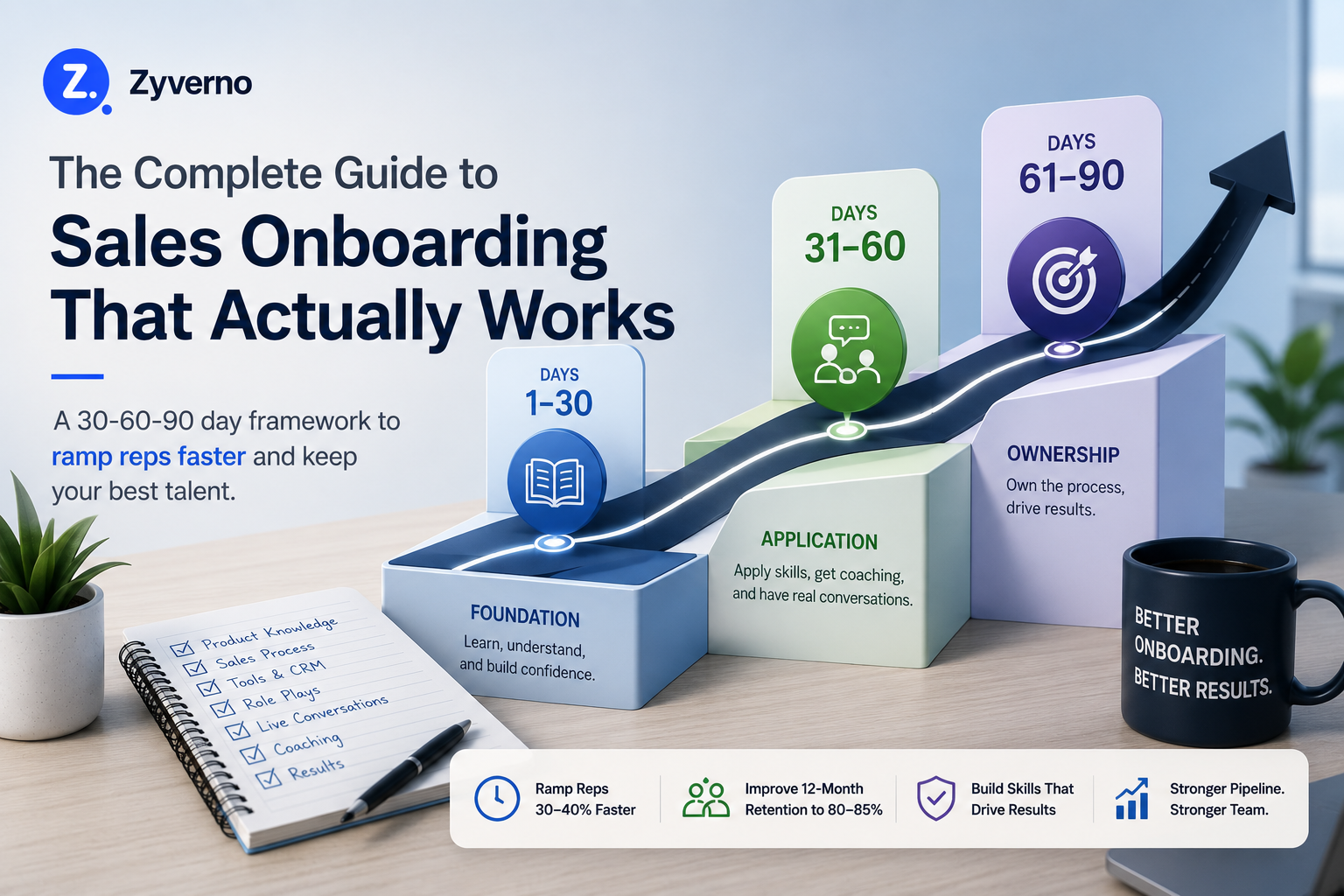
Structured sales onboarding cuts ramp time by 30-40% compared to informal programs. The failure mode in most programs is not a lack of effort. It is overloading reps with product knowledge while leaving them without the skills and process to sell. This guide covers what the right structure looks like, by phase and by outcome.
Key Takeaways
- Structured onboarding reduces ramp time by 30–40% and improves 12-month retention from 50–65% to 80–85%.
- The most common failure is knowledge-heavy programs with no skill practice 84% of training content is forgotten within three months without reinforcement.
- The 30-60-90 day framework is the minimum viable structure: days 1–30 for foundation, 31–60 for application with coaching, 61–90 for full ownership.
- Certification gates before live customer conversations prevent lead burn and bad habits that are hard to correct later.
- Onboarding is a retention intervention: 52% of top performers have left a role due to poor onboarding in their first 90 days.
Why Most Sales Onboarding Fails
Mistake 1: Treating the first week as the entire onboarding.
One week of product training, a laptop, and a customer relationship management login. The rep is then deployed. They don't know the buyer, the common objections, or how to get internal support on a stuck deal.
They start struggling, feel unsupported, and the 18-month clock on their tenure begins ticking.
Mistake 2: Knowledge-only programs.
Sales onboarding that is all classroom and no practice produces reps who can describe the product but can't sell it. Research shows 84% of training is forgotten within three months without reinforcement. Skills are built through repetition, call reviews, role plays, and joint visits, not through slides.
Mistake 3: No explicit milestones or success criteria.
If a new rep doesn't know what good looks like at 30, 60, and 90 days, they can't self-assess, and their manager can't coach proactively. Unclear expectations create anxiety and drift.
Mistake 4: Manager abdication.
Onboarding is treated as a human resources or enablement function. The manager checks in weekly, but isn't the driver. This disconnects the rep from the person they will rely on most and delays the relationship that drives retention.
Research shows 72% of new hires say one-on-one time with their manager is the most important part of onboarding.
Mistake 5: Skipping pre-boarding.
Most programs begin on day one. Administrative setup done on day one steals focus from learning. Getting tools access, customer relationship management login, email configuration, and compliance paperwork done before the rep starts means their first day is about the role, not the paperwork.
The 30-60-90 Day Framework
Pre-boarding: Before Day 1
Send the new rep the following before their start date:
- Tools access (customer relationship management login, email, communication platforms, scheduling software)
- Required compliance or human resources paperwork
- An overview of the team structure and key contacts
- Optional: a recorded product walkthrough or customer story to build early context
The goal is to eliminate administrative friction from the first week. That way the rep can focus on learning from day one.
Days 1-30: Foundation
The first 30 days are about knowledge, context, and first conversations, not closing.
By the end of day 30, the rep should:
- Understand the product, pricing, and positioning at a functional level
- Know the ideal customer profile in depth: who they are, what their problems are, how they buy
- Have shadowed 10+ calls (discovery, demos, and close calls)
- Completed a mock discovery call, scored against a rubric
- Understand the sales process: stages, criteria, expected actions at each stage
- Know how to use the customer relationship management system, the engagement tools, and the scheduling system
- Have met the key internal stakeholders they will need: account executive and sales development representative handoff points, customer success, and solutions engineering, if applicable
Week-by-week structure:
- Week 1: Product, positioning, and ideal customer profile
- Week 2: Sales process and tools; shadow calls begin
- Week 3: Competitive landscape and common objections
- Week 4: Mock calls, feedback, and prep for first live conversations
The goal at the end of day 30 is not a closed deal. It is a rep who is ready to have qualified conversations.
Days 1 to 30: What the Rep Builds Each Week
Four weeks of structured progression toward a single outcome: qualified conversations, not closed deals.
Week 1
Product and positioning
Learns product, pricing, ideal customer profile. Knows who they are selling to and what problem the product solves.
Week 2
Process, tools, shadow calls
Learns the sales process and customer relationship management tools. Begins shadowing live calls with senior reps.
Week 3
Competitors and objections
Studies the competitive landscape. Practices responding to the most common objections with the manager before any live exposure.
Week 4
Mock calls and certification
Completes mock discovery calls scored against a rubric. Receives written feedback. Does not advance until the standard is met.
Day 30
Ready for qualified conversations
Days 31-60: Application
Now they execute, with coaching. This phase bridges knowledge to performance.
By the end of day 60, the rep should:
- Be running their own discovery calls (with manager review)
- Have generated a defined pipeline target (set a specific number by role type and deal size)
- Have closed their first deal, or are within one conversation of closing
- Have a working understanding of their territory: who is a priority, why, and what the approach is
- Be tracking their own metrics daily
Manager role in this phase: Daily or every other day pipeline reviews and call debriefs. Not "how many calls did you make?" but "tell me about the best call you had this week, what worked, what would you change?" The goal is building a rep who can diagnose their own performance, not just execute tasks.
Red flag at day 60: A rep who hasn't had a qualified conversation or generated any pipeline. This is not a ramp failure by itself. It is a signal to investigate root cause immediately.
Ask whether the issue is skill (can't qualify), motivation (doesn't want to prospect), or circumstance (bad territory assignment, broken tool).
Days 61-90: Ownership
By day 61, the rep owns their territory and their pipeline. Manager involvement shifts from daily coaching to strategic input.
By the end of day 90, the rep should:
- Be at 70-80%+ of target activity metrics
- Have a pipeline sufficient to hit their first full-quarter quota
- Be self-diagnosing their own call quality and deal health
- Have demonstrated measurable improvement from day 30 to day 90 on a scored rubric
Industry benchmark: Top-performing teams see account executives at 85%+ quota attainment by month four. At month six, they should be fully ramped with sustainable performance. For sales development representatives, a full ramp is typically three months. See sales rep ramp time industry benchmarks for a breakdown by role type.
Certification Gates: Don't Let Reps Go Live Without Them
A certification gate is a competency checkpoint that a rep must pass before they can access the next stage of the role. Typically, that means a live customer conversation.
Why Certification Gates Exist: The Cause-Effect Chain
The article says gates save weeks. Here is how. The same four moments play out differently depending on whether a gate existed before the rep went live.
Without certification gates
Rep goes live unready
Product quiz skipped
Buyer asks a basic question the rep can't answer. The buyer's confidence drops and rarely recovers in the same conversation.
No mock discovery call
Discovery goes off track because the rep doesn't know how to qualify. The lead is burned, not recoverable. The rep doesn't know why.
Bad habits set in
Wrong objection handling and skipped qualification steps repeat across the first ten calls. The habits harden and persist for months.
Manager in remediation
Weeks of coaching time go toward correcting foundational errors. The manager cannot invest in the rep's growth because they're still fixing the start.
With certification gates
Rep certified before live calls
Product quiz passed
Rep enters the first live call confident. The buyer gets clear, direct answers to basic questions. Trust is established early.
Mock discovery call passed
Rep knows exactly how to structure qualification. The first real call generates a usable pipeline signal instead of a burned contact.
Correct habits form first
The first ten calls reinforce what the rep practiced and passed. No remediation needed. The habits that form are the ones worth keeping.
Manager coaches for growth
From Day 31 onward, coaching time goes toward skill development and deal strategy, not correcting errors that a gate would have caught before day one of live calls.
Five checkpoints that work:
- Product knowledge quiz: Can they explain the product in plain language, from the buyer's perspective?
- Ideal customer profile articulation: Can they describe the target buyer accurately, including their problems, triggers, and objections?
- Mock discovery call: Scored against a rubric. They don't move to live calls until they pass.
- Objection handling: Can they handle the three most common objections without escalating?
- Customer relationship management and tools proficiency: Can they log calls, update pipeline stages, and use the scheduling system correctly?
Reps who skip these checkpoints and go straight to live conversations tend to burn leads, damage relationships, and develop bad habits that are hard to correct later. The certification gate adds a few days to ramp time. It saves weeks of remediation.
What to Reinforce After Day 90
Onboarding doesn't end at 90 days. That is when most programs stop, but it is also when most attrition and skill decay begin.
84% of sales training content is forgotten within three months without reinforcement. The programs that produce three-year retention improvements keep investing after ramp.
Pipeline Review vs Skill-Focused Coaching: What Each Actually Looks Like
Most managers think they are doing skill coaching. Most are running pipeline reviews. The difference is specific. Here is how to tell which one you are in.
Pipeline review
What most managers run
"Where are you with each deal?" The rep lists pipeline stage by stage.
Manager asks "why is this deal stuck?" Rep gives status. Manager gives advice on next step. Repeat per deal.
Deal updates, next actions per opportunity.
30 to 45 minutes.
A list of next steps for each deal in their pipeline.
None. The rep knows what to do next, but not how to do it better.
Skill-focused coaching session
What works
"Tell me about the best call you had this week. What worked?" The rep reflects on a specific moment, not a deal stage.
Manager listens to five minutes of a recorded call with the rep. They stop at one specific moment and discuss: "What were you thinking here? What else could you have done?"
One skill observation, one specific behavior to practice next week.
20 to 30 minutes. Shorter and tighter than a pipeline review.
One specific thing to try differently in the next call. Not a list. One thing.
Direct. One behavior, one week, accumulated over months. This is what improvement looks like.
Ongoing practices that work:
- Weekly skill-focused one-on-ones: Not just pipeline review. Pick one skill area per week and coach it.
- Call library with examples: Store real calls (with rep permission) for training reference. "Listen to how she handled this objection" is more effective than any slide deck.
- Peer learning sessions: Monthly 60-minute sessions where reps share what is working. Discovery call tactics, objection responses, and email openers. Peer credibility is high.
- Quarterly calibration: Score every rep against the competency framework. This keeps standards visible and gives reps a concrete roadmap for development.
The Metrics That Tell You Whether Onboarding Is Working
How to read your own program's health: compare your actual numbers against these benchmarks.
Average ramp to first deal sits at 90-120 days in informal programs. Structured programs bring that down to 45-60 days.
Average ramp to full quota runs 5.7 months without a structured program. With one, it typically falls to 2.5-3 months.
12-month retention rate averages 50-65% at companies with informal onboarding. Structured programs push that to 80-85%.
Early-tenure win rate improves by approximately 27% with structured onboarding compared to informal programs.
Day 90 activity attainment sits at 40-60% in informal programs. Structured programs see 75-85%.
If your numbers are closer to the informal side, start with the most common failure: the gap between knowledge delivery and skill practice.
Structured vs Informal Onboarding: Five Key Metrics
Each pair of bars shows the same metric under two conditions. The gap between them is the cost of an unstructured program.
Time to first deal
Ramp to full quota
12-month retention rate
Early-tenure win rate
Day 90 activity attainment
Bar lengths within each metric pair are scaled relative to each other, not to a global maximum.
Common Pitfalls by Role Type
Sales Development Representative and Business Development Representative Onboarding
The core skill is outbound execution: cold calling, email sequences, and qualification. Common onboarding mistake: spending the first two weeks on product before the rep has made a single cold call.
Fix: Have sales development representatives make live cold calls in week two, with coaching. They don't need to be good. They need to start building repetitions.
Listen to the calls and debrief immediately. Adjust one thing. Repeat.
Account Executive Onboarding
Account executives need to understand the full deal cycle, not just the product. Onboarding should include simulated deals that walk through every stage from discovery to negotiation. The highest-value investment: recorded call libraries of your best discovery calls, annotated with why each question worked.
Sales Manager Onboarding
Often ignored. New sales managers frequently inherit a team before they have had any coaching on how to manage salespeople. This is how accidental micromanagers are made.
Onboarding for managers should include coaching frameworks and how to run a deal review rather than just a deal status check. It should also cover how to manage performance without creating anxiety, and how to handle a rep who is off track. The sales manager hiring guide covers how to set expectations with managers before their first day.
The Retention Connection
Onboarding is a retention intervention, not just a productivity one. 52% of top performers have left a role due to poor onboarding. Your most capable new hires are the most likely to leave if the first 90 days are disorganized.
It also starts at the hire itself. Reps who were accurately screened for role fit before joining arrive with realistic expectations. That gives the 30-60-90 framework a stronger foundation to build on. Tools like Zyverno run structured pre-hire screens that surface fit signals earlier, so the reps entering your onboarding program are more likely to complete it.
A rep who feels supported and is making progress at 90 days is invested. One who feels abandoned, confused, or set up to fail is already talking to recruiters.
The cost of replacing a sales rep (recruiting plus ramp plus pipeline loss) makes even a significant onboarding investment look like a bargain. A comprehensive onboarding program might cost $5,000-$10,000 per rep. If it prevents one turnover event per quarter, it pays for itself in the same month.
For more on the structural causes of sales attrition and how to address them, see how to reduce sales turnover.
Frequently Asked Questions
How long should sales onboarding last?
Minimum 90 days of structured programming, with reinforcement ongoing after that. One week is not onboarding. It is orientation. The 30-60-90 framework is the minimum viable structure for roles with any complexity.
What is the biggest onboarding mistake for small and mid-size businesses?
Relying on informal "pair the new rep with a top performer" training. This is better than nothing, but it produces reps who replicate one rep's style rather than learning a systematic process. It also pulls your top performer off their own pipeline. Use the peer shadowing model selectively and supplement with explicit skills training.
Should you hire before you have an onboarding program?
Yes, but build the program alongside the hire, not after. The first hire's experience in months one through three shapes what you learn about what new reps need. Document what you teach, how you teach it, and what works. By hiring three, you should have a real program.
How do you measure onboarding effectiveness?
Track three things: ramp to first deal, ramp to quota attainment, and 12-month retention. Compare cohorts (reps onboarded in Q1 2025 vs Q1 2026). If the metrics improve with each iteration of your onboarding program, it is working. If they don't, find the failure point in the 30-60-90 framework and fix it.