
Freight Coordinator Hiring: Screen Before You Interview
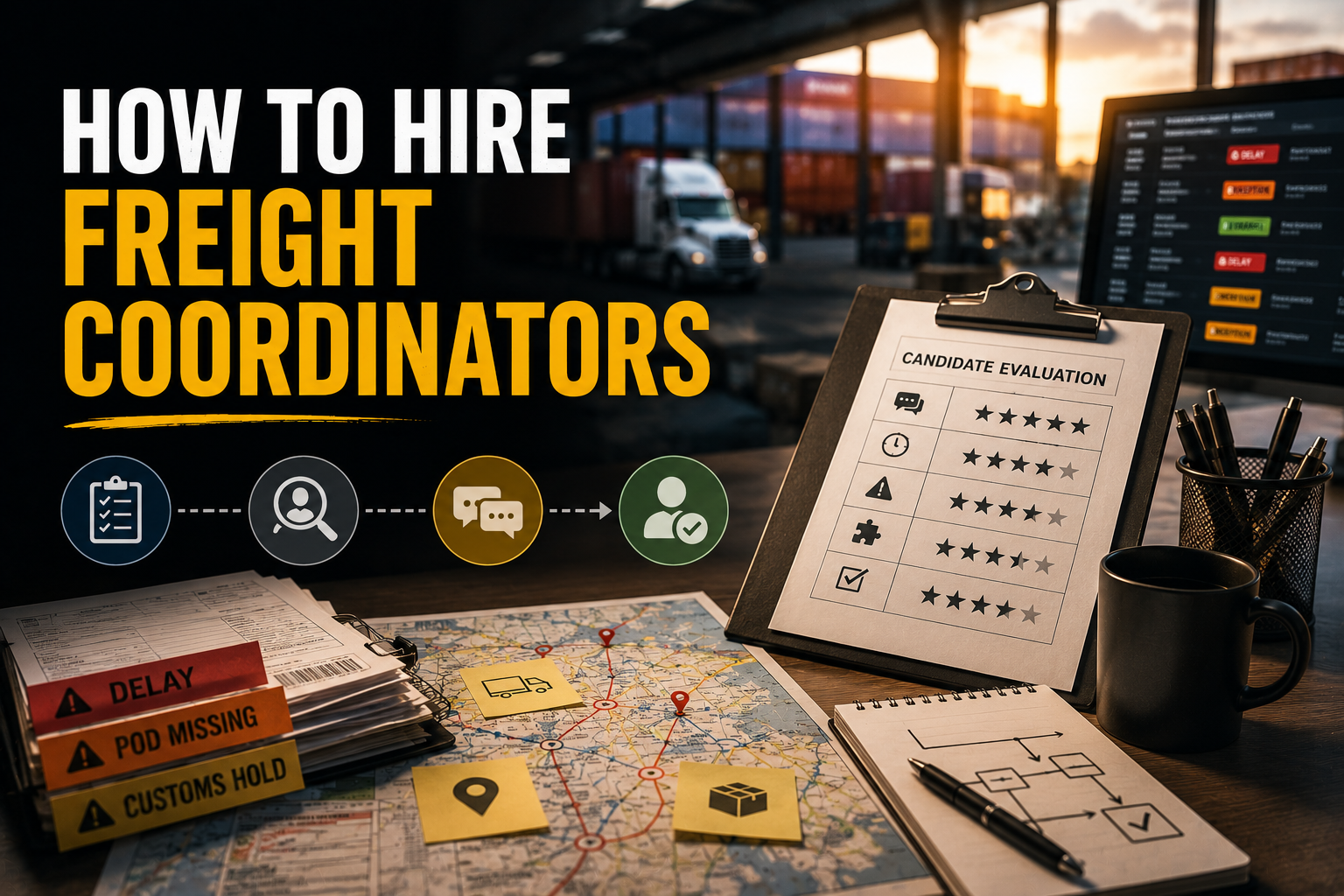
Most freight coordinator job postings attract the wrong people. The title sounds like office coordination, but the job is closer to real-time crisis management with carriers, customers, and shipments all moving at once. A pre-screen built around chaos tolerance will save you more time than any job board tweak.
Key Takeaways
- Freight coordinator is one of the most misapplied job titles in logistics. The title draws administrative applicants who cannot handle constant interruption.
- The job posting itself is rarely the problem. The real filter is a structured pre-screen before the first phone call.
- Comfort with ambiguity and speed of written communication are stronger early signals than years of experience.
- A four-step interview flow (written scenario, phone screen, live role-play, reference check) filters most unsuitable candidates before you invest interview time.
- Red flags appear in writing before they appear in person. A short written pre-screen question reveals more than a resume.
Why Freight Coordinator Applications Flood In
The job title is the problem. "Coordinator" implies organizing, scheduling, and communicating. That description fits a wide range of backgrounds, from office administrators to customer service staff to recent graduates with no logistics exposure.
Most applicants have never tracked a shipment in real time. They picture a role with a task list and a clear schedule. The reality is constant interruption and real-time problem-solving.
Why Turnover Stays High
That gap between expectation and reality is why freight coordinator turnover is high. Hiring the wrong person costs training time, customer trust, and team bandwidth. The solution is not a better job description. It is a better pre-screen.
What the Role Actually Demands
Before you can screen for the right candidate, you need to be precise about what the role requires. Most postings list "strong communication skills" and "experience with logistics software." Neither filters for the core skill: managing competing problems simultaneously without losing accuracy.
Carrier relationship management under pressure
When a carrier is running late, the coordinator is not just noting the delay. They are negotiating a new arrival window, updating the customer, and flagging the impact to internal teams, all at the same time.
What Administrative Backgrounds Miss
Candidates with purely administrative backgrounds have not developed this kind of conversational speed under pressure. It is a specific skill. It shows up in how they describe past jobs, not in what jobs they list.
Real-time exception handling
A shipment that runs without problems does not require a coordinator. The coordinator earns their value when things go wrong: a missed pickup, a damaged load, a customs hold, a carrier who goes out of service mid-route.
Exception handling requires tolerance for ambiguity and the confidence to act on incomplete information. It is not something you can train quickly.
Use these questions to surface it early in screening:
- "Tell me about a time when a shipment went wrong. What happened and what did you do?"
- "Describe a situation where you had to act on incomplete information. What was your process?"
- "What does a missed pickup look like in your current role? Walk me through your steps."
Cross-team documentation speed
Freight coordinators log bills of lading, proof of delivery records, carrier check-ins, and customer updates throughout the day. Speed matters as much as accuracy here. A coordinator who is slow to update the system creates blind spots for the rest of the team. Candidates from low-volume environments often underestimate how fast this pace moves.
The Pre-Screen That Filters 60% Before the First Call
The most effective pre-screen is a single written scenario question with a short time limit. You are not testing freight knowledge. You are testing how a person thinks under mild pressure and how clearly they write.
A sample prompt: "A carrier confirmed a pickup for 10 AM. It is now 11:30 AM, and you have not heard from them. The customer is asking for an update. Walk me through what you do in the next 30 minutes."
Set a 30-minute response window. Good candidates respond with a clear, sequenced answer. They name specific actions in a specific order. They do not write a paragraph of general statements about communication.
Candidates who miss the time window or respond with vague generalities will behave the same way on the job. The pre-screen is a direct preview of how someone operates.
For roles involving less-than-truckload or truckload freight, you can add a question about carrier type familiarity. Keep it simple. You are looking for whether they can explain the difference in plain language, not recite rate structures.
You can find a more detailed breakdown of pre-screen design for high-volume logistics roles in " How to reduce time to hire in logistics".
Interview Questions That Reveal Real Freight Experience
Once a candidate passes the written pre-screen, the interview should test the depth of experience and decision-making speed. Ask only about what they have actually done, not what they would do in theory.
Questions that work well for freight coordinator interviews:
- "Tell me about a shipment that went wrong from the moment the carrier confirmed pickup. What happened, what did you do, and what was the outcome?"
- "How do you handle three urgent carrier situations at the same time? Walk me through a real example."
- "What does your documentation process look like when a load is delayed? Who do you update first and why?"
- "Describe a time a carrier gave you incomplete or inaccurate information. How did you respond?"
A candidate who has worked in a real freight environment will answer with specifics: carrier types, freight types, documentation systems, and quantified outcomes. A candidate without genuine freight experience will speak in generalities.
The logistics dispatcher hiring guide covers a similar interview structure for roles with overlapping skills. The freight coordinator role adds a documentation layer that dispatcher roles sometimes do not require.
If your operation handles both less-than-truckload and truckload freight, add a short role-play. Give the candidate an incomplete scenario (carrier is three hours late, customer is calling, internal tracking shows no status update) and watch how they structure their response. You are looking for a calm, logical approach to incomplete information, not a perfect answer.
Red Flags in the Application and Interview
Watch for these signals across the application and interview stages:
- A resume listing only administrative or general office coordination roles with no logistics context. The applicant may be capable, but they have not been tested in a freight environment and may underestimate the pace.
- A cover letter that describes the role as "organized and detail-oriented" with no mention of problem-solving or urgency. Strong candidates understand the job is reactive, not procedural.
- Candidates who describe past freight problems as something escalated to a manager. A freight coordinator needs to resolve the problem, not report it upward.
- Slow written response times in the pre-screen, regardless of how well the candidate interviews in person. On the job, conditions are less controlled, and the pace is faster.
For teams hiring across multiple logistics roles at the same time, the supply chain coordinator hiring guide covers a related but distinct role with different screening criteria.
If your team is spending significant time screening applicants who do not meet basic requirements, Zyverno's screening platform runs the written pre-screen automatically, so your team only reviews candidates who have already passed the written filter.
FAQ
How many applicants should I expect for a freight coordinator posting?
Volume varies by market, but freight coordinator postings typically attract a broad applicant pool because the title does not filter for logistics-specific skills. Expect a high number of applicants relative to the number who are genuinely qualified. A structured pre-screen reduces this volume before you spend any interview time.
What is the difference between a freight coordinator and a logistics dispatcher?
A dispatcher focuses primarily on driver assignment and route management. A freight coordinator manages the broader shipment lifecycle, including carrier communication, documentation, customer updates, and exception handling. The roles overlap in smaller operations, but the coordinator role involves more documentation and cross-team communication.
Do freight coordinators need to know specific software?
Familiarity with transportation management systems and carrier tracking platforms is helpful, but most operations can train on specific tools. The harder skills (exception handling, documentation speed, carrier communication) are not tool-dependent. Prioritize those in screening before asking about software.
How long should the hiring process take for a freight coordinator?
A four-step process (written pre-screen, phone screen, role-play interview, reference check) can be completed in five to seven business days if you move quickly between steps. Delays usually happen at the reference check stage. Request references before the final interview so you can run both steps in parallel.