
Hire Supply Chain Coordinators Who Won't Quit
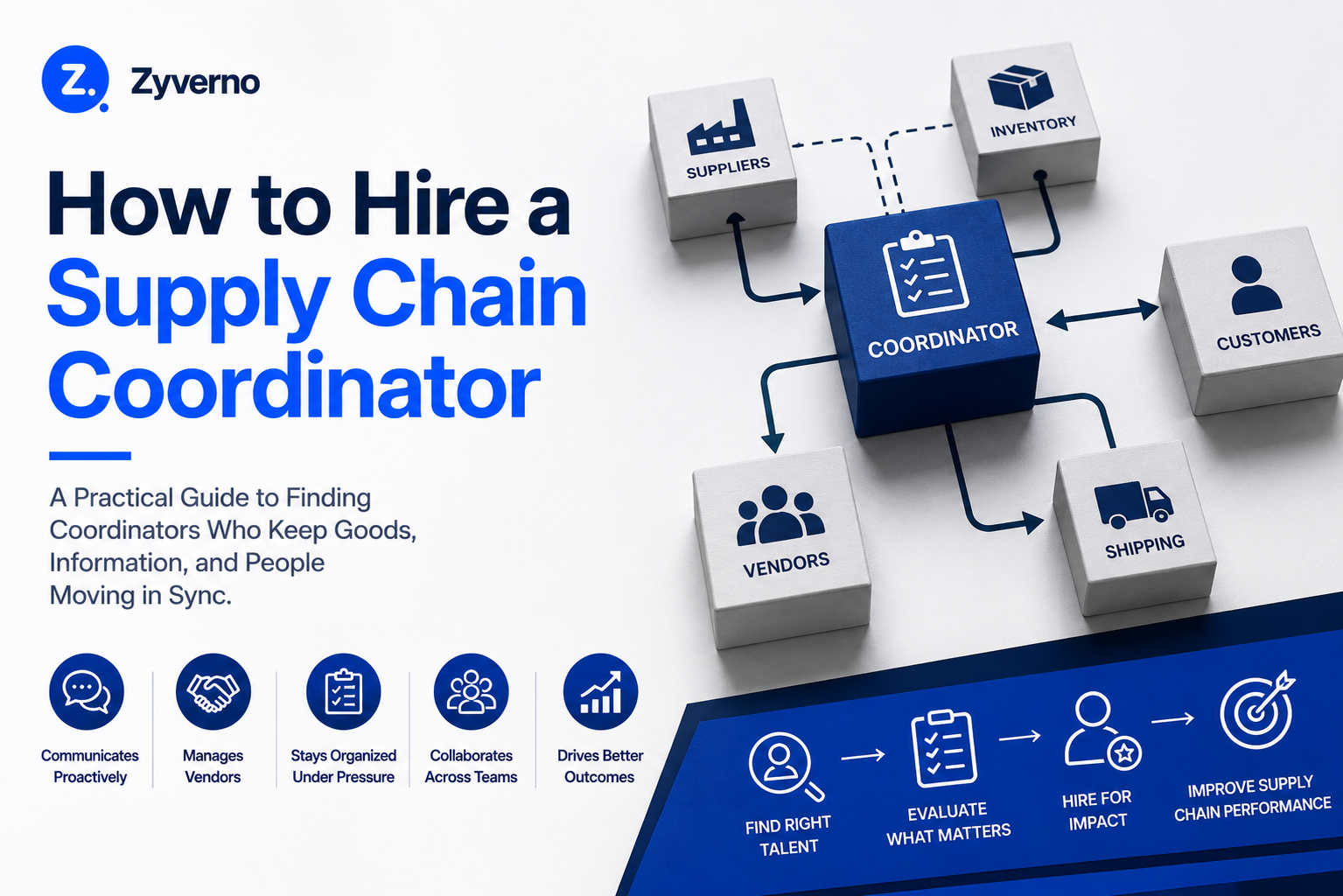
To hire a strong supply chain coordinator, focus on how candidates handle vendor pressure and cross-team breakdowns. Systems familiarity is not the bottleneck. The gap between a promising resume and a performer who lasts past the first quarter is wider here than most hiring managers expect.
What the Role Actually Requires
A supply chain coordinator keeps goods, information, and people moving in sync. On any given day, they track shipments, manage vendor relationships, update inventory records, and communicate delays to teams who have their own deadlines.
Systems They Work In
The technical side is learnable. Most coordinators work inside an enterprise resource planning system and a warehouse management system for inventory visibility. Many also use a transportation management system to track carrier performance and freight costs.
Why Behavior Is the Real Bottleneck
Hiring Weight by Competency
What actually predicts performance
Coordinators are often screened on systems knowledge, but the highest-failure-rate competencies are behavioral. This chart shows where to weight your evaluation time.
Weightings based on common failure patterns reported by hiring managers in logistics and operations roles. Behavioral competencies are harder to train than systems knowledge.
The harder part is behavioral. When a shipment is delayed, and three departments need different answers simultaneously, coordinators either hold things together or make it worse.
That ability to stay clear and calm under competing demands does not show up on a resume. The same cross-functional pressure appears in how to hire logistics dispatchers, a role that shares significant overlap in communication demands.
Direct Answer
How do you hire a good supply chain coordinator?
Screen for proactive communication and cross-functional accountability before you evaluate systems knowledge. Strong coordinators manage vendor relationships independently and keep stakeholders informed without being asked. They should know the metrics the role is measured against: order accuracy rate, on-time delivery rate, and freight cost per unit. Systems knowledge matters, but is learnable on the job.
Writing a Job Description That Attracts the Right Candidates
Most supply chain coordinator job descriptions list software and certifications. Few describe the actual situations the person will face.
A better job description names the real challenges. Managing vendors across time zones. Handling stock discrepancies before they become outages. Coordinating between a warehouse team and a procurement team with conflicting priorities.
Be Specific About Systems
If the role requires experience with a specific enterprise resource planning platform, warehouse management system, or transportation management system, say so. Generic "proficiency in supply chain software" attracts candidates who know one system and assume any will do.
Represent the Pace Honestly
State the pace of the environment honestly. A coordinator who thrives in a calm, process-driven operation may struggle in a high-growth business where procedures change monthly. Undersell the chaos, and you attract the wrong fit.
For a broader view of building a sourcing pipeline before you post, see the guide on logistics talent pipeline.
Screening Criteria
Screening Scorecard
Supply Chain Coordinator
Rate each signal before the interview ends. Three greens = proceed. Two or more reds = pass.
Use as a structured conversation guide. Mark each signal immediately after the relevant answer, not at the end of the call.
Not every applicant with supply chain experience on their resume will perform well in a coordinator role. Screen for these things before you spend time on interviews.
Hands-on systems experience. Ask candidates to name the enterprise resource planning, warehouse management, or transportation management system they used most. Then ask what they did in it daily. Vague answers like "I worked with various platforms" usually mean surface-level exposure.
Volume and pace match. Ask how many purchase orders, shipments, or vendor contacts they managed weekly. Someone coming from a small operation may be genuinely talented but unprepared for the volume you need.
Communication in writing. Supply chain coordinators write dozens of emails and messages daily. Ask for a work sample or send a short scenario during the screening stage. Clear, concise written communication is a reliable early filter.
Supply chain terminology. Candidates who genuinely work the role can explain concepts like bills of lading, safety stock levels, and lead times without prompting. Ask them to define freight cost per unit. Inability to use this language fluently is a signal worth noting.
Pre-employment assessment. A short scenario-based task reveals how candidates think under pressure. Ask them to resolve a fictional stockout or draft a vendor message about a delayed shipment. It takes fifteen minutes and gives you more signal than two rounds of interviews.
When you are receiving a large number of applicants, the screening stage becomes a bottleneck quickly. If your team is reviewing hundreds of applications manually, Zyverno can screen and score each candidate automatically. Your shortlist arrives pre-qualified before you open a single resume. For a closer look at how AI screening works in a logistics context, see AI screening for driver hiring. The same principles apply across coordinator and operational roles.
Interview Questions That Reveal Real Performance
The most predictive interview questions are situational. They ask candidates to describe what they actually did, not what they would hypothetically do.
When a Shipment Goes Wrong
"Walk me through a time a shipment went wrong. What broke down, and what did you do?"
This question reveals problem-solving under real pressure. Listen to how clearly they describe the sequence of events. Did they act independently or wait for direction? Did they communicate proactively with the affected teams?
Vendor Friction
"Describe a vendor relationship that was difficult to manage. How did you handle it?"
Coordinators regularly navigate vendors who miss deadlines, provide inaccurate information, or push back on accountability. This question surfaces how the candidate handles friction without escalating everything upward.
Catching Errors Early
"Tell me about a time you caught an inventory or data error before it caused a bigger problem."
Strong coordinators are detail-oriented by habit, not just when things go wrong. This question distinguishes people who stay ahead of errors from those who respond reactively.
Prioritization Under Pressure
"How do you prioritize when three things need your attention at the same time?"
There is no single right answer here. You are looking for a clear, practiced approach and specific examples, not a general statement about being organized.
What Strong Answers Look Like
One insight from hiring managers in logistics: candidates who describe specific metrics from past roles tend to outperform those who only describe their responsibilities. Order accuracy rates, on-time delivery percentages, and lead time reductions. Results-oriented framing in the interview correlates with results-oriented behavior in the role.
Red Flags to Watch For
Some signals in the interview process reliably predict early failure in this role.
Vague answers about past mistakes. Candidates who struggle to describe a specific operational failure often lack the self-awareness the role requires. Watch especially for those who frame every challenge as a team failure rather than something they personally navigated.
Difficulty explaining a process step by step. Ask them to walk through a typical day in their last role. If the answer is vague or jumps between tasks without structure, they likely do not have the process discipline the role demands.
Resistance to cross-functional feedback. Supply chain coordinators take input from procurement, warehousing, finance, and operations. Candidates who describe past friction with other teams in ways that position them as the sole rational actor are worth a closer look.
No examples of proactive communication. The best coordinators send updates before they are asked. Candidates who can only describe reactive communication, answering questions rather than anticipating them, often create downstream problems in the role.
Inability to name a performance metric. Ask for one number from their last role. Order accuracy, delivery rate, vendor fill rate. A coordinator who cannot recall any figures has likely not been working in a results-oriented environment. That is worth probing further.
Certifications and Qualifications
What Experience Looks Like
Most coordinator roles require two to four years of hands-on experience in logistics, procurement, or operations. Formal education in supply chain management, business, or a related field is common but not always required.
Recognized Certifications
Certifications from the Association for Supply Chain Management carry real weight as a signal of commitment. The Certified Supply Chain Professional designation and the Certified in Planning and Inventory Management credential are the two most relevant for coordinator-level roles. Neither is required to hire well, but candidates who hold them have typically invested in the function beyond the basics.
Use Certifications as a Tiebreaker, Not a Gate
Coordinators who have managed hundreds of vendor relationships without a formal credential will often outperform certified candidates with less hands-on experience. Treat certifications as a signal of commitment, not a minimum bar.
What to Expect in the Current Hiring Market
According to the U.S. Bureau of Labor Statistics, about 58,700 openings for purchasing managers, buyers, and purchasing agents are projected each year through 2034. Supply chain coordinators are a significant part of that pipeline, and competition for experienced candidates is consistent.
Candidates Are Evaluating You Too
Candidates with hands-on enterprise resource planning experience and a track record of managing vendor relationships independently are in high demand. Expect strong applicants to be evaluating you as much as you are evaluating them.
Move Faster Than Your Competitors
Pay close attention to the first interview response time. Experienced coordinators who are actively interviewing often have multiple processes running at once. If your process takes three weeks to move from screening to offer, you will lose candidates to faster-moving competitors. The " How to reduce time to hire in logistics" guide covers the specific stages where delays compound and how to cut them without lowering your bar.
The high-volume logistics hiring playbook covers screening structure and timeline management at scale across logistics roles.
Retention: What Causes Early Exits
Hiring a strong coordinator and losing them at month three is a common and expensive pattern. The most frequent causes are worth understanding before you hire.
Lack of career development is the leading driver of voluntary exits in supply chain roles. Coordinators who see no path to a senior coordinator, analyst, or manager role will leave once the role feels flat. That typically happens in the six to twelve-month window.
Pace mismatch is the second most common cause. A coordinator hired into a high-growth environment without fair warning will often disengage before the 90-day mark. The role involves weekly process changes and constant cross-functional demands. That needs to be said before the offer. The broader retention patterns driving early exits across operations roles are covered in the warehouse staffing challenges.
Set expectations clearly in the interview process, not just in the offer letter. Coordinators who accept the role, knowing the environment, tend to stay longer than those who discover it on the job.
The First 90 Days
The most common early failure: coordinators get lost in new systems and new vendor relationships at the same time.
Weeks One and Two
Structure the first two weeks around systems access and process documentation before introducing independent vendor work. Let new coordinators shadow existing relationships rather than inheriting them cold. This reduces errors during the transition and builds confidence faster.
Month One
Assign a specific ownership area within the first month. Coordinators who have a defined domain ramp faster than those given a broad mandate with no clear lane. That domain can be a set of vendors or a single product category that they own fully.
30-Day and 90-Day Reviews
Onboarding Plan
Supply Chain Coordinator: First 90 Days
Separate systems training from vendor ownership. Rushing the handover is the most common onboarding failure.
Access and process documentation
Milestone: can navigate core systems without help
Assigned ownership area
Milestone: owns one lane with zero dropped communications
Full portfolio, first performance read
Milestone: operating independently across all assigned lanes
The most common onboarding failure: handing over vendor relationships before systems training is complete. Separate these phases deliberately.
Set a 30-day check-in focused on process questions, not performance metrics. At 90 days, review output quality across order accuracy, communication frequency, and vendor responsiveness. These three measures give you a reliable early read on whether the hire is on track.
A complete framework for logistics hiring, including role definitions, sourcing strategy, and onboarding structure, is in the logistics hiring guide.
Key Takeaways
- Prioritize cross-functional communication skills over systems knowledge alone.
- Write job descriptions that name specific operational challenges, not just tool lists.
- Use situational interview questions that ask for past behavior, not hypothetical responses.
- Include a short pre-employment scenario assessment during screening.
- Watch for red flags: vague answers about failures, no examples of proactive communication, and difficulty describing processes step by step.
- Move fast. Experienced candidates are in demand and running multiple processes simultaneously.
- Structure the first 90 days to separate systems onboarding from vendor relationship ownership.
- Be honest about pace and growth path in the interview. It reduces early exits.
Frequently Asked Questions
What qualifications should a supply chain coordinator have?
Most supply chain coordinator roles require two to four years of experience in logistics, procurement, or operations. Experience with enterprise resource planning, warehouse management, or transportation management systems is standard. Formal certifications from the Association for Supply Chain Management are a plus, but not a gate. Communication skills and process discipline matter more than credentials for day-to-day performance.
What is the biggest hiring mistake for supply chain coordinators?
Overweighting technical systems knowledge and underweighting communication skills. Coordinators who know the software but struggle to keep multiple stakeholders informed tend to create bottlenecks rather than solve them.
How long should hiring take for a supply chain coordinator?
Most companies complete the process in two to four weeks from first application to offer. Moving faster reduces the risk of losing qualified candidates to other employers who are also hiring actively in this market.
What does a supply chain coordinator do differently from a logistics coordinator?
The titles overlap significantly. Supply chain coordinators typically own a broader scope, covering procurement, vendor management, and inventory in addition to transportation and fulfillment. Logistics coordinators are more often focused specifically on shipment tracking and carrier relationships. In practice, responsibilities vary by company size and structure.
What metrics does a supply chain coordinator track?
The most common performance metrics are order accuracy rate, on-time delivery rate, vendor fill rate, and freight cost per unit. Coordinators in procurement-heavy roles may also track purchase order cycle time and supplier lead time variance.
Frequently asked questions
Related articles
Distribution Center Staffing: Hire in the Right Order
Discover why hiring sequence trumps speed in distribution center staffing. Ensure effective onboarding and lower attrition rates with strategic planning.
logisticsCost Per Hire in Logistics: Benchmarks and Where to Cut
Discover benchmarks for cost per hire in logistics. Learn how to identify hidden costs and streamline hiring processes for efficiency.
logisticsFreight Coordinator Hiring: Screen Before You Interview
Streamline your freight coordinator hiring process with effective pre-screening techniques. Improve candidate quality and reduce turnover.