
Hiring Transportation Managers: What Top Logistics Firms Do
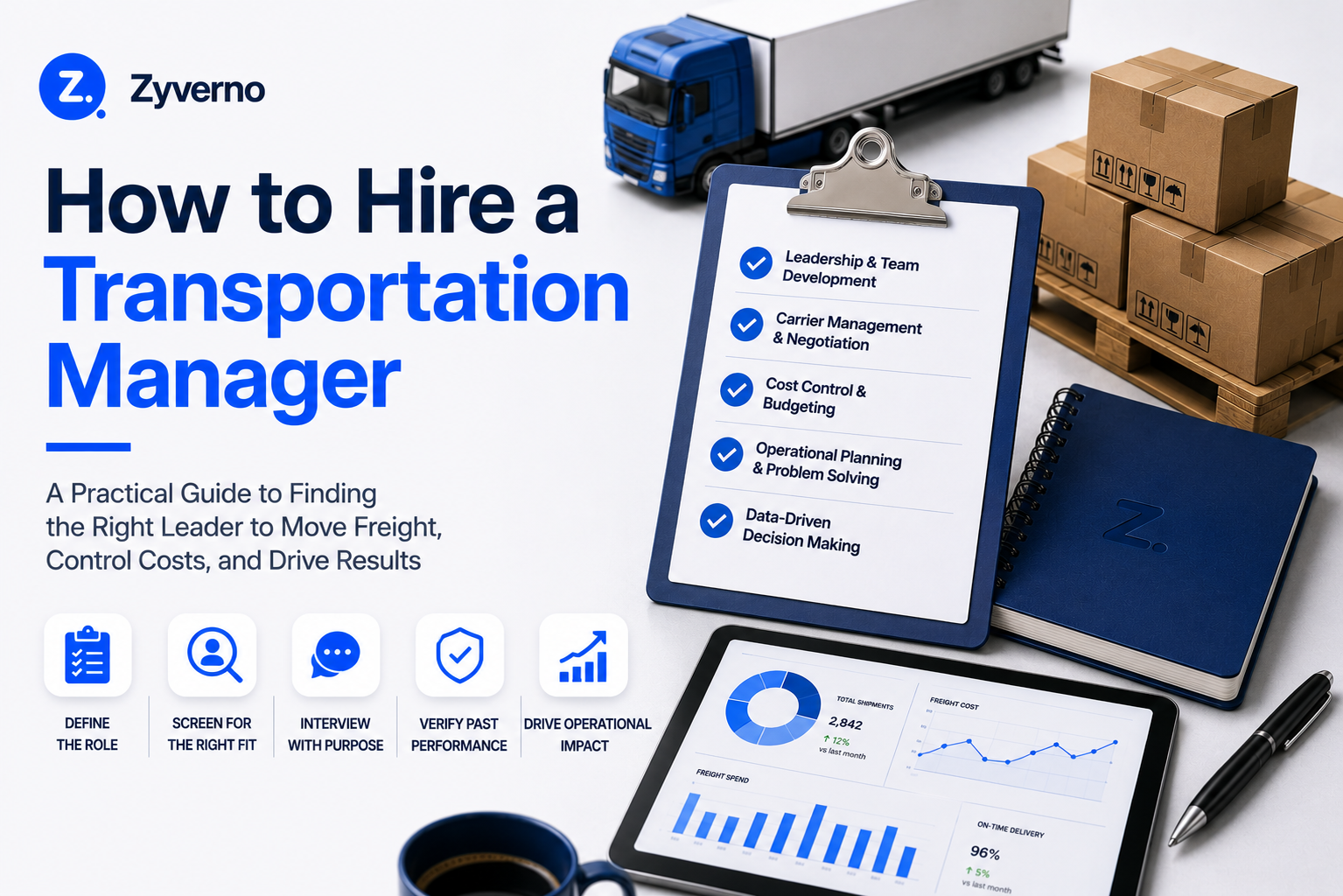
To hire a transportation manager, define the role precisely before posting, screen for operational judgment and cost management experience, run structured interviews with a practical freight scenario, and verify past performance through specific reference questions. The quality of your role definition predicts the quality of your candidate pool more than any other single factor.
Hiring a transportation manager is one of the highest-stakes decisions a logistics operation makes. The right person keeps freight moving, carriers accountable, and costs under control. The wrong one creates problems that take months to unwind.
This guide covers what to prioritize at every stage: defining the role correctly, writing a job posting that attracts qualified candidates, structuring the screening process, and identifying the signals that separate strong hires from costly ones.
Define the Role Before You Post
Transportation manager is a broad title. At one company, it means overseeing a fleet of owned trucks. At another, it means managing carrier relationships, freight brokers, and inbound logistics from overseas suppliers. Before writing a job posting, answer three questions.
What Does This Person Own?
Fleet management, carrier procurement, last-mile delivery operations, and freight cost optimization each require different experience. Candidates will self-select correctly when the posting is specific.
What Does a Typical Week Look Like?
A role that is 80% exception management and crisis resolution needs a different person than one that is 80% process building and reporting. State both types of activity in the posting.
Who Does This Person Manage?
A manager overseeing ten drivers needs strong coaching instincts. One overseeing a team of logistics coordinators needs more system-building and reporting capability. Make the reporting structure explicit.
Write a Job Posting That Filters Correctly
Vague job postings create high application volume with low relevance. A well-written posting does the filtering work before any screening happens.
Be Specific About Experience and Scale
Name the modes of transport the candidate must have managed: full truckload, less-than-truckload, rail, intermodal, or last-mile delivery. Name the scale: how many shipments per day, how many carriers, what geographic footprint.
Include hard requirements clearly and early. If the role requires experience with transportation management software, name the category. If a commercial driver's license is expected even though the manager won't drive regularly, state that explicitly. Candidates who have driven freight understand freight problems at a different level than those who have not. The qualities that make a strong truck driver hire are often the same qualities that predict success in a transportation manager who came up through operations.
Include Salary Range and Relevant Certifications
Compensation Reference
Transportation Manager Salary Ranges by Role Type
Publishing a range in your job posting reduces mismatched applicants
Why this matters for your posting: Roles without a stated range receive 30 to 40% more unqualified applications on average, because candidates self-select based on their own salary expectations rather than the role's scope. State the range early, alongside the scale and reporting structure.
Source: Indeed hiring data, 2024. Ranges vary by geography, industry sector, and fleet complexity.
Transportation manager roles span a wide band, from around $68,000 for mid-level positions to over $100,000 for complex multi-site operations. Postings without a range attract candidates who are misaligned on expectations and waste time on both sides.
Note any relevant certifications you value. The Certified Transportation Professional credential from the National Private Truck Council is a recognized signal of professional depth. So is the Certified in Logistics, Transportation and Distribution designation from the Association for Supply Chain Management. Not all strong candidates will hold them, but candidates who pursue them tend to take regulatory compliance and continuous improvement seriously.
State What Good Looks Like in the First 90 Days
Genuinely capable candidates will engage with that framing. Candidates who are not will either not apply or will fail to articulate how they would approach it in the interview, which is a useful signal.
Screen for the Right Signals
According to Talogy's transport and logistics recruitment research, 71% of employers in the sector struggle to find candidates with the right skills. That constraint means the market is competitive, and qualified candidates are comparing offers quickly. A slow or poorly structured screening process loses strong applicants before they reach the interview stage. The tactics for reducing time to hire in logistics apply directly to this role.
Screening questions for this role should focus on three areas.
Operational judgment. Ask candidates to describe a time when a carrier failed midday, and they had to reroute a full day's freight. What did they do first? Who did they call? What was the outcome? Candidates with real experience will give specific, sequential answers. Candidates who have not managed this type of situation will give general ones.
Cost management. Freight costs are a direct lever on margins. Ask how they have reduced cost per mile, load, or lane in a previous role. A strong answer includes the starting cost, the lever they pulled, and the outcome in numbers.
Team accountability. Ask how they handled a driver or logistics coordinator who was consistently underperforming. Candidates who have managed frontline logistics workers understand that performance conversations in this context are different from office environments. They require directness, documentation, and follow-through.
Add a Compliance Question
Screening Framework
Three Pillars of Transportation Manager Screening
Operational Judgment
How they handle real-time disruption
Ask this:
"A carrier fails midday. Walk me through exactly what you did first, who you called, and what the outcome was."
What to listen for:
Strong answer
Specific, sequential steps. Named contacts. A number-based outcome.
Weak answer
General process description. No specific decision-maker. No outcome.
Cost Management
Whether they have moved the numbers
Ask this:
"Tell me about a time you reduced cost per mile, per load, or per lane. What was the starting figure and what did you do to change it?"
What to listen for:
Strong answer
Starting cost stated. Specific lever named. Percentage or dollar outcome given.
Weak answer
Talks about "working with carriers" without naming what changed or by how much.
Team Accountability
How they manage frontline performance
Ask this:
"Describe a time you had to address consistent underperformance from a driver or logistics coordinator. What did you do and how did it resolve?"
What to listen for:
Strong answer
Clear sequence: conversation, documentation, follow-up. Honest about outcome.
Weak answer
Vague or defers to HR entirely. No direct action taken personally.
Ask the candidate to walk you through how they have managed driver qualification files or hours-of-service records in a previous role. Ask whether they have been through a Department of Transportation audit. Candidates who have held compliance accountability in a regulated environment answer this differently than those who have only observed it from a distance.
When screening volume is high, the manual review burden can slow everything down. For organizations processing dozens of applicants per opening, frontline hiring tools like Zyverno run structured evaluations via voice or chat before a single interview is scheduled, so the hiring manager receives a ranked shortlist rather than a raw applicant pool. The same approach applies to AI screening for driver hiring, and the principles transfer directly to manager-level roles with high application volume.
Run Structured Interviews
Unstructured interviews reward articulate candidates, not necessarily competent ones. For a role this operationally complex, structure matters.
Use the Same Questions for Every Candidate
Use the same question set for every candidate. Scoring each answer against defined criteria makes the comparison objective. It also protects against the common mistake of hiring the candidate who interviewed best rather than the one most likely to succeed in the role.
Watch for Polish Without Substance
One experienced logistics recruiter noted that the hiring mistake they see most often is giving too much weight to confidence and polish. Too little weight goes to whether the candidate has done the unglamorous parts of the job: sitting with a dispatcher at 2 am during a weather delay, walking a carrier yard to understand dwell time firsthand, dealing with a detention dispute on a Friday afternoon. Candidates who have done those things carry a different kind of practical knowledge than those who have managed from reports alone.
Use a Practical Freight Scenario
Process Flow
Where Transportation Manager Hires Go Wrong
Five stages, with the most common failure point at each
Stage 1
Role Design
Define the role
What does this person actually own?
Fleet management, carrier procurement, and last-mile delivery each require different backgrounds. A posting that covers all three without weighting any attracts mismatched applicants.
Common failure: title without scopeStage 2
Job Posting
Write the posting
Name the modes, scale, and 90-day expectations
Postings that list generic requirements attract generic candidates. Specifics about freight volume, carrier count, and what success looks like in 90 days filter for real capability.
Common failure: vague requirementsStage 3
Screening
Screen candidates
Test for operational judgment, cost management, and accountability
Resume review tells you where someone has worked. Structured screening reveals whether they can handle the actual problems the role produces.
Common failure: resume-only reviewStage 4
Interview
Structured interviews
Same questions, scored criteria, practical scenario
Unstructured interviews reward confidence. A freight scenario exercise reveals how candidates think through cost, timing, and communication under pressure.
Common failure: hiring the best interviewerStage 5
References
Reference checks
Ask about decisions, not personality
Useful references describe specific situations: a fast decision under pressure, how the candidate handled a service failure, whether the reference would hire them again for a complex freight role.
Common failure: treating it as a formalityGive candidates a realistic exercise: costs are over budget by 12%, a key carrier just increased rates by 8%, and you need to present a corrective action plan to leadership in one week. Ask them to walk through their approach out loud. This reveals analytical process, communication style, and whether their instincts match your operation.
Also, ask how they have used transportation management software to improve visibility or reduce cost. Candidates promoted from dispatcher or driver roles often have strong operational instincts but limited system experience. Candidates with transportation management software backgrounds may have the reverse. Knowing which gap you are hiring into helps you plan onboarding accordingly.
Check References With Specific Questions
Reference calls are often treated as a formality. They should not be.
Question 1: Decision Under Pressure
Ask the reference to describe a specific situation where the candidate had to make a fast decision under pressure. Ask what the outcome was. Ask whether they would hire this person again for a role that required managing carrier relationships at scale.
Question 2: Relationship With Frontline Workers
Ask about the candidate's relationship with drivers and warehouse staff. Transportation managers who are respected by frontline workers surface operational problems faster. The reference's answer here is often the most telling part of the call.
Question 3: Response to Cost Spikes and Service Failures
Ask how the candidate responded when costs spiked unexpectedly or a carrier failed. Did they escalate well? Did they have a plan before calling their manager? A candidate who always needed to be told what to do next is a candidate who will need to be managed closely in this role.
Red Flags to Watch For
Several patterns appear repeatedly in unsuccessful transportation manager hires:
- Fluent on strategy, thin on mechanics. Candidates who cannot explain the mechanics of a specific carrier contract or detention billing dispute have often managed at a distance. They will struggle to get traction with a frontline team.
- Blame without accountability. Candidates who attribute past performance problems entirely to carriers, drivers, or market conditions without acknowledging what they could have done differently are unlikely to hold themselves accountable in this role.
- No direct compliance experience. Candidates who cannot describe how they have handled a Department of Transportation compliance issue are a risk in regulated fleet environments. This is not a knowledge gap that can be corrected quickly on the job.
- No pattern of taking on harder operations. Ambition in this field often looks like voluntarily moving to a more complex operation, not a more prestigious title. Candidates who have never made that kind of move are worth scrutinizing.
Set the New Hire Up to Succeed
Most transportation manager onboarding focuses on introducing systems and processes. The more important introduction is to the people.
In the first two weeks, the new manager should spend time with each driver, dispatcher, and logistics coordinator they will work with directly. For operations that are hiring across multiple layers at once, how to hire warehouse supervisors and team leads covers the adjacent role that most often reports into a transportation manager. The goal is not to evaluate them. It is to surface the informal knowledge those people hold: which carriers are reliable on short notice, which lanes have chronic delays, which warehouse staff communicate problems early versus late.
Transportation managers who skip this step and move straight to process changes create resistance that takes months to undo. The ones who spend two weeks observing before acting tend to move faster and with fewer setbacks once they do.
Set Performance Expectations at 30, 60, and 90 Days
Clear milestones prevent the ambiguity that causes new managers to either overreach or underdeliver in the first quarter:
- 30 days: The manager knows the carrier mix, understands the cost structure, and has named the top three operational friction points.
- 60 days: A plan to address those friction points exists.
- 90 days: Measurable progress on at least one of them.
Build a Talent Pipeline Before the Need Is Urgent
The best time to hire a transportation manager is before the previous one leaves. Most companies start the process after the departure, which compresses the timeline and forces compromises.
A basic logistics talent pipeline keeps three to five warm candidates in contact through periodic updates: industry news, company milestones, and role developments. When a position opens, those candidates are already familiar with the company and can move faster through the process.
For a deeper look at building that pipeline across logistics roles, the guide at /logistics/logistics-talent-pipeline covers the structure in detail.
What to Prioritize
Transportation manager hiring fails most often for one of two reasons: the role was defined too broadly, or the screening process rewarded the wrong signals.
The Short Checklist
- Define the role with precision before posting
- Screen for operational judgment, cost management, and team accountability
- Structure the interview so that every candidate answers the same questions
- Check references with specific questions, not general ones
- Build the talent pipeline before urgency forces a compromise
For a broader framework covering all logistics management roles, the complete guide at /logistics/how-to-hire-for-logistics-complete-guide covers the full hiring process from sourcing to onboarding.
For hiring related roles that interact directly with the transportation manager, /logistics/how-to-hire-logistics-dispatchers covers the specific signals to look for in dispatcher candidates.
Frequently Asked Questions
What qualifications should a transportation manager have?
Most transportation manager roles require at least five years of experience in logistics, supply chain, or fleet operations, with two or more years in a supervisory capacity. Relevant experience with transportation management software is increasingly expected, as is familiarity with carrier procurement and freight cost management. The Certified Transportation Professional credential and the Certified in Logistics, Transportation, and Distribution designation are recognized signals of professional depth. A commercial driver's license is not always required, but it is a strong differentiator for roles with a fleet component.
How long does it take to hire a transportation manager?
The average time to fill a transportation manager role is 45 to 60 days when starting from scratch. Organizations with an active talent pipeline can reduce that to 20 to 30 days. Roles in specialized markets or requiring rare technical qualifications can take longer.
What is the biggest mistake companies make when hiring a transportation manager?
Defining the role too broadly. When the job posting covers everything from fleet operations to procurement to analytics without weighing which skills matter most, the hiring process attracts mismatched candidates and makes comparison difficult. The clearer the role definition, the better the hire.